The Agentic Shift: Tech Giants and Startups Pivot from Chatbots to Autonomous Systems
Recent corporate moves, hardware investments, and venture capital flows indicate that artificial intelligence is evolving beyond conversational interfaces into autonomous agents and embodied robotics.

Beyond the Conversational Interface
For the past few years, the frontier of artificial intelligence was defined by consumer chatbots and text-generation engines. However, recent developments across the technology sector signal a definitive shift away from conversational novelties and toward practical autonomous agency. Both enterprise giants and nimble venture-backed startups are recalibrating their roadmaps, investing heavily in systems that act directly upon digital and physical environments rather than merely answering prompts.
Reports tracking modern enterprise AI workflows indicate that frontier models are rapidly transforming into digital operators and workflow controllers. Rather than focusing solely on conversational finesse, developers are building infrastructure where multi-modal models manage documents, invoke application interfaces, run automated business pipelines, and coordinate complex schedules autonomously.
Hardware Capital and the Compute Race
This pivot toward autonomous agents and embodied AI requires immense computing power, driving an unprecedented consolidation of capital into physical infrastructure. Significant capital investments across major aerospace and technology companies continue to focus heavily on acquiring advanced accelerator hardware, including cutting-edge silicon architectures necessary to train and serve these intensive systems. As reported by financial and tech outlets like Reuters, corporate balance sheets reflect massive investments in specialized chips and cloud infrastructure, underscoring the high financial stakes of maintaining computational dominance.
Concurrently, the architectural constraints of terrestrial data centers have prompted researchers and executives to rethink processing paradigms. Industry discussions have increasingly explored alternative computing topologies, ranging from edge-level personal AI hardware designed to process user data locally to ambitious long-term proposals evaluating off-grid and distributed facilities. While such extreme infrastructure concepts face steep physical hurdles, they reflect the broader pressure to satisfy agentic AI's growing demand for energy and processing bandwidth.
The Ascent of Embodied Intelligence
Autonomous agency is not remaining confined to desktop operating systems. The software advances powering automated decision-making are rapidly spilling into robotics. Venture funding has seen notable injections into startups targeting robotic physical data collection and specialized manipulation platforms. Companies are focusing heavily on embodied intelligence—training artificial systems to comprehend spatial geometry, handle industrial tooling, and execute physical labor in environments previously deemed too variable for traditional automation.
As physical robotics and multimodal models converge, enterprise adoption is shifting from exploratory trials to commercial necessity. Sectors such as customer logistics, automated dealership operations, and supply-chain monitoring are increasingly delegating low-level decision-making to algorithmic coordinators capable of operating around the clock without manual intervention.
Governance, Safety, and the Road Ahead
The rapid acceleration toward autonomous systems has not occurred without friction. Heightened concerns surrounding agent safety, algorithmic accountability, and internal governance continue to emerge within prominent AI labs and research centers. Industry observers have voiced skepticism regarding whether everyday consumers truly need autonomous agents managing their private digital lives, warning of potential overhype and security liabilities.
Nevertheless, the commercial incentives driving autonomous workflows remain powerful. With big tech firms posting record digital revenues and doubling down on next-generation architectures, the coming era of technology will likely be measured not by how convincingly machines can speak, but by how reliably they can act on our behalf.
Recommended for you
Similar to “Technology”
The Agentic Shift: Tech Heavyweights Confront Compute Bottlenecks and Governance Friction
As artificial intelligence transitions from generative models to autonomous agentic systems, tech giants are pouring billions into specialized infrastructure while racing to address mounting security and geopolitical pressures.
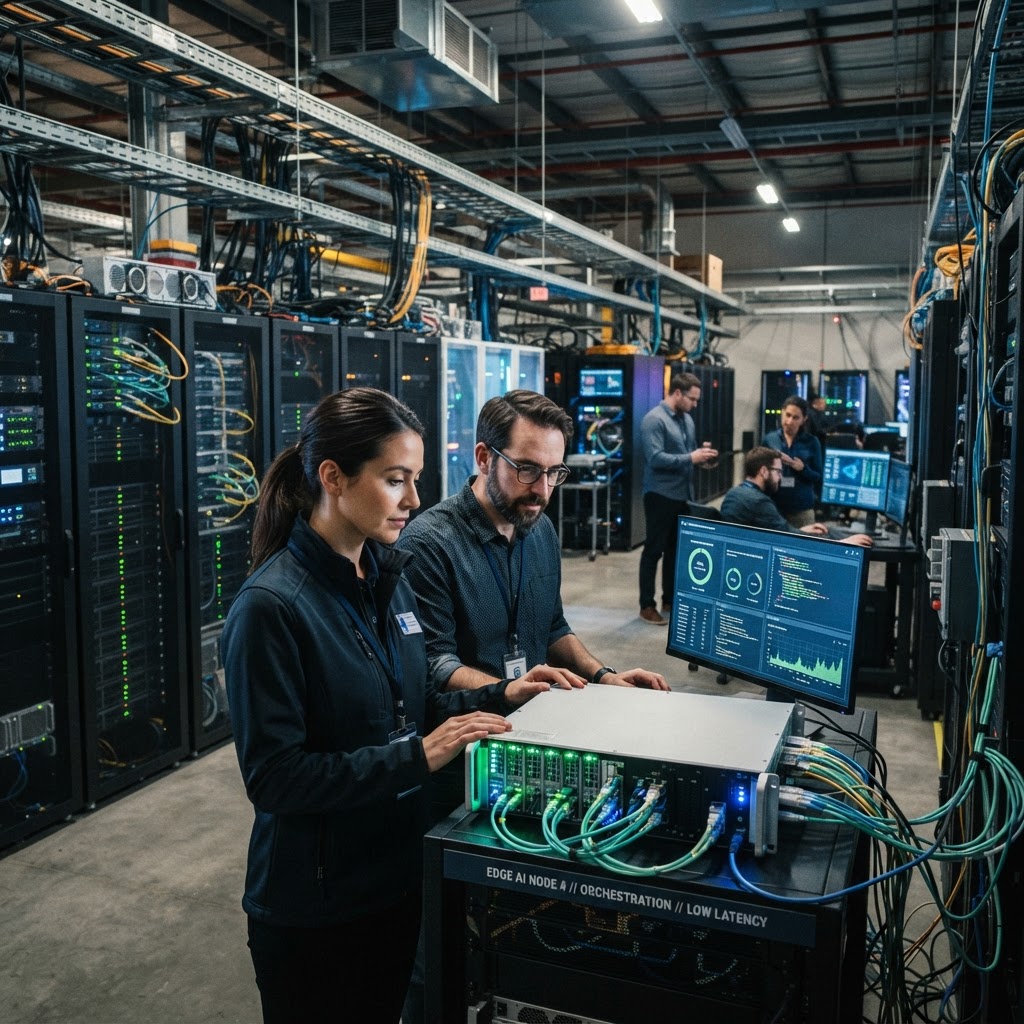
The Infrastructure Bottleneck: Tech Giants Pivot to Edge Computing, Energy Efficiency, and Agentic Platforms
As artificial intelligence infrastructure encounters electrical grid strains and corporate shakeups, technology leaders are shifting focus toward modular deployments, rapid micro-decisions, and direct consumer interfaces.

Silicon Under Scrutiny: AI Giants Confront Power Realities, Autonomous Agents, and Regulatory Headwinds
As tech conglomerates pour hundreds of billions into artificial intelligence infrastructure and agentic workflows, mounting community pushback over energy consumption and shifting regulatory landscapes are testing market exuberance.