Frontiers of Understanding: From Quantum Contextuality to Hidden Ocean Heatwaves
Recent scientific breakthroughs across physics, oceanography, and paleoclimatology are unveiling long-hidden mechanisms that govern our universe, from quantum processors surpassing classical benchmarks to subterranean thermal surges reshaping marine ecology.
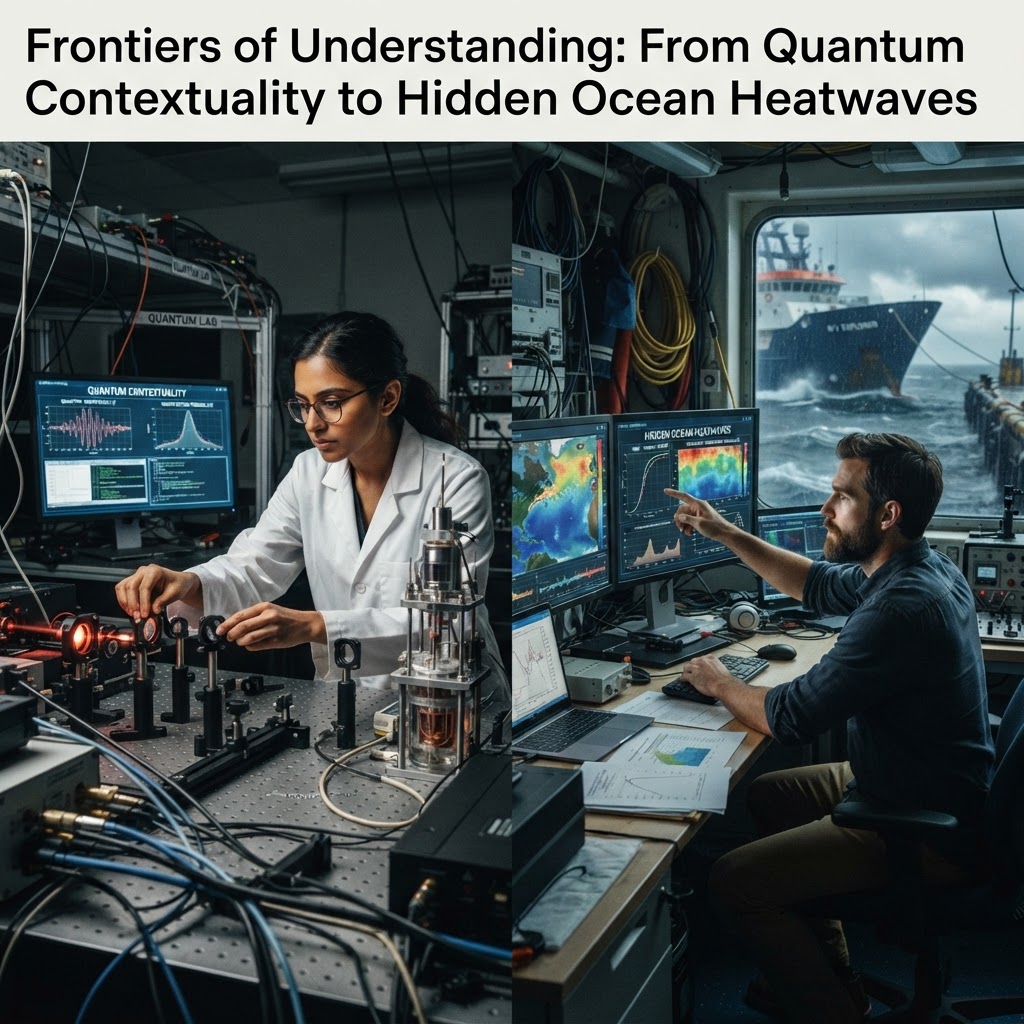
Unlocking Non-Classical Power in Quantum Processors
In the realm of physics, researchers have achieved milestone verifications of quantum mechanics that push the boundary of practical computing. A centerpiece of this work, recently spotlighted on the cover of the journal Science, showcases direct demonstrations of quantum contextuality—a core non-classical feature wherein the outcome of a physical measurement depends fundamentally on other simultaneous or sequential measurements. Working with advanced superconducting circuits such as Google’s 105-qubit Willow chip, researchers conducted game-theoretic tests where winning consistently is mathematically impossible using classical computing resources alone. By proving contextuality at scale, experimentalists not only confirmed that these processors evade classical simulation limits, but they also established critical error-detection benchmarks necessary for scaling up fault-tolerant quantum hardware.
The Deep-Water Threat of Subsurface Marine Heatwaves
While quantum physicists probe the microscopic fabric of reality, earth scientists are shifting their gaze beneath the ocean surface to unmask hidden thermal extremes. A comprehensive study published in npj Climate and Atmospheric Science has unveiled the extensive vertical structure of over 500 large-scale subsurface marine heatwaves (MHWs) across the global ocean. Unlike superficial sea-surface temperature spikes that are readily tracked by orbital infrared radiometers, these subsurface heatwaves penetrate hundreds of meters downward, lurking within the water column for months or even years. Utilizing a multidimensional event-tracking framework across three decades of reanalysis data, researchers categorized these thermal surges into seven distinct vertical archetypes. Notable historical anomalies—such as the infamous northeast Pacific 'Blob' and the Ningaloo Niño—extended far deeper and wider than surface observations suggested. Because these subsurface heat reservoirs correlate closely with broader oscillations like El Niño, understanding their dynamics offers meteorologists and marine conservationists a vital, previously obscured early-warning metric for ecological shockwaves.
Atmospheric Teleconnections: How Polar Melting Alters Tropical Monsoons
Complementing findings in oceanography, paleoclimatology has pinpointed surprising long-distance linkages between high-latitude ice loss and tropical rainfall patterns. In Nature Communications, scientists demonstrated that the sustained retreat of the Greenland Ice Sheet acts as a direct, dynamic amplifier for the North African summer monsoon. By examining the mid-Pliocene epoch—a natural analogue for sustained global warmth—and coupling paleoclimate proxy data with high-resolution global atmospheric models, researchers reconstructed a polar-tropical teleconnection. As Greenland’s ice sheet recedes, altered thermal contrasts perturb the upper-tropospheric westerly jet stream. This perturbation launches a stationary planetary Rossby wave train that stretches from the Arctic across southern latitudes, fundamentally intensifying moisture convergence over the Sahara and Sahel. The revelation shows that gradual changes in polar cryospheres possess the mechanical leverage to dramatically alter precipitation baselines thousands of miles away.
Rethinking Mind, Matter, and Automation
Parallel breakthroughs across neurobiology and technology further illuminate how modern science is dismantling long-held assumptions. In cognitive science, new evaluations of invertebrate brains, including bumblebees equipped with fewer than one million neurons, have revealed striking signs of complex problem-solving, social imitation, and proto-emotional states, forcing neuroscientists to rethink the minimal architecture needed for intelligence. Simultaneously, independent evaluations highlighted by United Nations agencies regarding generative artificial intelligence have stressed the persistent distinction between rote prediction and actual scientific comprehension. While top language models achieve high factual marks on standard climate science, they falter under multi-step causal reasoning tasks and often retract verified facts when challenged by stubborn human interlocutors.
Across planetary scales, computational paradigms, and living organisms, this wave of discoveries underscores a common thread: reality consistently defies superficial assumptions. Whether exposing the hidden depths of ocean heat, tracing atmospheric bridges across hemispheres, or harnessing the subtle laws of quantum contextuality, scientists are building a far more interconnected and nuanced map of the natural world.
Recommended for you
Similar to “Science”
Frontiers of Discovery: From the First Moments of the Cosmos to Biohybrid Intelligence
Recent scientific breakthroughs across astrophysics, quantum materials, and biomedical engineering are reshaping our understanding of the universe and pioneering novel interfaces for human health.
Frontiers of Discovery: Recent Breakthroughs Reshaping Physics, Genetics, and Earth Science
From unexpected magnetic control at the atomic scale to massive genetic catalogs and deep ocean thermal shifts, recent findings are actively challenging long-held scientific paradigms.
Frontiers of Discovery: Breakthroughs in Quantum Materials, Deep Ocean Heat, and Precision Oncology
Recent advances across physics, climate oceanography, and oncology highlight how atomic-scale manipulations, deep-sea tracking, and molecular genetic discoveries are reshaping modern science.