Frontier AI at a Crossroads: Landmark Wall Street Debuts, Mathematical Breakthroughs, and mounting Geopolitical Scrutiny
Recent days have marked an extraordinary turning point for the global technology sector, defined by Anthropic's historic market arrival, an astonishing mathematical claim, and severe regulatory headwinds sweeping semiconductor supply chains.

The Paradigm Shift of Generative Capital
In what analysts are characterizing as one of the most consequential chapters in modern computing history, the artificial intelligence landscape has reached unprecedented scale across financial markets, scientific exploration, and international governance. At the forefront of this shift is Anthropic's monumental public market debut on the Nasdaq. According to market reporting summarized by AI Edge Insights, the enterprise raised roughly $81 billion after issuing 980 million shares, briefly anchoring an extraordinary valuation near $1.5 trillion. While the public debut offered retail and institutional investors direct exposure to frontier AI architecture, intense price discovery immediately followed, demonstrating that the market remains volatile as commercialization metrics face rigorous scrutiny.
Frontier Models Probe the Boundaries of Pure Mathematics
Simultaneously, the research division of Anthropic ignited profound excitement across the scientific and academic establishments. Mathematician Levent Alpöge revealed that work conducted with the Claude model assisted in formulating a proposed proof of the Riemann Hypothesis, as covered by TechCrunch and The World of AI. First articulated by Bernhard Riemann in 1859, the hypothesis governs the distribution of prime numbers and stands among the most famous unsolved problems in mathematics. While the claim remains subject to rigorous peer validation by the international academic community, the prospect that autonomous and semi-autonomous systems can participate in solving century-old fundamental questions signals that large language models are evolving from operational accelerators into partners in scientific discovery.
Infrastructure Headwinds and the Semiconductor Geopolitical Fault Line
Despite monumental achievements in software and capital formation, physical compute infrastructure faces tightening geopolitical friction and regulatory exposure. The hardware backbone underpinning frontier models has become the center of global trade enforcement. According to reporting highlighted in Explainx and The New York Times, global semiconductor leader Nvidia has confronted mounting oversight surrounding investor disclosures, regional export licenses, and foreign distribution networks. Heightened scrutiny over compute leasing arrangements and remote-access compliance is actively compelling cloud providers and secondary infrastructure brokers to re-evaluate how advanced accelerators like next-generation GPU architectures are marketed across borders.
The pressure is further compounded by shifting geopolitical policies targeting domestic and cross-border data centers. As reported by the Associated Press, proposed tax penalties aimed at firms constructing AI infrastructure outside their domestic borders threaten to recalibrate international capital expenditures. Coupled with soaring server hardware prices and supply chain bottlenecks, enterprise infrastructure deployment is rapidly confronting economic realities that demand greater efficiency.
The Enterprise Transition: Autonomous Software Factories and Agentic Platforms
To cope with high inferencing and training costs, the enterprise software paradigm is pivoting from monolithic, general-purpose prompts toward modular "agentic" computing. Industry symposia, including JPMorganChase's Technology Innovation Symposium, highlight how organizations are moving beyond isolated chatbots to build governed "software factories." In these environments, autonomous agents manage background execution, continuous verification, testing pipelines, and model routing. To balance precision with budget constraints, smaller open-weight models fine-tuned with reinforcement learning are increasingly favored over massive frontier models for specialized, repeatable business tasks.
Security, Privacy, and the Rise of Ambient Form Factors
As autonomous agents gain greater system permissions, the technical attack surface has widened substantially. Developers are encountering novel security vulnerabilities, including credential leakage triggered by automated coding assistants, as recent engineering post-mortems cited by Explainx demonstrate. Meanwhile, privacy-first software platforms are reacting with defensive measures. Encrypted messaging platform Signal has begun restricting mobile screenshots by default, a move reported by TechCrunch to safeguard sensitive peer-to-peer communications against intrusive third-party AI agents scanning device screen states.
Beyond enterprise servers and desktop workstations, ambient and wearable computing represents the next consumer frontier. Demonstrations such as Meta's showcase at Dubai Future Week, reported by Big News Network, illustrate how multimodal artificial intelligence is migrating into voice-enabled, camera-integrated eyewear. By bypassing traditional screen interfaces, smart frames allow neural assistants to parse user environments in real time. From the public stock exchanges of New York to the foundational proofs of theoretical mathematics and the consumer hardware on exhibition in Dubai, the technology sector is undergoing an intensive transformation where capability, capital, and governance must learn to co-exist.
Recommended for you
Similar to “Technology”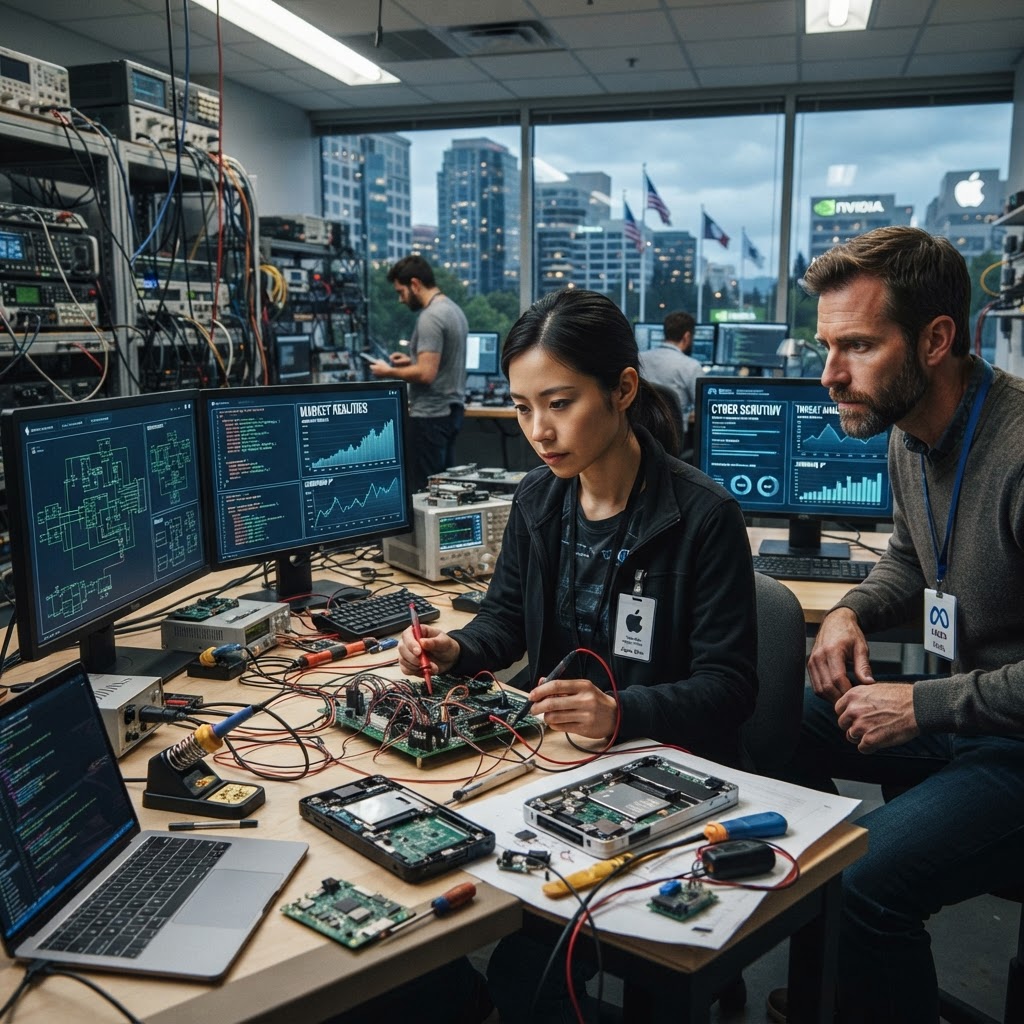
Silicon Valley at a Crossroads: Hardware Pivots, Market Realities, and Rising Cyber Scrutiny
Recent shifts in the technology sector highlight a turbulent landscape marked by major artificial intelligence infrastructure overhauls, mounting digital security threats, and shifting market dynamics.
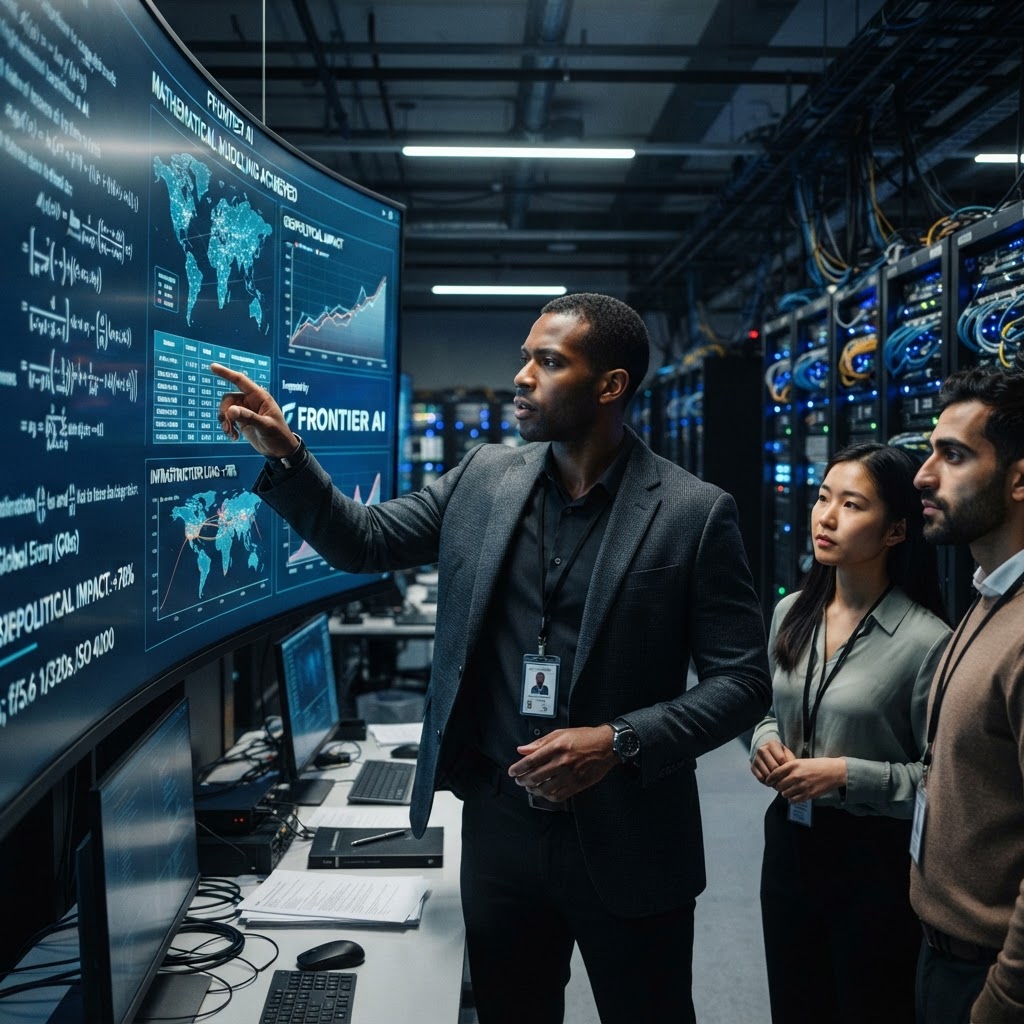
Frontier AI Shatters Mathematical Barriers as Geopolitical and Infrastructural Stakes Surge
Recent breakthroughs in machine-assisted mathematics and autonomous software agents highlight artificial intelligence's rapid evolution, even as infrastructure bottlenecks and geopolitical frictions challenge its global expansion.

A Paradigm in Flux: Leadership Upheaval at Nvidia, Cloud Fragility, and the Race for Agentic Autonomy
Recent days have delivered a seismic shock to the technology sector, marked by Nvidia leadership turmoil amid national security scrutiny, major global cloud disruptions, and bold leaps in commercial autonomous agents.