Frontiers of Discovery: From the First Moments of the Cosmos to Biohybrid Intelligence
Recent scientific breakthroughs across astrophysics, quantum materials, and biomedical engineering are reshaping our understanding of the universe and pioneering novel interfaces for human health.
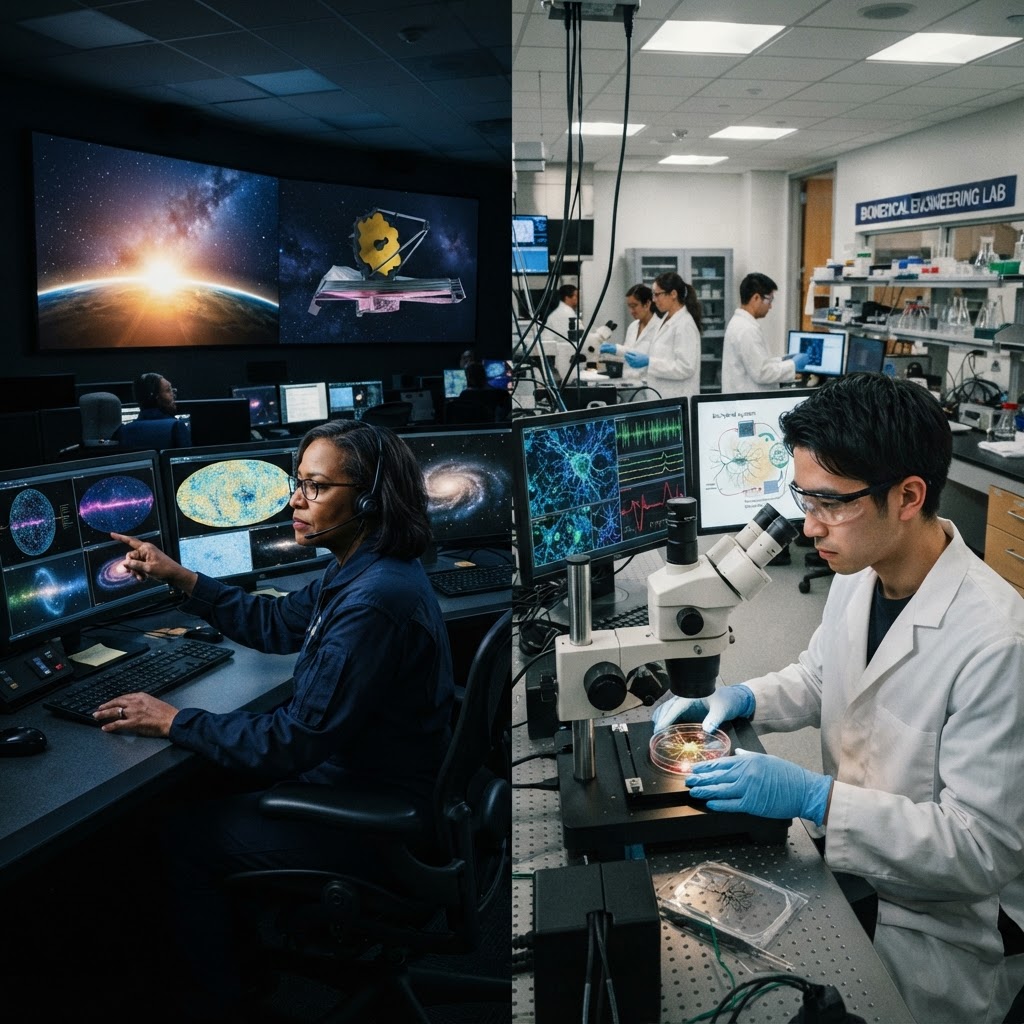
Unlocking the Earliest Minutes of the Universe
Recent developments across international research institutions have accelerated scientific progress on multiple fronts, ranging from deep-space cosmology to microscopic quantum interfaces. In observational astrophysics, researchers have achieved unprecedented precision in studying the universe's primordial era. According to recent reports compiled by ScienceDaily, astronomers have succeeded in measuring the specific abundance of helium produced during the first five minutes following the Big Bang. By pinning down the exact proportions of primordial elements, cosmologists are gaining refined clarity on the dense, incandescent epoch that preceded the formation of the first stars, placing strict experimental boundaries on fundamental cosmological theories.
Complementing these cosmic revelations are insights gathered from closer planetary explorations. Planetary scientists analyzing data and samples from NASA missions—including the OSIRIS-REx probe that visited asteroid Bennu—have resolved long-standing riddles regarding thermal behavior on small celestial bodies. As reported in recent findings highlighted by ScienceDaily, scientists uncovered why Bennu sheds heat with surprising rapidness despite being heavily strewn with rocky boulders. The resolution of this puzzle not only clarifies how primordial solar system debris responds to solar radiation, but also provides crucial models for predicting the orbital evolution of potentially hazardous near-Earth objects.
Breakthroughs at the Quantum and Molecular Limits
While astrophysicists chart the macrocosm, condensed matter and quantum physicists are pioneering breakthroughs at atomic scales. Experimental researchers have engineered an ultra-clean material substrate capable of preserving the delicate quantum coherence of individual molecules at their fundamental physical limit. In traditional quantum systems, unwanted interactions with surface imperfections and atmospheric noise rapidly degrade fragile quantum states. By isolating molecules on pristine, atomically uniform surfaces, scientists can now observe and manipulate quantum phenomena that were previously obscured by decoherence, setting the stage for more stable quantum memory architectures and sensitive molecular sensors.
Alongside physical quantum substrates, computational research is tackling the mechanics of biological systems and data fidelity. Academic networks and publishers, such as those participating in the Frontiers initiative to prepare European research for artificial intelligence, are deploying automated curation tools and granting structures to ensure scientific datasets are machine-actionable. By formalizing FAIR data principles for complex physical and biological studies, researchers hope to utilize artificial intelligence to accelerate the design of novel materials and decode complex experimental spectra without introducing synthetic bias.
Transforming Medicine: Organoids and Space Flight Resilience
The convergence of biotechnology and computational neuroscience has yielded similarly striking results. Biological engineers have successfully demonstrated biohybrid computational systems, including mini-brain organoids trained to process sensory tactile cues such as Braille patterns. These organoids, cultured from stem cells to mimic basic neural tissue architecture, demonstrate synaptic plasticity and localized signal processing when interfaced with microelectrode arrays. Such biohybrid systems provide invaluable insights into how neural circuits encode external information, while laying the foundational steps toward living computational models that bypass standard semiconductor bottlenecks.
Medical researchers are also tackling systemic physiological challenges. In a major milestone for biomedical engineering, a research team publishing in Science described an autonomous, wireless electrocatalytic closed-loop device designed for the drug-free management of diabesity—a composite condition encompassing diabetes and obesity. By delivering targeted bioelectronic cues to regulate metabolic feedback pathways in real time, the technology opens a non-pharmacological avenue for chronic metabolic therapy, potentially circumventing the adverse effects and adherence hurdles associated with conventional medications.
Human adaptability is also finding validation under extreme physical conditions. Long-duration aerospace medical studies evaluating astronaut cardiovascular data have revealed that the human heart exhibits surprising resilience to extended weightlessness. When supplemented by structured physical exercise regimens, cardiac tissue retains functional integrity and adapts favorably to simulated Martian gravity. The findings offer strong physiological reassurance for upcoming crewed expeditions to Mars, proving that human space exploration can overcome several once-feared biological barriers.
Synthesizing New Paradigms
Whether measuring the chemical remnants of cosmic dawn, isolating individual quantum molecules, or engineering responsive neural organoids, the current wave of scientific discovery is distinguished by deep cross-disciplinary convergence. As physical theory, biological design, and autonomous computational platforms continue to coalesce, scientists are finding that resolving deep fundamental questions frequently unlocks practical technological paradigms for the modern world.
Recommended for you
Similar to “Science”
Frontiers of Understanding: From Quantum Contextuality to Hidden Ocean Heatwaves
Recent scientific breakthroughs across physics, oceanography, and paleoclimatology are unveiling long-hidden mechanisms that govern our universe, from quantum processors surpassing classical benchmarks to subterranean thermal surges reshaping marine ecology.
Frontiers of Discovery: How Recent Breakthroughs in Physics, Biomedicine, and Space Exploration Are Redefining Modern Science
From high-stakes neutrino observations to innovative therapeutics and potential biosignatures on Mars, contemporary scientific research is rapidly rewriting our understanding of both the human body and the cosmos.
Frontiers of Discovery: How Recent Breakthroughs in Cellular Mapping, Synthetic Biology, and Materials Science Are Reshaping Modern Science
Recent advances across molecular biology, condensed-matter physics, and biomedical engineering are unlocking long-standing puzzles about how cells communicate, how aging operates, and how adaptive materials can heal themselves.