Frontiers of Discovery: How Recent Breakthroughs in Physics, Biomedicine, and Space Exploration Are Redefining Modern Science
From high-stakes neutrino observations to innovative therapeutics and potential biosignatures on Mars, contemporary scientific research is rapidly rewriting our understanding of both the human body and the cosmos.
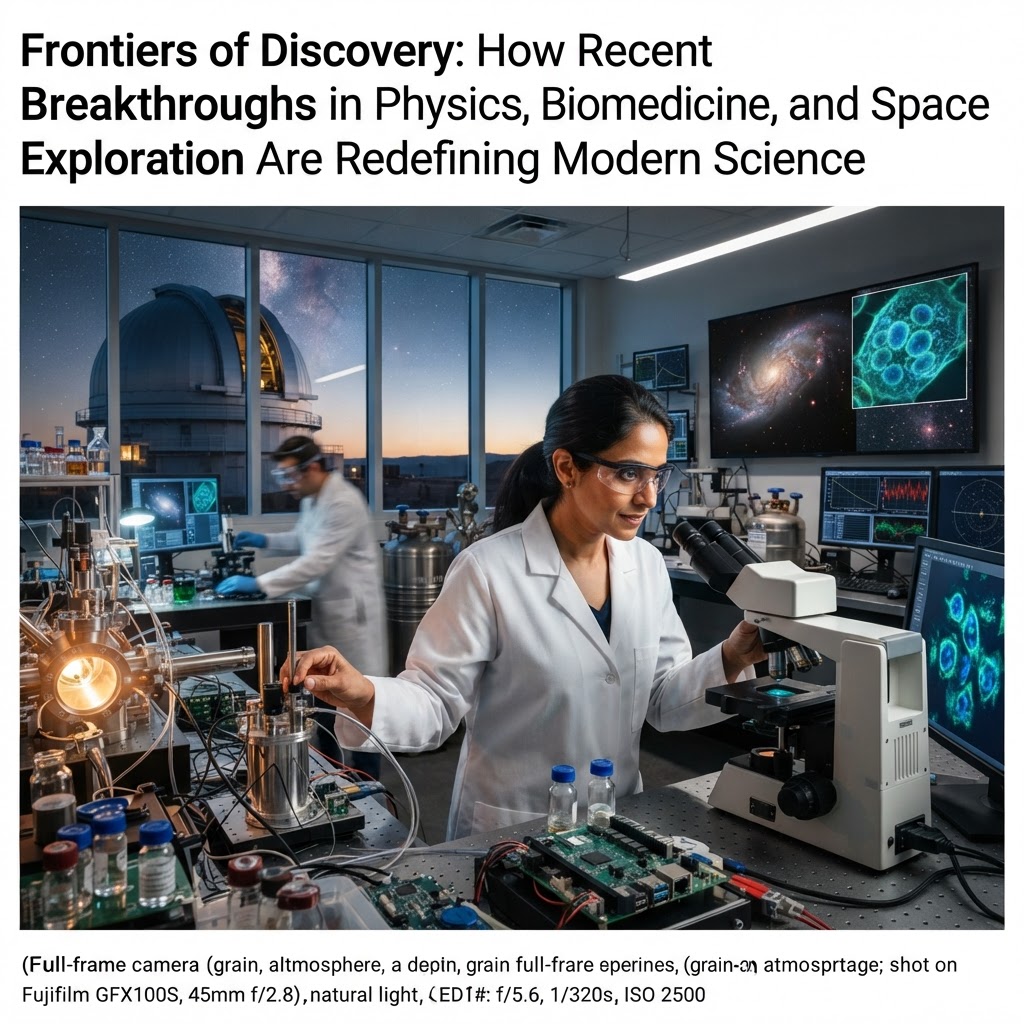
Unveiling the Fundamental Mysteries of Matter
In the quiet depths of subterranean laboratories and particle physics observatories around the globe, scientists are inching closer to solving some of the universe's most elusive puzzles. A central focus of recent investigation has been the neutrino—an almost massless, neutrally charged fundamental particle that rarely interacts with ordinary matter. Long considered one of the most enigmatic components of the Standard Model, neutrinos fluctuate between three distinct types or 'flavors' as they travel across vast distances.
Advanced experimental facilities, such as the Jiangmen Underground Neutrino Observatory (JUNO) in China, are currently pursuing a decisive ordering of these particles by mass. Pinpointing the neutrino mass hierarchy represents a monumental benchmark in modern astrophysics and particle theory. Determining whether the third neutrino state is heavier or lighter than the others will illuminate the fundamental physics that governed the earliest moments after the Big Bang, potentially explaining why our universe contains vast quantities of matter while antimatter largely vanished.
Rewriting Disease Prevention and Cellular Biology
Parallel breakthroughs are transforming biomedical research, where novel strategies to neutralize pathogens and repair biological pathways are accelerating into clinical realities. Recent high-profile evaluations of long-acting viral countermeasures—most notably twice-yearly capsid inhibitors such as lenacapavir—have sparked intense enthusiasm within public health networks. Rather than demanding daily oral regimens, these therapies disrupt the viral protein shell with sustained efficacy, fundamentally reshaping preventative care and pointing toward universal architectures for combating mutating viral strains.
At the microscopic scale, the study of genetics and cellular longevity has experienced similar paradigm shifts. Modern research is expanding the precision of CRISPR-based gene editing techniques and exploring the delicate dynamics of telomeres—the protective caps at the ends of chromosomes. By discovering unexpected pathways that drive cellular metastasis and identifying the intricate genetic markers governing human memory and neurodevelopment, researchers are laying the groundwork for targeted interventions that could halt neurodegenerative decay and mitigate chronic disease before symptoms manifest.
The Search for Life Beyond Earth
Far beyond our atmosphere, robotic sentinels traversing planetary landscapes continue to expand our view of cosmic habitability. On Mars, NASA's Perseverance rover has generated heightened intrigue through its examination of ancient sedimentary basins in Jezero Crater. The rover's spectroscopic instruments have recently analyzed intriguing mineral formations characterized by distinct iron-phosphate rings and organic signatures.
On Earth, such geochemical patterns frequently correlate with ancient microbial activity in aquatic environments. While astrobiologists urge disciplined caution—emphasizing that non-biological, abiotic chemical reactions can also forge these micro-structures—the samples represent some of the most compelling evidence collected to date regarding the possibility of past Martian life. Verifying these findings will depend on upcoming international sample-return architectures, which aim to deliver these pristine planetary cores back to terrestrial laboratories for comprehensive isotopic evaluation.
Challenging Environments and Planetary Resilience
Scientific exploration is simultaneously pushing into our own planet's harshest extremes. Teams of interdisciplinary researchers are braving extended expeditions into isolated polar environments, including drifting laboratories frozen deep within Arctic ice packs. These high-latitude missions allow scientists to gather crucial baseline data regarding sea ice thinning, deep ocean currents, and unique polar microbial ecosystems that play a disproportionate role in regulating the Earth's climate engine.
As these diverse investigations converge—from the subatomic fabric of reality to the biochemistry of living cells and the geobiology of alien worlds—the global scientific community is experiencing a rare period of cross-disciplinary acceleration. Together, these breakthroughs emphasize that science remains a dynamic, self-correcting quest, continuously testing hypotheses against the raw data of nature to expand humanity's collective horizons.
Recommended for you
Similar to “Science”
Frontiers of Discovery: How AI Biolabs, Metabolic Research, and Endosymbiosis Are Redefining Modern Science
Recent advances across biotechnology, cellular evolution, and targeted therapeutics are transforming our understanding of living systems and opening new horizons for global medicine.
Frontiers of Discovery: How Recent Breakthroughs in Physics, Medicine, and Computing Are Redefining Modern Science
From detecting extreme-energy cosmic ghost particles to unlocking backward bacterial defenses and brain-inspired electronics, a surge of recent discoveries is transforming our understanding of the universe and human biology.
Frontiers of Discovery: How Recent Breakthroughs in Neuroscience, Oncology, and Climate Science Are Redefining Modern Research
Recent discoveries in neurological processing, cancer biology, and environmental monitoring are fundamentally transforming established scientific doctrines and providing critical insights into life, health, and our changing planet.