Navigating the Policy Tightrope: Global Economy Balances Inflation Risks and Growth Resilience
As central banks worldwide calibrate interest rates against persistent price pressures and volatile commodity markets, the global economy continues to demonstrate uneven yet notable resilience.

The Shifting Landscape of Central Banking
International monetary policymakers are navigating an increasingly delicate balancing act as they balance growth retention against persistent inflationary pressures. Across major financial capitals, central banks are assessing when and how aggressively to recalibrate monetary policy. While several developed markets have initiated policy adjustments to stimulate slowing domestic demand, policymakers remain vigilant against secondary inflation waves driven by volatile energy commodities and persistent services sector inflation, as tracked by monitors across Bloomberg Economics.
Resilient Labor Markets Defy Macroeconomic Headwinds
One of the most striking dynamics in recent economic readings has been the enduring strength of employment across developed economies. Despite elevated borrowing costs that traditionally dampen hiring, labor markets across Europe and North America have remained remarkably resilient. Data highlighted by The Wall Street Journal indicates that European labor conditions continue to hold firm despite broader regional slowdowns. Similarly, resilient consumer activity supported by steady domestic wages in the United States has contributed to an ongoing economic floor, according to insights from the Deloitte US Economic Forecast.
Commodity Volatility and Geopolitical Pressures
The stability of the global economic trajectory remains tied to swings in energy and primary commodity markets. Fluctuations in crude oil prices, prompted by mixed international supply signals and escalating geopolitical tensions, pose ongoing upside risks to headline inflation figures, as reported by Reuters Econ World. Escalating transport friction, regional security crises, and disruptions along key maritime choke points have revived concerns regarding supply chain friction. In turn, sovereign debt markets have experienced renewed yield volatility as investors recalibrate their expectations for long-term real interest rates, a dynamic observed by The Financial Times.
International Trade and Institutional Friction
Beyond cyclical fluctuations, structural shifts in global trade architecture continue to define the medium-term economic outlook. Multilateral institutions and trade organizations face rising pressures toward industrial policy, regionalization, and nearshoring. Analysis published by The National underscores that institutional impasses in trade reform could cost the global economy significant fractions of aggregate output over the coming decades if fragmentation goes unaddressed. Concurrently, regional partnerships and bilateral pacts are multiplying as nation-states seek to insulate domestic production from geopolitical shocks.
The Road Ahead: Uneven Recovery and Divergent Paths
Looking toward future quarters, macroeconomic performance is expected to diverge across geographic regions. Emerging markets with agile supply linkages and robust demographic profiles are capturing new investment flows, while advanced economies grapple with managing high debt-to-GDP ratios alongside aging populations. Comprehensive assessments from the IMF World Economic Outlook emphasize that maintaining fiscal discipline while safeguarding vital investments in innovation and sustainability will determine which economies emerge strongest from the current period of monetary transition.
Recommended for you
Similar to “Global Economy”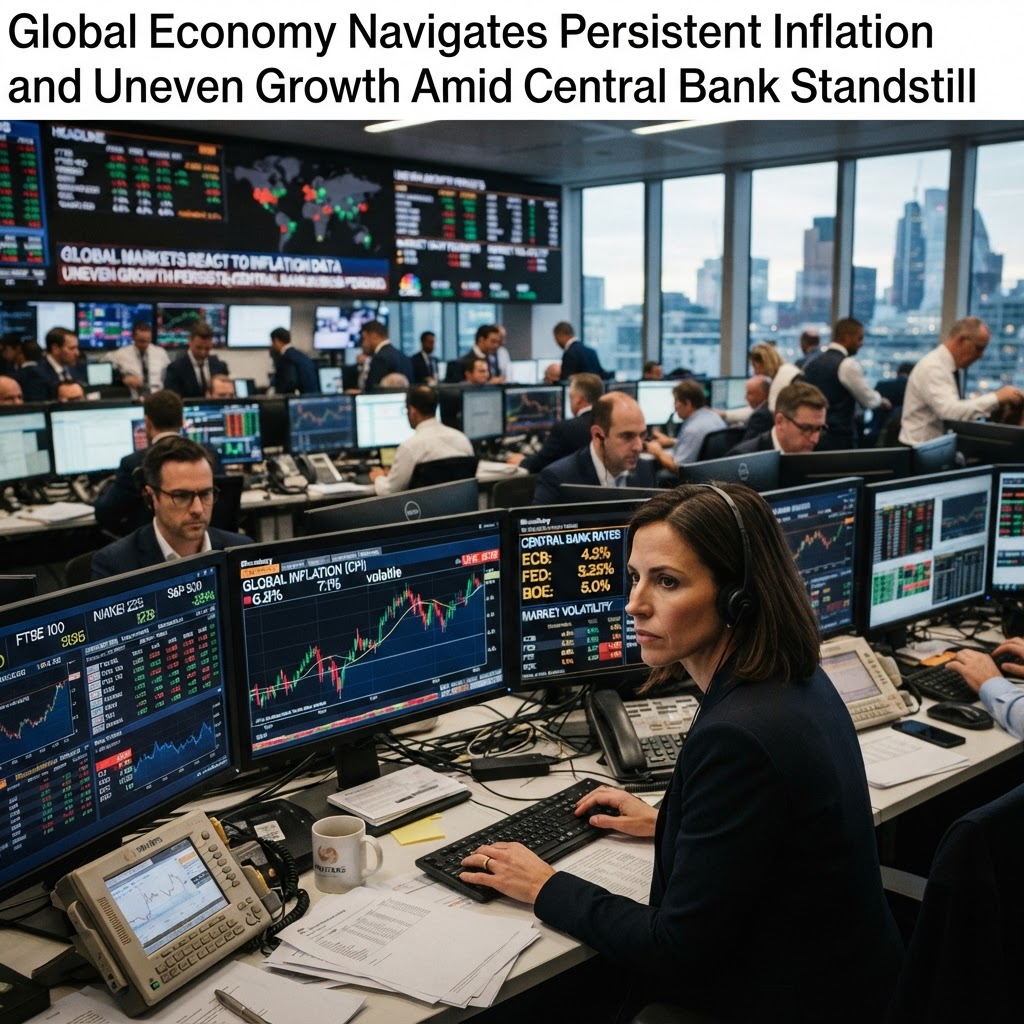
Global Economy Navigates Persistent Inflation and Uneven Growth Amid Central Bank Standstill
Recent economic indicators reveal sustained worldwide business momentum alongside stubborn price pressures, compelling major central banks toward a hawkish pause while commodity tensions cast a shadow over future expansion.

Fragile Balances: Global Economy Navigates Geopolitical Fractures, Sticky Inflation, and Policy Pivots
As global markets grapple with persistent inflationary pressures, shifting trade alliances, and geopolitical friction across energy corridors, major central banks face complex balancing acts between sustaining growth and taming price volatility.

A Fragile Resilience: Global Economy Navigates High Rates, Inflation Pressures, and an AI-Led Divide
Recent data from central banks and global multilateral institutions reveal an expanding yet uneven world economy, where corporate technology investment clashes with persistent inflation, rising bond yields, and narrowing fiscal buffers.