A Fragile Resilience: Global Economy Navigates High Rates, Inflation Pressures, and an AI-Led Divide
Recent data from central banks and global multilateral institutions reveal an expanding yet uneven world economy, where corporate technology investment clashes with persistent inflation, rising bond yields, and narrowing fiscal buffers.

The Two-Tiered Path of Global Expansion
The global economic landscape in late 2026 presents a striking paradox. Headline growth numbers continue to reflect resilience across key markets, defying earlier predictions of an imminent downturn. Yet beneath this aggregate performance lies an increasingly fragmented reality. Multilateral institutions and private forecasting groups point to a two-speed world where a select group of advanced, tech-intensive economies are surging ahead while energy-dependent, low-income, and credit-constrained nations encounter mounting headwinds.
According to assessments highlighted during recent gatherings of the International Monetary Fund (IMF), world GDP is expanding near long-term trend rates, yet the distribution of that momentum is markedly asymmetrical. Economies reaping the benefits of an unprecedented artificial intelligence investment wave and favorable terms of trade have sustained surprising vigor. In contrast, emerging markets and lower-income nations struggling with elevated commodity prices and rising sovereign borrowing costs face a much more restricted horizon. Economists warn that the economic buffers accumulated over past cycles—both fiscal reserves and private household savings—are wearing dangerously thin, leaving governments with fewer policy levers to cushion future disturbances.
The Artificial Intelligence Investment Surge and Supply Strains
A primary driver of the current divergence is the scale of capital expenditure pouring into artificial intelligence infrastructure. Global corporations are allocating hundreds of billions of dollars to the construction of data centers, high-performance computing clusters, and specialized electrical infrastructure. Analysts from Deloitte Insights note that this surge has provided a substantial tailwind to gross private investment, sustaining manufacturing pipelines and advanced engineering sectors.
However, this intense deployment of capital has introduced unexpected macroeconomic friction. Demand for physical hardware has severely tightened input markets, fueling distinct categories of price increases. Hardware components, specialized server assemblies, and peripherals have experienced significant year-over-year cost inflation. Moreover, the massive power requirements of advanced computational clusters have strained electrical grids, sparking localized energy bottlenecks and intense competition for industrial equipment such as heavy-duty natural gas turbines. As a result, the technology boom is exerting upward pressure on wholesale costs across non-tech industries, complicating efforts to fully normalize broad price indices.
Resilient Activity Meets Stubborn Inflation
Economic indicators from the world's largest economy illustrate this tension clearly. Flash purchasing managers' data published by S&P Global demonstrate that private-sector business activity remains firmly in expansion territory, with composite output metrics tracking well above the 50 neutral mark. Resilient corporate order books, active hiring to meet capacity constraints, and ongoing domestic demand continue to characterize broad business sentiment. Similarly, figures from The Conference Board suggest that leading indicators, while leveling off on a month-to-month basis, maintain positive mid-term trajectories.
Nevertheless, inflationary undercurrents remain stubborn. Survey results point to a renewed acceleration in output selling prices—the fastest monthly pace logged in several years—driven by the combined effects of energy volatility, technology input costs, and sustained services demand. Core inflation measures continue to sit uncomfortably above the 2 percent objectives favored by monetary authorities. As household saving rates gradually decline from their post-pandemic highs, consumer durability is increasingly tested by persistent price pressures on daily staples and utility expenses.
Central Banks Hold Policy Tight Amid Bond Market Pressure
Against this turbulent backdrop, monetary authorities are maintaining a posture of strict caution. The Federal Reserve concluded its October policy meeting by electing to leave baseline interest rates unchanged, adopting a watchful stance as policymakers evaluate incoming labor and pricing reports. The Federal Open Market Committee characterized underlying economic momentum as expanding at a strong pace, a signal that immediate rate reductions are unlikely to materialize while inflation risks remain tilted to the upside, as reported by CNBC.
This prolonged era of restrictive policy has rattled debt markets. Long-term sovereign debt yields have climbed sharply across North America and Europe, with benchmark 10-year US Treasury yields pressing beyond the 5 percent threshold and touching levels unseen in decades. The rise in sovereign yields reverberates globally, tightening financial conditions for corporate borrowers and driving up the cost of debt service for sovereign nations already carrying heavy obligations. Market participants who anticipated an orderly monetary easing cycle have had to recalibrate their expectations as strong growth data clashes with the realities of persistent inflation.
A Fractured Global Outlook
International institutions such as the World Bank and credit rating agencies emphasize that the margin for error is shrinking across regional economies. While the United States continues to demonstrate robust internal activity, other major trading blocs are showing signs of structural strain. Growth within China has moderated amid subdued domestic consumption, balanced primarily by sustained industrial manufacturing exports. In Europe, escalating energy concerns and fiscal constraints have dampened consumer sentiment, leaving retail confidence muted in key industrial economies such as Germany.
The central dilemma confronting global policymakers is one of trade-offs. To reignite stagnant sectors and alleviate the burden of elevated debt servicing, lower borrowing costs are urgently needed. Yet premature policy easing risks cementing higher inflation into wage negotiations and retail pricing structures, especially as geopolitical disruptions near international transit choke points keep commodity markets fragile. Navigating the remainder of the year will require central banks and finance ministries to balance the benefits of dynamic private technology investment against the vulnerabilities of a highly leveraged and unevenly expanding global financial system.
Recommended for you
Similar to “Global Economy”
Global Economy Navigates Persistent Inflation Pressures and Sovereign Debt Strains
Central banks warn of rising sovereign debt vulnerabilities and sticky inflation, even as investments in technology and stabilizing energy markets offer signs of medium-term economic resilience.

A Fragile Balancing Act: Global Economy Navigates Persistent Inflation, Divergent Growth, and Tightening Financial Pressures
Central banks face mounting pressure to hold or lift rates as geopolitical oil shocks and food inflation collide with sharp regional growth disparities and a cooling technology sector.
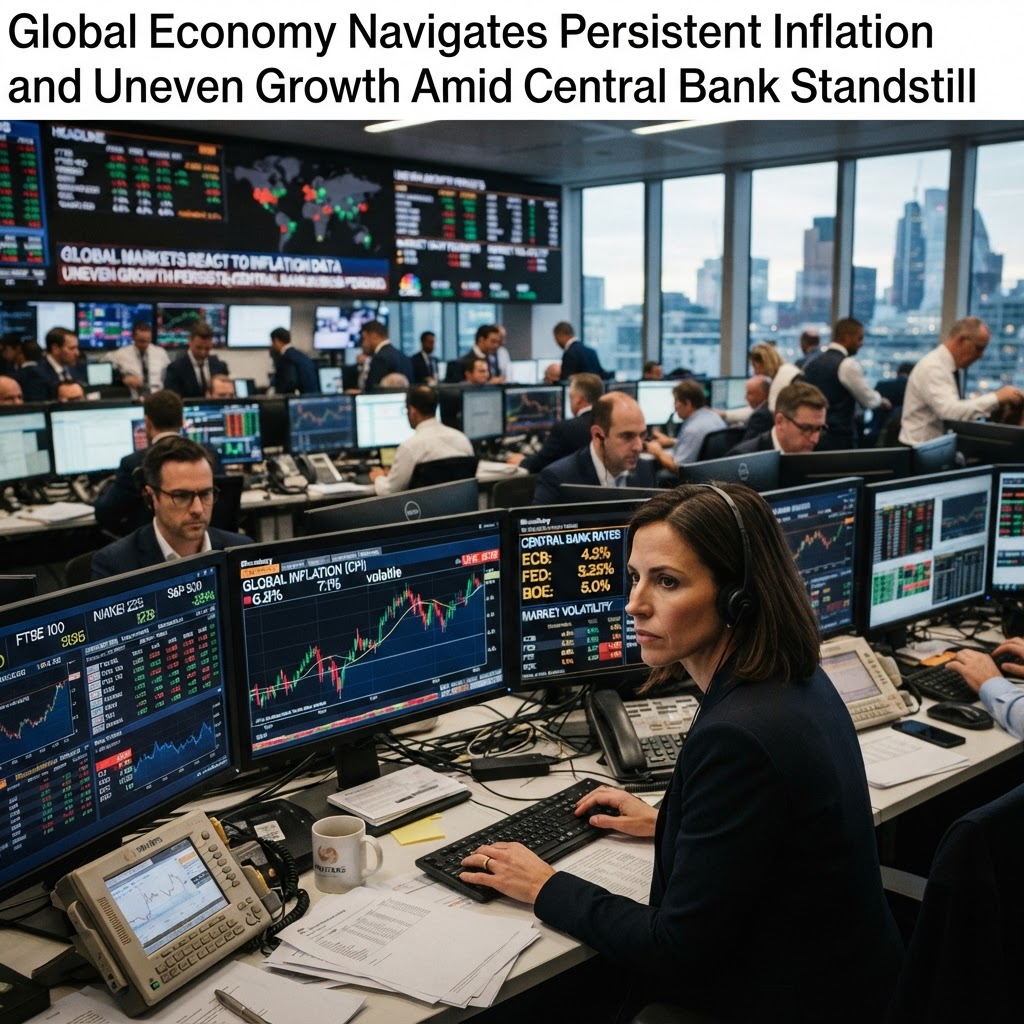
Global Economy Navigates Persistent Inflation and Uneven Growth Amid Central Bank Standstill
Recent economic indicators reveal sustained worldwide business momentum alongside stubborn price pressures, compelling major central banks toward a hawkish pause while commodity tensions cast a shadow over future expansion.