Global Economy Navigates Persistent Inflation and Uneven Growth Amid Central Bank Standstill
Recent economic indicators reveal sustained worldwide business momentum alongside stubborn price pressures, compelling major central banks toward a hawkish pause while commodity tensions cast a shadow over future expansion.
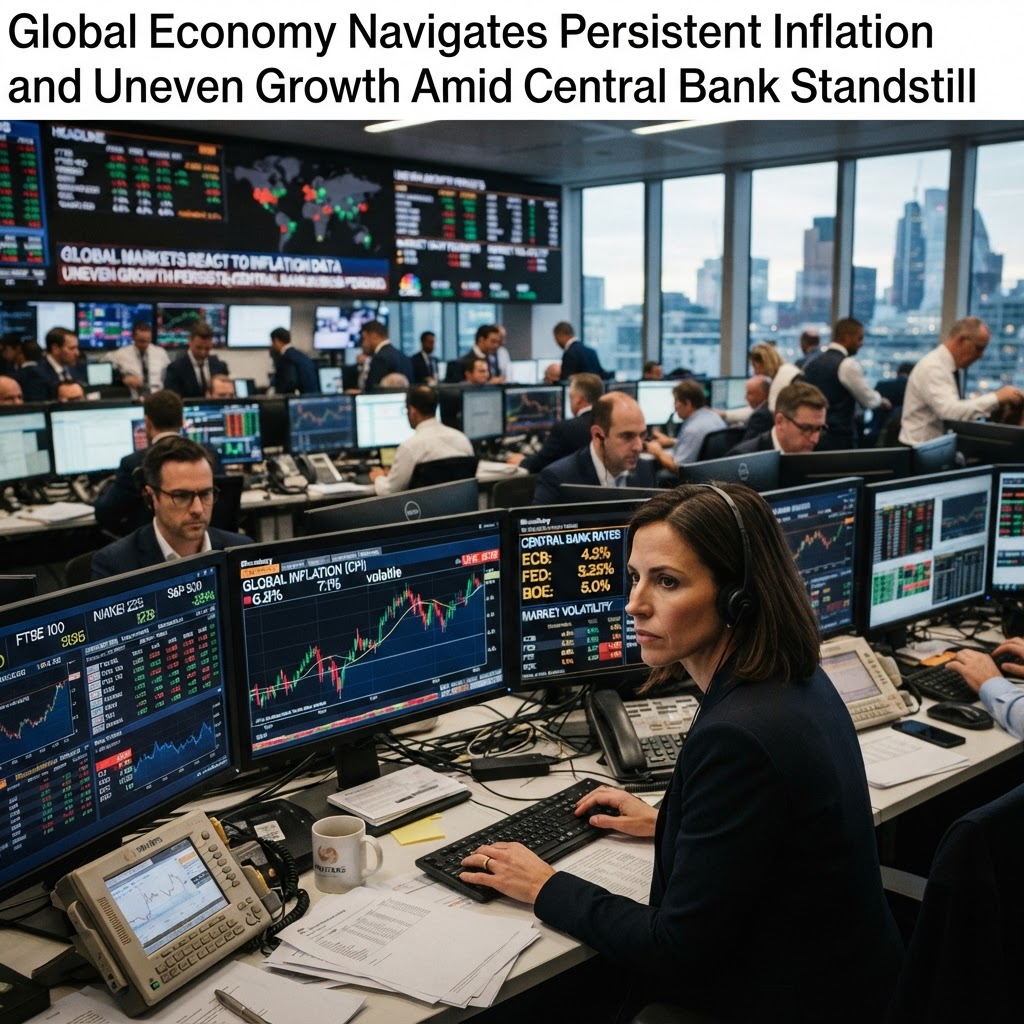
Resilience Defies Expectations Amid Cross-Border Divergence
The global economic engine continues to demonstrate surprising vitality, yet underneath headline figures lies a picture of sharp regional contrast. International institutions, led by the International Monetary Fund at its annual gatherings, note that worldwide output is projected to grow between 3.1% and 3.4%, powered by durable domestic demand and an expansive capital spending cycle in key technological frontiers, as noted by the IMF World Economic Outlook. Private sector forecasting counterparts such as Fitch Ratings have echoed similar optimism, moderately lifting expectations for overall global GDP expansion to 2.6% for the year, according to the Fitch Ratings Global Economic Outlook.
Manufacturing and services across major hubs have shown synchronized gains, with recent business surveys revealing the most broad-based sectoral expansion recorded in several years, detailed by S&P Global. In the United States, flash composite indices hover near multi-year highs despite modest month-on-month cooling, driven by strong corporate earnings and robust order books, as reported in the S&P Global Flash US PMI. However, this momentum has not materialized evenly. While consumption and corporate balance sheets inside the United States show resilience, several major European economies face sluggish industrial orders, and emerging markets contend with the tightening grip of elevated international borrowing rates.
Central Banks Anchor on a Hawkish Pause
Monetary policy across the Group of Seven is reaching a critical inflection point. Facing a conflicting cocktail of robust employment figures alongside stubborn headline inflation, policymakers are adopting a posture characterized by a cautious hold rather than immediate monetary easing, as covered by Bloomberg. The Federal Reserve, the European Central Bank, and the Bank of Japan are coordinating what market observers describe as a hawkish plateau—pausing rate hikes to gauge the delayed impact of previous monetary tightening while firmly discouraging premature market expectations for aggressive rate cuts.
Economists analyzing leading cyclical indicators observe that underlying signals remain ambiguous. The Conference Board's Leading Economic Index for the United States leveled off following prior contractions, suggesting that while imminent recessionary risks have receded, a clear, unrestrained path to uninterrupted accelerated growth is yet to be established, per The Conference Board. In an analytical assessment published by Deloitte Insights, researchers highlighted that contradictory labor and manufacturing prints have complicated forward guidance, leaving central bankers tied strictly to incremental data releases.
The Dual Squeeze: Commodity Pressures and Household Strain
The primary barrier confronting central banks remains the persistence of price pressures. Headline inflation forecasts for the current year have been pushed upward toward 4.7%, propelled in large part by volatile energy markets and heightened shipping expenses, as tracked by the World Economic Forum. International benchmark crude prices topping $114 per barrel have reintroduced energy price shocks that disproportionately squeeze lower-income households and input-dependent manufacturers.
Beyond oil, structural shifts are triggering anxieties around long-term critical materials. Industrial demand driven by electrification and data center infrastructure is colliding with strict mining constraints. Analysts warn of severe medium-to-long term deficits in base metals, particularly copper, which could add structural cost floors beneath industrial production over the coming decade, as reported by the Financial Times. These supply-side headwinds complicate the task of cooling inflation via conventional demand-suppression tools alone.
Household Sentiment and the Road Ahead
Despite steady top-line growth metrics and active hiring across service industries, consumer sentiment is experiencing notable deterioration across several advanced economies. Surging food, utility, and fuel costs have eroded real household purchasing power, generating a palpable disconnect between macroeconomic indicators and public sentiment, according to analysis by Bloomberg.
As the international economy moves toward the close of the calendar year, policymakers and business leaders confront a complex balancing act. The combination of sustained capital expenditure, persistent raw material supply constraints, and sticky inflation presents a delicate policy environment. Global growth has maintained footing under substantial pressure, but steering that growth toward long-term stability without inducing financial dislocation remains the preeminent economic challenge of the period.
Recommended for you
Similar to “Global Economy”
Global Growth Shows Surprising Resilience as Inflationary Energy Shocks Cloud the Monetary Path
Recent economic indicators reveal persistent momentum across worldwide manufacturing and services, though renewed energy cost spikes and sticky inflation continue to complicate central bank trajectories.

Navigating the Policy Tightrope: Global Economy Balances Inflation Risks and Growth Resilience
As central banks worldwide calibrate interest rates against persistent price pressures and volatile commodity markets, the global economy continues to demonstrate uneven yet notable resilience.

Persistent Inflation and Rising Rates Cast Long Shadows Over Global Resilience
Major central banks signal prolonged monetary tightening despite tumbling crude prices, as sovereign bond pressures and technology sector anxieties cloud the near-term economic horizon.