Frontiers of Discovery: How AI Watermarking, Cosmic Mapping, and Targeted Therapies Are Reshaping Modern Science
Recent breakthroughs across computational biology, astrophysics, and precision oncology demonstrate how cross-disciplinary innovation is redefining the limits of scientific exploration.
The Convergence of Computation and Biotechnology
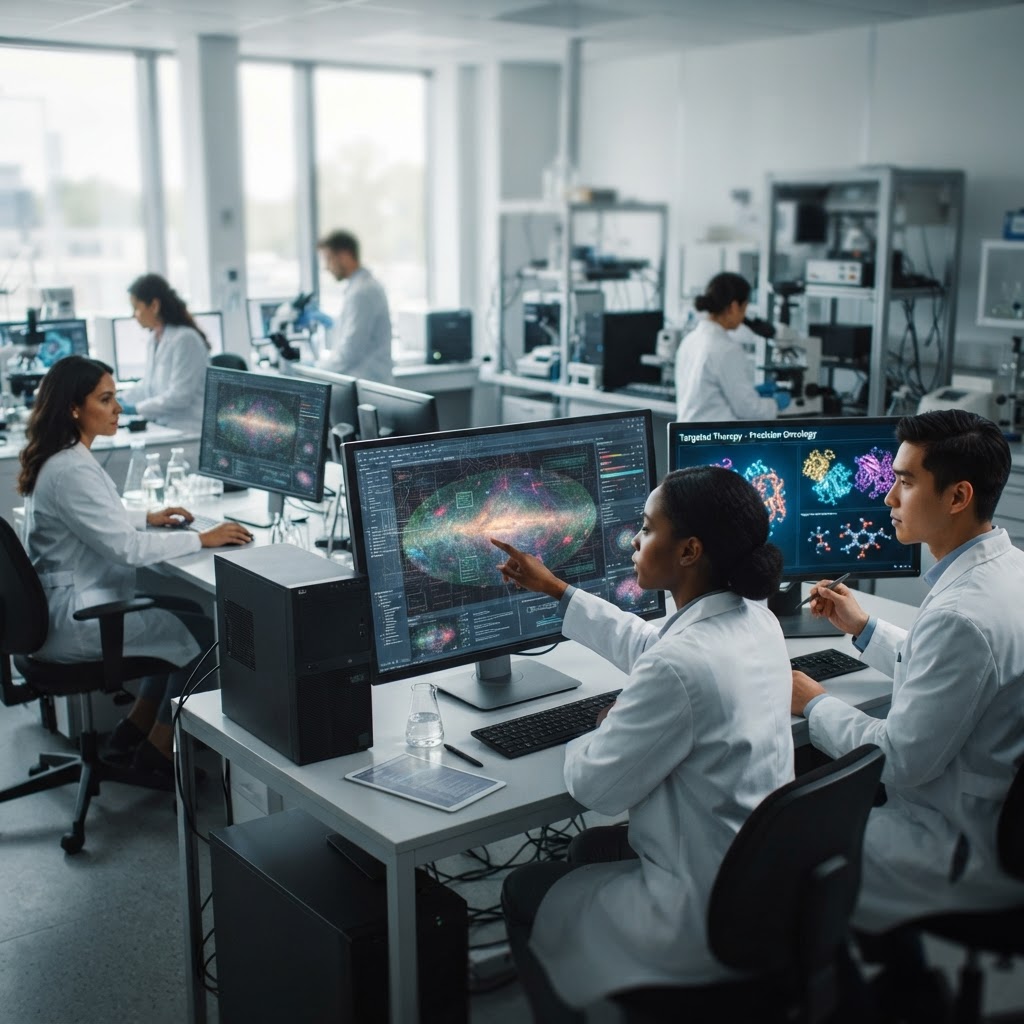
In recent days, the scientific community has witnessed a surge of breakthroughs where advanced computation directly intersects with molecular biology. As computational tools and artificial intelligence models increasingly design synthetic proteins from scratch, researchers have confronted a twin challenge: accelerating therapeutic discovery while preventing the misuse of engineered biological agents. A major development highlighted in recent reports from Science/AAAS reveals new techniques designed to 'watermark' AI-generated protein sequences. By subtly encoding cryptographic identifiers into amino acid sequences without disrupting their three-dimensional structure or biochemical function, researchers can now trace the provenance of synthetic molecules. This method offers an essential safeguard against biosecurity hazards while ensuring intellectual property attribution as computational biology laboratories scale up generative design.
Mapping the Cosmos at Unprecedented Fidelity
Simultaneously, observational astrophysics has achieved a monumental milestone. Astronomical teams utilizing the Dark Energy Spectroscopic Instrument (DESI) have expanded our window into the deep cosmos by compiling the most comprehensive 3D map of the universe produced to date, as detailed in coverage by The Week. Armed with 5,000 robotic fiber-optic positioning sensors mounted on the Mayall Telescope, DESI has captured the spectra of tens of millions of galaxies and luminous quasars. By tracing the spatial clustering and gravitational velocities of these distant cosmological bodies across billions of light-years, physicists are gathering crucial clues to evaluate whether dark energy acts as a constant cosmological parameter or fluctuates dynamically over cosmic time.
Precision Oncology: Targeted Inhibitors Redefining Survival
The field of clinical medicine has matched these computational and physical achievements with critical progress in cancer research. Pancreatic ductal adenocarcinoma has long remained one of oncology’s most intractable hurdles, largely owing to late clinical presentation and significant chemo-resistance. However, recent clinical evaluation of targeted oncological agents—such as the experimental therapeutic daraxonrasib—signals a potential shift in patient prognosis. As reported in recent scientific roundups, clinical trials indicate the targeted compound can significantly extend progression-free and overall survival rates compared to conventional cytotoxic regimens. Crucially, clinicians noted that the compound's adverse-effect profile remained manageable, pointing toward more targeted and less debilitating therapeutic protocols for patients with advanced disease.
Synthetic Neurology and Biohybrid Systems
Parallel advancements in bioengineering are dissolving the traditional boundary between synthetic devices and living biological architecture. Investigations published in journals including Nature Nanotechnology document the successful fabrication of artificial neurons capable of exchanging electrochemical signals with living mammalian brain tissue. Unlike previous passive electrode arrays, these neuromorphic biomimetic units actively process and emit neurotransmitter-mediated pulses, evoking natural synaptic responses from adjoining tissue. This development opens profound avenues for neural prosthetics, targeted brain-machine interfaces, and potential restorative interventions for neurodegenerative deficits.
Global Scientific Collaboration in an Era of Transition
These rapid achievements across disparate fields underscore a broader transformation within the global research ecosystem. The integration of computational automation, high-throughput physical mapping, and nanoscale bioengineering has lowered empirical barriers that stood for decades. Yet, as international research institutions navigate shifts in funding, geopolitical strain, and biosecurity scrutiny, the scientific enterprise is prioritizing open verification and robust governance. By uniting cross-disciplinary engineering with rigorous safety standards, modern science continues to unravel natural phenomena while constructing powerful new instruments for human health and planetary exploration.
Recommended for you
Similar to “Science”
Frontiers of Discovery: How AI, Evolutionary Timelines, and Sustainable Engineering Are Reshaping Modern Science
Recent breakthroughs spanning biological communication, ancient evolutionary paleontology, and resource extraction demonstrate how cross-disciplinary research is accelerating global scientific understanding.
Frontiers of Discovery: Breakthroughs in Quantum Materials, Deep Ocean Heat, and Precision Oncology
Recent advances across physics, climate oceanography, and oncology highlight how atomic-scale manipulations, deep-sea tracking, and molecular genetic discoveries are reshaping modern science.
Frontiers of Discovery: How Recent Breakthroughs in Physics, Medicine, and Deep-Sea Biology Are Reshaping Science
From microchip-transforming magnetic physics and orbital construction to breakthroughs in cancer genomics and ocean carbon capture, recent discoveries highlight an accelerating era of cross-disciplinary innovation.