Frontiers of Discovery: How Recent Breakthroughs in Physics, Medicine, and Deep-Sea Biology Are Reshaping Science
From microchip-transforming magnetic physics and orbital construction to breakthroughs in cancer genomics and ocean carbon capture, recent discoveries highlight an accelerating era of cross-disciplinary innovation.
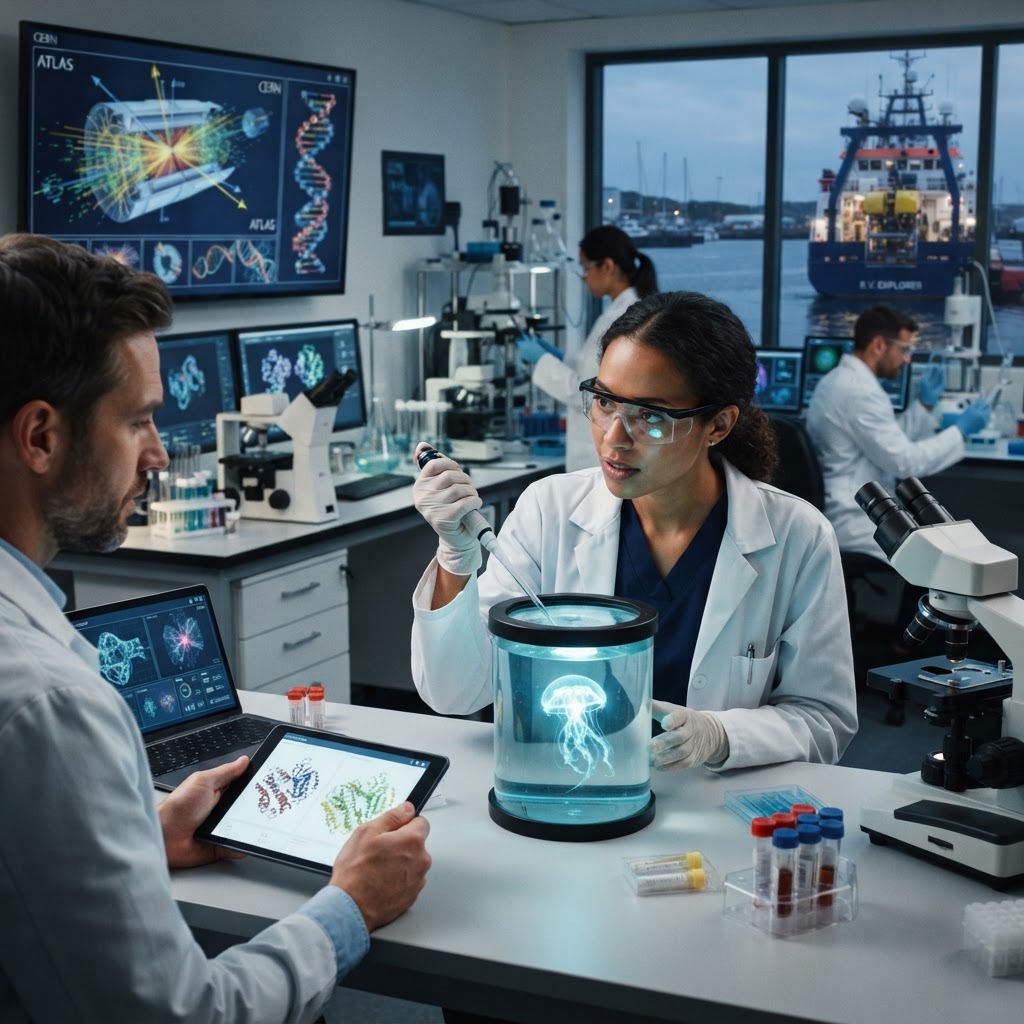
A New Frontier in Condensed Matter Physics
In the relentless pursuit of sustainable computing, a landmark discovery has emerged from material science that could profoundly alter the energy footprint of modern computing. As artificial intelligence architectures continue to strain global electrical grids, researchers at Brown University announced a decisive breakthrough concerning multiferroic materials, reported by ScienceDaily. For years, materials scientists have sought to harness bismuth ferrite to engineer ultra-low-power memory and logic chips. However, when these films are fabricated thin enough to be integrated into microelectronics, they have traditionally suffered from what physicists term the 'dead layer' effect—a complete loss of both electrical and magnetic functional behavior.
By overcoming this barrier, the researchers developed atomic-scale films that not only preserve their vital functional properties at near-angstrom thickness but also demonstrate an exotic form of magnetism known as altermagnetism. Combining the swift switching dynamics of antiferromagnets with the strong readout states characteristic of ferromagnets, this state could enable non-volatile computer chips that operate at vastly higher speeds while drawing a fraction of conventional power. The implications extend far beyond theoretical physics, providing a concrete pathway toward energy-efficient hardware suited for the next generation of artificial intelligence.
Rewriting the Rules of Precision Oncology and Neuroscience
Parallel revolutions are sweeping through biomedical science, where high-resolution cellular mapping and targeted molecular mechanisms are yielding major advances. Recent reports from the University of Texas MD Anderson Cancer Center, highlighted via EurekAlert!, demonstrate significant strides in combating drug resistance and deciphering tumor environments. In lung oncology, the Phase 1b FURTHER trial demonstrated that the targeted compound firmonertinib offered extended progression-free survival in patients presenting uncommon EGFR mutations by matching treatment strategies to structural configurations rather than generic sequence profiles.
Concurrently, cellular profiling has opened new therapeutic vistas. Researchers constructed a fine-scale cellular atlas mapping the microenvironment of ductal carcinoma in situ, illuminating the immunological and stromal markers that dictate whether early-stage lesions remain dormant or evolve into invasive disease. Other teams have isolated critical enzymes, such as METTL13 and regulators of the c-MYC oncogene, that preserve cancer-driving pathways, offering new druggable targets to disable tumor survival strategies. Complementing these clinical developments, as detailed by Nature, an international consortium profiled nearly 26 million brain cells to deliver the first comprehensive atlas of the human basal ganglia. This monumental resource offers neuroscientists an unprecedented blueprint to deconstruct disorders ranging from Parkinson's disease and schizophrenia to severe addiction.
Orbital Engineering and Particle Mysteries
Beyond our terrestrial laboratories, the limits of technology and physics are being systematically expanded into space and the subatomic realm. In low-Earth orbit, robotic manufacturing achieved a pivotal proof-of-concept when engineers demonstrated the autonomous assembly of structural frameworks in space without human astronaut intervention, according to reports in the Scientific Inquirer. Developed under DARPA's NOM4D initiative, the automated system joined composite components into structural trusses, marking a crucial step toward building gigawatt-scale solar collectors, deep-space communication arrays, and massive orbital observatories far too large to launch within existing rocket fairings.
Simultaneously, fundamental physics achieved an exceptional milestone at CERN's Large Hadron Collider. Analyzing LHCb experiment data, researchers detected evidence of an exceptionally rare decay process: a neutral beauty meson transforming into two muons. Predicted to occur merely once in approximately ten billion beauty-quark decays, isolating this faint physical signature required sophisticated machine-learning techniques and instrument upgrades to overcome background noise. While holding at an evidential threshold of 3.2 standard deviations, the measurement reinforces the predictive precision of the Standard Model while tightly constraining hypothetical supersymmetrical particles.
The Deep Sea and Climate Resilience
Back on Earth, environmental scientists are uncovering subtle microbial mechanisms that play outsized roles in stabilizing the planetary climate. Marine biologists and biophysicists from the Scripps Institution of Oceanography, collaborative partners, and international institutions discovered that the physical properties of 'marine snow'—the continuous descent of biological matter and plankton toward the ocean floor—heavily govern carbon sequestration dynamics. Utilizing high-resolution microscopy to observe bacterial interactions, scientists discovered that the structural viscosity and stickiness of sinking organic aggregates dictate microbial colonization rates.
While less viscous material degrades rapidly near the surface, denser, highly viscous aggregates resist bacterial breakdown, transporting more than six times as much organic carbon into abyssal depths. Because these sinking particles lock carbon away from atmospheric exchange for centuries, integrating these physical characteristics into Earth system models will fundamentally improve climate forecasting precision. From the atomic architecture of quantum chips to the global biogeochemical cycles of our oceans, contemporary science is steadily transforming our mastery over matter, biology, and the natural world.
Recommended for you
Similar to “Science”
Frontiers of Discovery: Breakthroughs in Quantum Materials, Deep Ocean Heat, and Precision Oncology
Recent advances across physics, climate oceanography, and oncology highlight how atomic-scale manipulations, deep-sea tracking, and molecular genetic discoveries are reshaping modern science.
Quantum Frontiers and Biohybrid Horizons: How Cross-Disciplinary Breakthroughs Are Reshaping Modern Science
Recent discoveries spanning quantum physics, biological computing, and deep-earth geophysics are challenging longstanding assumptions and accelerating technological integration across scientific fields.
Frontiers of Discovery: How Recent Breakthroughs in Physics, Medicine, and Computing Are Redefining Modern Science
From detecting extreme-energy cosmic ghost particles to unlocking backward bacterial defenses and brain-inspired electronics, a surge of recent discoveries is transforming our understanding of the universe and human biology.