Frontiers of Discovery: Breakthroughs in Quantum Materials, Deep Ocean Heat, and Precision Oncology
Recent advances across physics, climate oceanography, and oncology highlight how atomic-scale manipulations, deep-sea tracking, and molecular genetic discoveries are reshaping modern science.
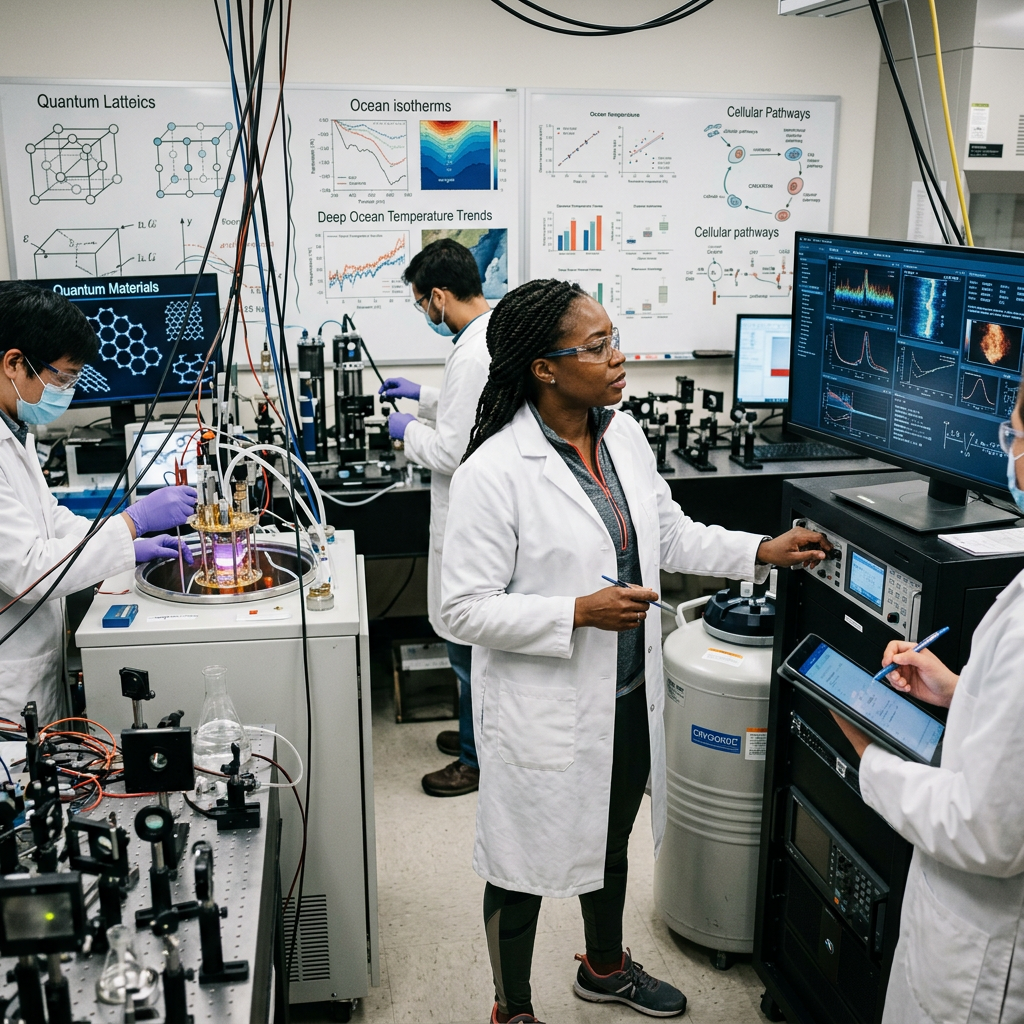
Unlocking Next-Generation Energy-Efficient Computing
In the realm of materials science and microelectronics, finding sustainable solutions to satisfy the computing requirements of artificial intelligence has become paramount. Recent investigations conducted by researchers at Brown University report a long-sought solution to the persistent 'dead layer' effect in multiferroic materials, as highlighted in reporting by ScienceDaily. Traditionally, when promising multiferroic candidates like bismuth ferrite are thinned down to just a few nanometers or angstroms for device integration, they lose their functional magnetic and ferroelectric properties.
By fundamentally modifying the atomic interface, the researchers managed to retain the compound's intrinsic functional behavior at nearly atomic dimensions. Crucially, the engineered thin films revealed an emergent altermagnetic state—a magnetic phase that combines the fast dynamics and negligible stray fields of antiferromagnets with the functional read-out capabilities of ferromagnets. This opens a promising pathway toward non-volatile, ultra-low-power microchips that could curb the massive power footprint of high-performance artificial intelligence accelerators.
Mapping the Hidden Heat of the Subsurface Oceans
While ocean surface anomalies have historically drawn widespread attention from climate scientists, the deeper thermal layers of the ocean often harbor hidden environmental crises. According to a landmark global study published in npj Climate and Atmospheric Science, researchers utilized a four-dimensional tracking framework across ocean temperature reanalysis datasets from 1993 to 2020 to reveal the architecture of subsurface marine heatwaves (MHWs). The analysis tracked more than 500 large-scale events occurring in the upper 1,000 meters of the ocean between 60°N and 60°S.
The findings demonstrate that thermal anomalies often penetrate several hundreds of meters beneath the water's surface, decoupled from surface conditions. Significant regional phenomena, including the northeast Pacific 'Blob' and the Ningaloo Niño off Western Australia, maintained deep vertical expressions far outside their surface boundaries. By classifying recurring vertical structural profiles, the researchers linked five major heatwave varieties directly to phases of the El Niño–Southern Oscillation (ENSO), emphasizing that vertical ocean stratification can trap extreme warming for months or years, with severe implications for benthic habitats and marine biodiversity.
Molecular Vulnerabilities in Tumor Repair Mechanisms
Simultaneously, the biological sciences are witnessing major advances in unraveling the genetic and enzymatic lifelines that allow diseased cells to survive. Scientists at Memorial Sloan Kettering Cancer Center (MSK) unveiled critical insights into how tumors lacking the BRCA2 gene manage to stay viable, as published in their MSK Research Highlights. While BRCA2 deficiencies undermine classic homologous recombination repair—leading to the dangerous accumulation of single-stranded DNA gaps—cancers harboring these mutations frequently persist and resist standard interventions.
The study demonstrated that BRCA2-deficient tumor cells rely heavily on the 9-1-1 protein complex (comprising RAD9A, RAD1, and HUS1) as an essential survival mechanism. The 9-1-1 assembly performs a dual role: it prevents the exonuclease EXO1 from enlarging DNA gaps into catastrophic double-strand breaks, and it recruits the specialized repair polymerase POL-zeta to seal the lesions. Inhibiting the 9-1-1 complex or disrupting its interaction with POL-zeta caused the DNA gaps in BRCA2-mutant cells to become unmanageable, leading directly to selective cell death. Because this dependency is not observed in BRCA1-deficient cells, the finding offers a precision target for therapeutic interventions designed to eradicate BRCA2-mutant tumors while sparing healthy tissue.
Expanding the Frontiers of Model Organisms and Deep Time
Beyond human clinical research, basic biology and evolutionary paleontology are benefiting from expansive new datasets. At the Clemson Institute for Human Genetics, scientists expanded the Drosophila Genetic Reference Panel to over a thousand sequenced lines, encompassing roughly 8.76 million genetic variants, according to Clemson News. This high-resolution platform equips the global scientific community to dissect the complex polygenic architecture of age-related diseases, metabolic conditions, and variable drug responses.
Parallel developments in evolutionary biology and geoscience—from identifying how ancient flora deploy metabolic thermogenesis to attract beetle pollinators, to discovering 3.95-billion-year-old trondhjemitic gneisses that point toward early transient plate subduction—reinforce that scientific progress is advancing concurrently across multiple scales. By bridging the micro-mechanics of quantum materials with global climate dynamics and deep evolutionary histories, researchers continue to expand our comprehension of the physical and biological world.
Recommended for you
Similar to “Science”
Frontiers of Discovery: How Recent Breakthroughs in Physics, Medicine, and Deep-Sea Biology Are Reshaping Science
From microchip-transforming magnetic physics and orbital construction to breakthroughs in cancer genomics and ocean carbon capture, recent discoveries highlight an accelerating era of cross-disciplinary innovation.
Frontiers of Discovery: Recent Breakthroughs Reshaping Medicine, Molecular Biology, and Quantum Physics
Recent major developments across global laboratories highlight extraordinary momentum in modern research, ranging from optical control of cellular mechanisms and gut microbiome discoveries to unprecedented leaps in quantum hardware and preventative medicine.
Frontiers of Discovery: How Recent Breakthroughs in Cellular Mapping, Synthetic Biology, and Materials Science Are Reshaping Modern Science
Recent advances across molecular biology, condensed-matter physics, and biomedical engineering are unlocking long-standing puzzles about how cells communicate, how aging operates, and how adaptive materials can heal themselves.