Global Growth Shows Surprising Resilience as Inflationary Energy Shocks Cloud the Monetary Path
Recent economic indicators reveal persistent momentum across worldwide manufacturing and services, though renewed energy cost spikes and sticky inflation continue to complicate central bank trajectories.

A Complex Balance of Expansion and Vulnerability
The international economic stage is currently navigating a period of sharp contradictions. Fresh business activity barometers and macroeconomic benchmarks released across major regions suggest an economy displaying remarkable durability. Yet, beneath the headline expansion, surging energy costs, persistent underlying inflation, and fiscal strains are testing the durability of this momentum.
According to comprehensive monthly surveys from S&P Global, global purchasing managers' indexes reached their joint-highest levels since 2021. The upturn has demonstrated surprising breadth, with expansion broadening across both the service economy and factory output. Manufacturing sectors, in particular, showed their sharpest rebound in years, reflecting broad-based production gains after an extended period of uneven performance. While official revisions have often painted a muted portrait of middle-year growth, high-frequency survey data suggest that real-world output has picked up steam across nearly all major tracking categories.
The Dual Pressures Facing the United States
In the United States, economic readings have sent distinctly mixed signals, leaving policy analysts and financial markets attempting to decipher conflicting tea leaves. As reported by Deloitte Insights, observers are closely monitoring volatile labor market benchmarks after surprising softness in recent employment data, which temporarily intensified expectations for monetary loosening.
However, that cooling narrative contrasts with sustained private-sector output. The flash composite PMI data highlighted by Econ Data Tools slipped slightly to 57.6 from 58.4, yet remains well above the neutral threshold of 50, signifying robust continuing activity. Simultaneously, the pace of selling-price growth accelerated at one of its fastest rates in recent history. Complementing this, The Conference Board's Leading Economic Index (LEI) held steady in its latest release, halting previous sequences of declines and pointing toward near-term stability rather than imminent contraction. These conflicting dynamics—solid top-line business demand paired with stubborn cost pressures—limit the latitude of central bankers seeking to ease policy without reigniting price spirals.
Renewed Price Pressures from the Energy Complex
A central driver of fresh macroeconomic apprehension is the resurgence of price pressures fueled by international commodities. Global supply chain metrics indicate lengthened supplier delivery times, with transportation and travel-intensive segments absorbing sharp cost increases. As documented by S&P Global's inflation tracking, energy price rebounds have pushed corporate input costs higher across developed economies, notably across continental Europe, while emerging markets present a diverging picture with localized variations ranging from elevated inflation in Latin America to mild deflationary pockets in parts of East Asia.
Forecast updates detailed in S&P Global Market Intelligence's October Outlook note that near-term baseline projections for crude benchmarks have been elevated, with Brent prices approaching high thresholds due to geopolitical headwinds and tighter supply balances. This upward drift in petroleum prices directly risks feeding back into core service costs, frustrating efforts by monetary authorities to bring headline rates definitively back toward their target ranges.
Testing the Limits of Global Resilience
The institutional consensus remains cautiously watchful. Multilateral organizations such as the International Monetary Fund, as outlined by The Guardian and official IMF analysis, have acknowledged that international markets weathered recent geopolitical turbulence far better than worst-case projections suggested. Nevertheless, policy advisers caution that this fortitude cannot be taken for granted indefinitely.
With sovereign and private debt stockpiles reaching record highs and interest servicing expenditures consuming an expanding share of public budgets, fiscal flexibility across developed and developing nations has narrowed considerably. At the same time, strategic reserves have dropped to multi-decade lows in key economies, leaving reduced buffers against unforeseen disruptions. As central banks and finance ministries look toward upcoming policy decisions, the central challenge will be maintaining steady investment and employment while preventing an entrenched second wave of cost-push inflation from derailing broader economic stability.
Recommended for you
Similar to “Global Economy”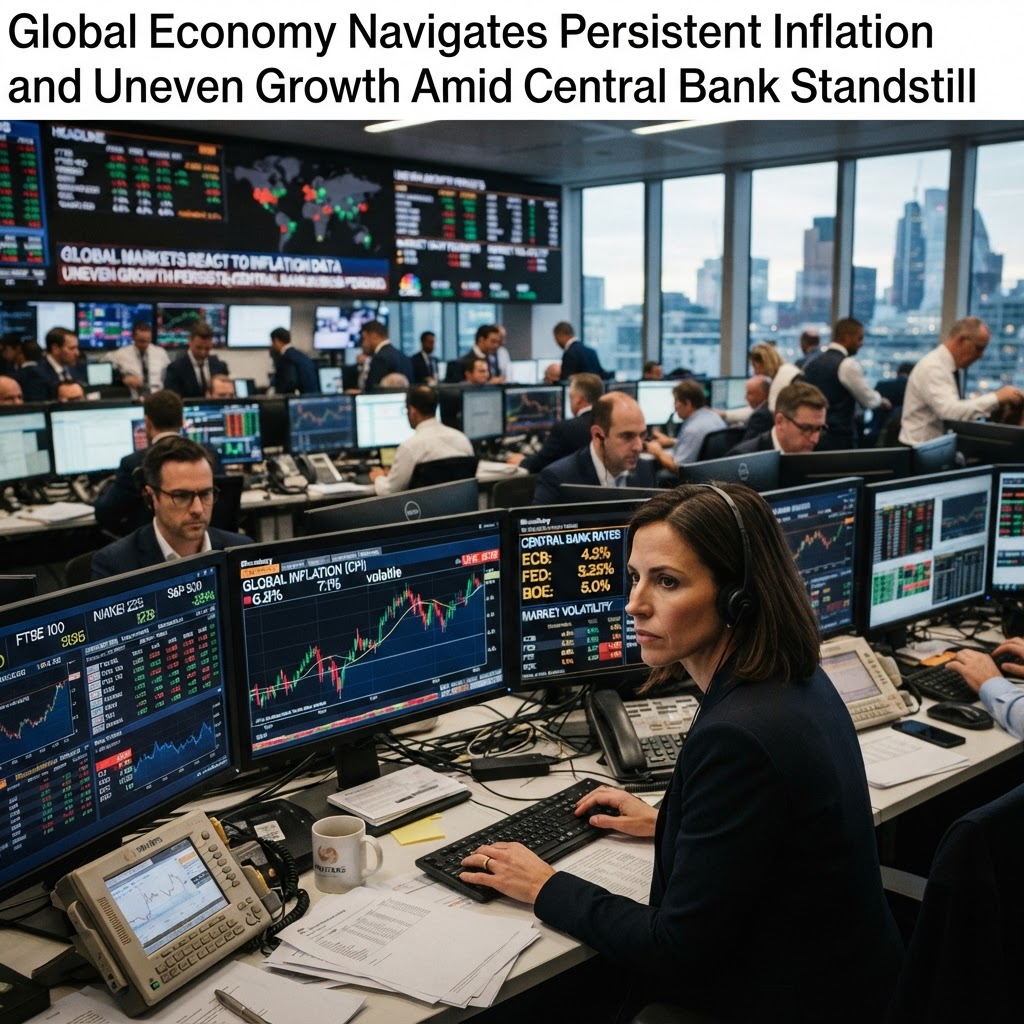
Global Economy Navigates Persistent Inflation and Uneven Growth Amid Central Bank Standstill
Recent economic indicators reveal sustained worldwide business momentum alongside stubborn price pressures, compelling major central banks toward a hawkish pause while commodity tensions cast a shadow over future expansion.

Sticky Inflation and Surging Bond Yields Confront the Global Economic Expansion
Central banks face renewed policy dilemmas as resilient job numbers, persistent commodity shocks, and massive artificial intelligence capital expenditures combine to push bond yields upward and complicate the inflation outlook.

Global Economy Navigates AI Boom, Persistent Inflation, and Energy Shocks
Surging capital investment in artificial intelligence and resilient labor markets are propelling global activity, even as volatile energy markets and sticky services inflation constrain central bank policy.