Shattering Old Paradigms: From Flawed Superconductors to Mechanical Immune Cells
Recent findings across physics, cellular biology, and ancient anthropology are challenging long-standing dogmas about material stability, cellular function, and human migration.
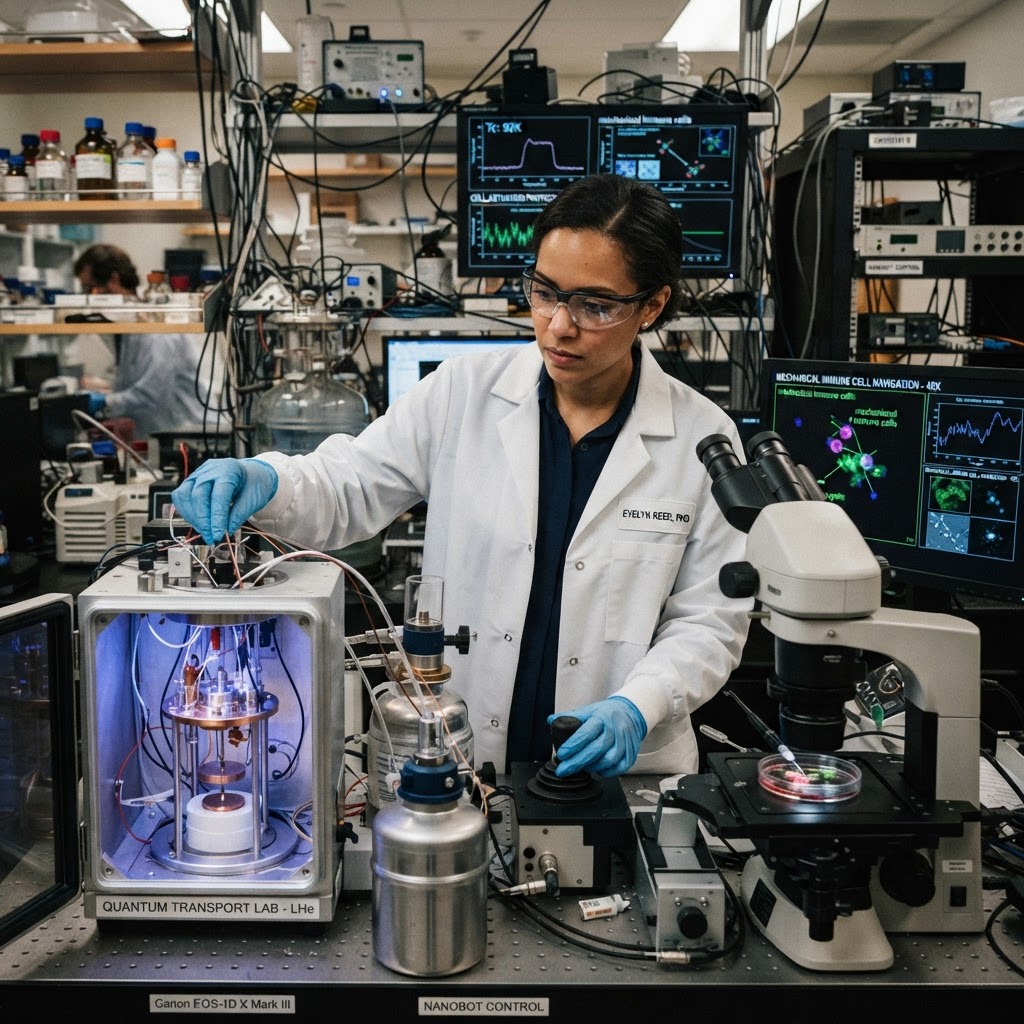
Challenging Four Decades of Condensed Matter Physics
In condensed matter physics, standard theoretical frameworks rarely face sudden revisions. Yet research led by the University of Warwick has revealed that a widely studied superconducting material possesses an intricate, previously hidden internal flaw. For roughly forty years, scientists operated under the working assumption that these high-temperature superconductor crystals remained uniform throughout their structure. Utilizing advanced three-dimensional imaging techniques, investigators discovered a patchwork of crystal variants characterized by unusually broad structural boundaries.
These boundary zones are far from negligible anomalies; they are expansive enough to alter the electrical properties of the material and weaken the overall superconducting state. The revelation offers a long-sought explanation for why seemingly identical batches of superconductors exhibit vast discrepancies in performance. The findings reported by ScienceDaily suggest that similar structural variations may be widespread among other cuprate superconductors, prompting researchers worldwide to recalibrate fundamental models that have governed the field since the late twentieth century.
The Mechanobiology of Immune Memory
Parallel shifts in perspective are sweeping through immunology. Biologists at McGill University have uncovered an unexpected property of T cells that alters current models of adaptive immunity. While immune cells have traditionally been characterized almost entirely through chemical interactions—such as binding antigens or responding to cytokine gradients—the McGill team demonstrated that T cells actively gauge the physical rigidity of their microenvironment.
By sensing the mechanical stiffness of neighboring tissues, T cells interpret physical cues that directly influence their persistence and transformation into long-term memory cells. This discovery bridges mechanical biology and systemic defense, indicating that the physical architecture of inflamed or scarred tissue dictates immunological response just as significantly as chemical signaling. Researchers believe this finding could lead to refined designs for cellular immunotherapies, where the physical delivery substrate might be optimized to enhance therapeutic durability.
Rewriting Early Human Migration
Significant updates are also emerging from paleoanthropology. Recent fossil and lithic excavations in the Jordan Valley demonstrate that early hominins established presences in the region at least 1.9 million years ago. This dating pushes back previous timelines for hominin migration out of Africa by hundreds of thousands of years, as reported in ScienceDaily's recent news roundup.
The extended chronology implies that early members of the genus Homo adapted to varied climates and ecological corridors far earlier than previously believed. Rather than relying on advanced stone technology developed later in the Pleistocene, these hominins demonstrated behavioral flexibility and survival strategies that enabled intercontinental dispersal well ahead of traditional timelines.
Clinical Trade-offs and the Complexities of Aging
The biological sciences are also grappling with complex trade-offs in modern pharmacology. Studies examining Janus kinase (JAK) inhibitors—widely prescribed to manage rheumatoid arthritis and related autoimmune disorders—have uncovered an unintended immunological vulnerability. By shutting down key inflammatory pathways, these treatments can inadvertently impede natural cellular defenses that restrict viral replication, facilitating systemic viral spread during acute infections.
Concurrently, research into senescence and longevity is advancing rapidly. Teams investigating so-called zombie cells—senescent cells that halt division yet secrete inflammatory factors—have discovered new molecular targets to slow tissue degradation. Coupled with emerging insights linking specific gut microbiome populations to biological age, science is gradually moving past generic anti-aging hypotheses toward targeted interventions that integrate mechanical, chemical, and microbial systems.
Recommended for you
Similar to “Science”
Frontiers of Discovery: How Recent Breakthroughs in Cellular Mapping, Synthetic Biology, and Materials Science Are Reshaping Modern Science
Recent advances across molecular biology, condensed-matter physics, and biomedical engineering are unlocking long-standing puzzles about how cells communicate, how aging operates, and how adaptive materials can heal themselves.
Frontiers of Precision: How New Breakthroughs in Physics, Immunology, and Plant Biology Are Reshaping Science
Recent advances across disciplines—from antimatter trapping and cellular stress mechanisms to human-challenge immunology—are delivering granular answers to long-standing scientific puzzles.

Frontiers of Discovery: Recent Breakthroughs Reshaping Physics, Genetics, and Earth Science
From unexpected magnetic control at the atomic scale to massive genetic catalogs and deep ocean thermal shifts, recent findings are actively challenging long-held scientific paradigms.