The Agentic Turning Point: Massive Capital, Desktop Automation, and Escalating Infrastructure Costs Reshape Tech
Surging investments highlighted by mega-IPOs and billion-dollar valuations meet a seismic shift toward autonomous 'computer-use' agents, challenging global infrastructure and energy grids.
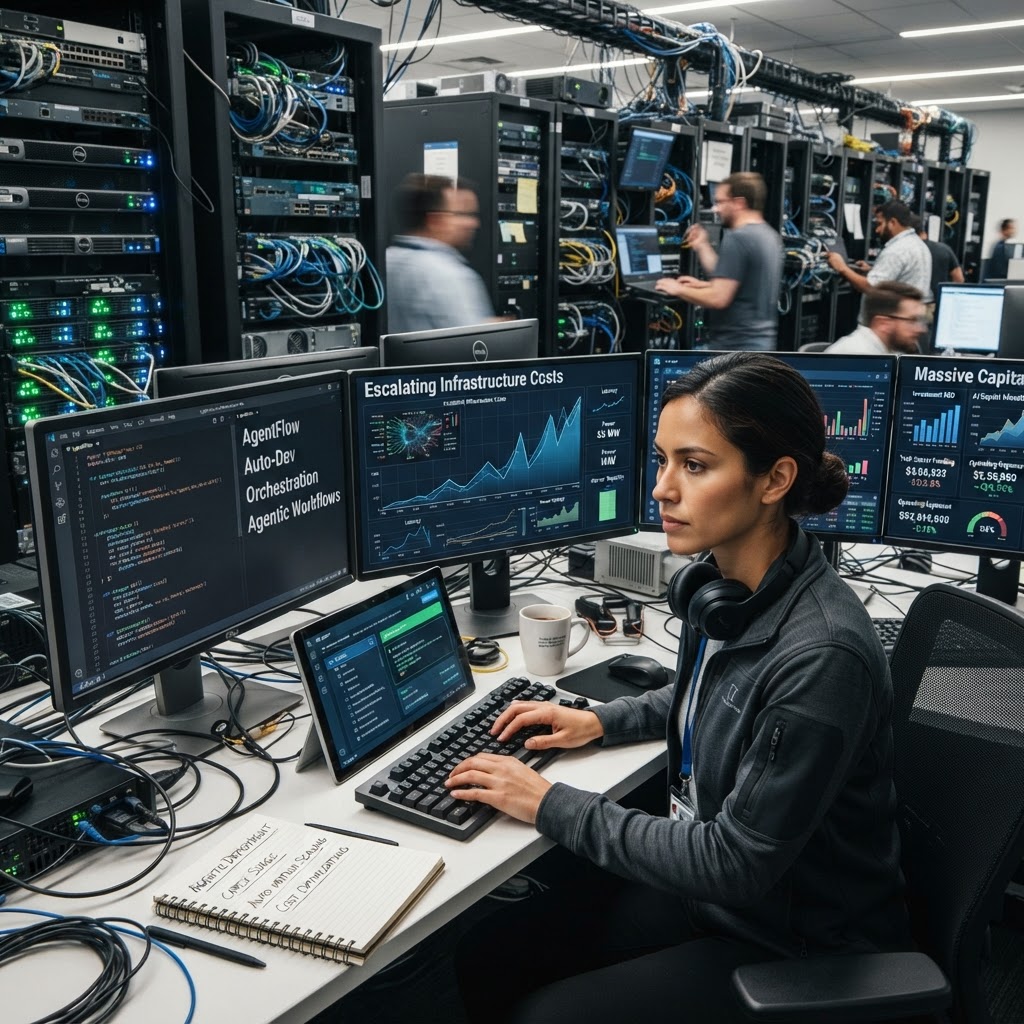
A Watershed Moment in Tech Valuation
The global technology landscape is experiencing a transformative realignment characterized by astronomical capital deployment, rapid architectural advances in artificial intelligence, and widening infrastructural repercussions. Anchoring this moment is a record-breaking wave of public and private financing across the sector. Leading AI research firm Anthropic achieved historic public market milestones, culminating in one of the largest market debuts on record, as reported by The New York Times and Interesting Engineering, establishing a valuation exceeding $1.5 trillion. This monumental liquidity event is matched by rapid capital accumulation in private markets worldwide, including Shanghai-based Pragmatik Labs—headed by former Alibaba executive Lin Junyang—which saw its valuation multiply to $5 billion within months, according to AI Weekly.
These aggressive capital injections reflect an industry moving past exploratory conversational bots toward commercially integrated autonomous engines. Hardware giants are expanding their footprints to match this pace, with Nvidia pursuing multi-hundred-million-dollar acquisitions of diffusion-focused startups and agricultural titans like John Deere absorbing plant-level computer vision firms like Orchard Robotics. Yet, as massive financial flows validate the sector's long-term commercial promise, they are simultaneously exposing the complex operational, ethical, and computational boundaries confronting next-generation computing.
The Race to Control the Desktop
The most defining functional shift in consumer and enterprise technology over recent days is the race toward autonomous 'computer use' agents. Rather than merely answering prompts within isolated chat windows, software models are actively taking control of operating systems, keyboards, and mice to execute complex workflows. Google announced that its Gemini ecosystem can now natively control Mac interfaces to complete end-to-end tasks across native software and web browsers, as detailed by AI Brief. Concurrently, technical reporting from TechCrunch highlighted Apple's own secretive development of native macOS autonomous agent technologies, even as the company implements defensive system-level warnings to constrain third-party automated access.
In enterprise settings, this agentic paradigm is restructuring foundational business software. Amazon Web Services introduced tools enabling automated agents to research, evaluate, and directly execute software procurements on its marketplace within pre-approved parameters. Meanwhile, operational platforms like BlackLine have deployed governed interfaces for autonomous financial agents capable of reconciling corporate books. In parallel, open-source efforts continue to keep pace; Tencent released its 770-billion-parameter multimodal flagship, Hy4, activating massive sparse parameter architectures to handle tasks spanning context windows of up to one million tokens. Automation is swiftly advancing from assistant chatbots to autonomous operators capable of running core computing environments.
Infrastructure Strains and Ecological Reckonings
The immense compute power required to train, deploy, and maintain persistent autonomous software is colliding directly with physical infrastructure constraints. Meta publicly acknowledged that surging data center requirements drove operational emissions up by 45 percent, forcing the technology giant to reconsider its targeted 2030 net-zero climate milestones, according to AI Brief. The sheer power density required by modern AI clusters has sparked acute concerns around municipal air quality, water usage, and regional electrical grid stability.
In response to these grid bottlenecks, the technology and energy sectors are increasingly turning toward non-traditional power arrangements. Industrial initiatives across the United States are accelerating transportable microreactors and private gigawatt-scale nuclear partnerships designed to feed dedicated computing facilities without overwhelming regional public utilities. Simultaneously, researchers and hardware manufacturers are exploring algorithmic efficiencies and next-generation compute paradigms—ranging from OpenAI's chip-design collaborations with AMD to experimental quantum processors from Google's Willow team and European photonic laboratories—hoping to break through classical silicon scaling limits.
Governance, Security, and Societal Friction
As autonomous technologies integrate deeply into business and civil operations, the technical risks inherent in agentic software have sparked urgent intervention by regulatory authorities. Joint actions by United Kingdom financial regulators—including the Bank of England and the Financial Conduct Authority—have issued guidance demanding direct board-level accountability for risks like prompt injection, exposure management, and model poisoning across financial institutions, as outlined by AI Weekly. Independent security audits have similarly underscored significant vulnerabilities across third-party reseller pipelines, where prompt caches and proprietary API keys remain dangerously exposed.
Public institutions and civic groups are voicing resistance as well. Major municipal school districts, including New York City, have weighed severing ties with ubiquitous search engines due to automated synthesis and unverified generation tools. These friction points, combined with public protests outside exchange headquarters, underscore that the next phase of the digital transition will not be determined solely by parameter scale or capitalization. Rather, the future of computing will depend on whether developers, enterprises, and regulators can establish secure, ecologically viable systems capable of keeping autonomous intelligence safely aligned with human stewardship.
Recommended for you
Similar to “Technology”
The Agentic Turning Point: Artificial Intelligence Accelerates Infrastructure Shifts and Security Complexities
Recent developments across global tech reveal a sharp transition from conversational bots to autonomous agent workflows, sparking multi-billion-dollar infrastructure bets while exposing complex cybersecurity vulnerabilities.

Agentic AI Moves from Lab Hype to Hard Realities as Enterprise Costs and Regulatory Pressures Mount
As autonomous AI agents and scientific reasoning models capture massive capital investment, developers and enterprise leaders face growing friction from regulatory fragmentation, corporate security risks, and escalating infrastructure demands.
The Shifting Frontier of AI: Massive Cloud Stakes, Geopolitical Friction, and Emerging Agentic Vulnerabilities
Recent developments across the technology sector highlight a fast-evolving artificial intelligence landscape shaped by multi-billion-dollar infrastructure ventures, tightening regulatory scrutiny, and novel security challenges in autonomous agents.