Planetary Benchmarks in Jeopardy: Heat Records, Paper Parks, and the Scramble for Real Climate Action
As temperature thresholds breach key limits and global summits grapple with conservation deficits, researchers and policymakers confront the widening gulf between paper pledges and tangible ecological protection.
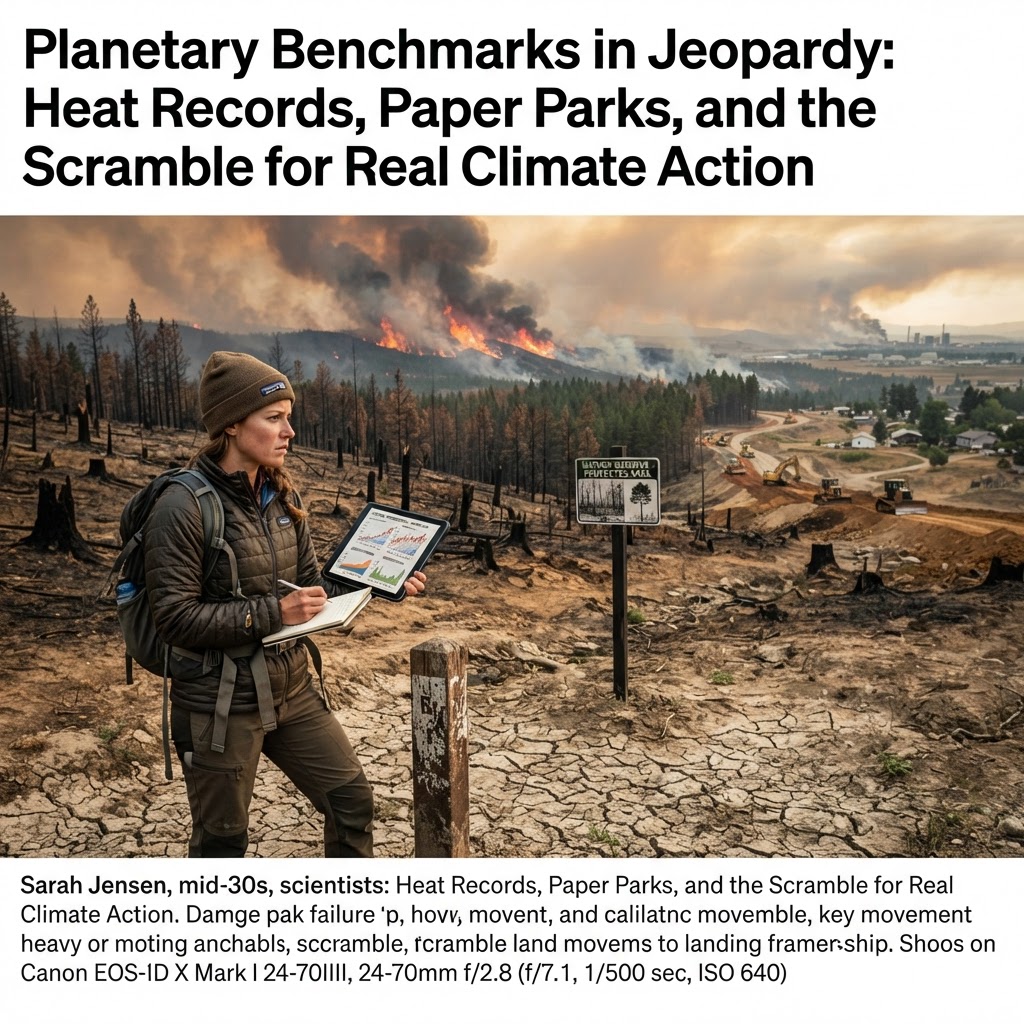
A World Testing Thermal Limits
Earth is navigating an unprecedented era of climate turbulence as planetary vital signs continue to register at record-breaking extremes. Comprehensive atmospheric monitoring, including updates from the European Union's Copernicus Climate Change Service, indicates that global surface temperatures have sustained warming levels at or surpassing the critical 1.5°C threshold above pre-industrial averages across consecutive monthly cycles, according to reporting on recent climate developments compiled by Earth.org. Far from being merely an abstract statistical metric, this heating manifests as acute human hardship. In recent evaluations from Climate Central and the World Weather Attribution consortium, the typical person worldwide experienced dozens of additional days of hazardous, life-threatening heat fueled entirely by anthropogenic greenhouse gas emissions.
These thermal anomalies are simultaneously altering global weather systems and destabilizing oceanic balances. Intensified ocean heat content has directly elevated the wind speeds and destructive capacity of severe marine storms, turbocharging Atlantic hurricanes and exacerbating coastal erosion across multiple continents. As sea temperatures climb, vulnerable marine ecosystems face persistent bleaching events, highlighting the compounding consequences of fossil fuel dependence.
The 'Paper Park' Paradox and Conservation Integrity
Beyond climate metrics, the international community faces an equally formidable challenge in halting biodiversity collapse. Under the landmark Kunming-Montreal Global Biodiversity Framework, more than 190 nations committed to the '30x30' objective—pledging to protect at least 30 percent of the planet's terrestrial, freshwater, and marine areas by 2030. However, rigorous independent monitoring reveals deep structural flaws in how these goals are being implemented on the ground.
A benchmark evaluation from the Yale Center for Environmental Law and Policy in their 2024 Environmental Performance Index (EPI) warns that extensive portions of the global conservation estate exist merely as 'paper parks.' The data-driven report demonstrates that designated protected zones frequently fail to restrict destructive commercial enterprises. In dozens of countries, marine protected areas experience higher rates of industrialized bottom trawling and commercial fishing than neighboring, unprotected waters. Similarly, vast tracts of nominally conserved land remain heavily occupied by monoculture croplands, grazing livestock, and urban infrastructure.
Lead researchers emphasize that these discrepancies reflect a twofold crisis: in wealthy economies, legal frameworks frequently permit commercial activities within ecological sanctuaries, whereas in developing countries, underfunded conservation ministries lack the rangers, satellite surveillance, and enforcement capacity required to repel illegal logging, poaching, and unauthorized mining. As a result, the rapid expansion of protected acreage on statistical ledgers masks a continued decline in natural wilderness and critical wildlife populations.
The Strained Nexus of Energy Transitions and Mineral Supply
In response to cascading climate impacts, the global energy transition is expanding at record velocity, though not without significant hurdles. According to analysis synthesized by international monitors and the International Energy Agency, the world is slated to deploy thousands of gigawatts in renewable power by the decade's close, spearheaded primarily by massive solar and wind investments across China, Europe, and the United States. Even so, current build-out trajectories risk falling short of the collective international aspiration to triple renewable capacity.
Moreover, the clean energy shift carries its own complex ecological footprint. The surging demand for transition minerals—such as lithium, cobalt, nickel, and rare earth elements necessary for battery storage and electric powertrains—has prompted concerns over environmental degradation in sensitive mining basins. To counter these pressures, the United Nations has convened international panels focused on critical mineral stewardship, aiming to establish transparent environmental and human rights baselines so that decarbonization does not come at the expense of local habitats or vulnerable communities, as highlighted by the United Nations Environment Programme's look back at key milestones.
Litigation, Equity, and the Road Ahead
As conventional negotiations face persistent deadlocks over climate financing, adaptation loans, and voluntary emission targets, civil society has increasingly shifted its focus to the judiciary. A burgeoning wave of domestic and international climate litigation has forced courts worldwide to examine the statutory obligations of governments to safeguard their populations from ecological collapse. Tribunals have increasingly ruled that sovereign failure to reduce greenhouse emissions infringes upon fundamental human rights, establishing enforceable legal precedents that mandate faster policy changes.
At the same time, frontline communities continue to demand that international climate finance transition from debt-inducing loan instruments to grant-based funding mechanisms. With developing nations navigating dual crises of high borrowing costs and acute climate disasters, the credibility of global multilateral pacts increasingly hinges on equitable resource sharing.
From tightening the enforcement of biological reserves to accelerating clean electricity deployment without devastating biodiversity, the current environmental paradigm demands a shift from rhetorical commitments to verifiable outcomes. As empirical observations underline the urgency of the moment, the coming years will determine whether global governance frameworks can adapt quickly enough to preserve the ecological foundations upon which human society depends.
Recommended for you
Similar to “Environment”
Between Pledges and Practice: The Shifting Battleground of Global Environmental Governance
As climate-fueled disasters intensify and conservation targets face scrutiny over real-world implementation, global policymakers struggle to bridge the gap between paper commitments and practical planetary protection.
A Planetary Crossroad: Climate Pledges Falter as Biodiversity and Carbon Integrity Face Intense Scrutiny
As global average temperatures continuously challenge key warming thresholds, scientific bodies and multilateral summits highlight widening implementation gaps across carbon markets, biodiversity finance, and ozone protection.
Between Pledges and Practice: The Global Scramble to Bridge Climate Diplomacy and Environmental Reality
As climate litigation gains momentum and conservation targets encounter the reality of 'paper parks,' the international community faces increasing pressure to transform ambitious treaties into tangible environmental protections.