Frontiers of Matter and Mind: Recent Breakdowns in the Barriers of Physics, Biology, and Computation
Recent breakthroughs spanning laser microscopy, quantum surface engineering, and biohybrid intelligence highlight how precision technologies are transforming modern science.
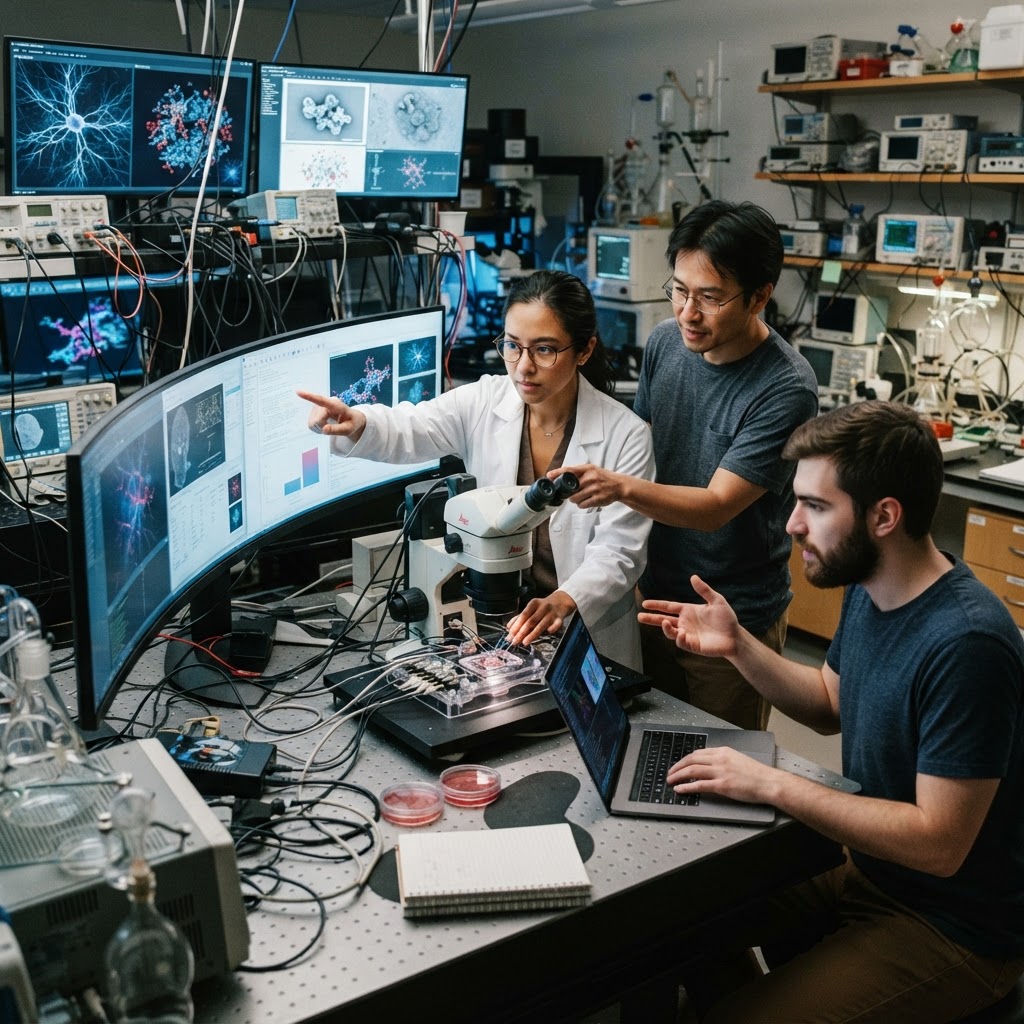
The Convergence of Modern Scientific Inquiry
In recent days, the scientific landscape has experienced rapid advancements across multiple disciplines, from nanoscale physical engineering to deep-time geophysics and biological computing. A series of landmark findings reported across leading journals and scientific platforms shows how researchers are deploying ever-more sophisticated instrumentation to observe phenomena previously hidden beneath limits of scale, time, and resolution.
Revealing Cellular Architecture with Laser Microscopy
A central challenge in structural biology has been the inability to visualize nanoscale biochemical assembly in real time without damaging living specimens. In newly published work, investigators have unveiled a revolutionary laser-based microscopy technique capable of illuminating cellular machinery previously lost in background noise. According to reports from ScienceDaily Health News, this platform provides unprecedented optical resolution, allowing researchers to watch the step-by-step self-assembly of virus-like particles. Rather than relying solely on deterministic blueprints, these nanoscale structures emerge through an intricate, trial-and-error molecular dance that produces near-perfect symmetrical architectures.
Quantum Control and Two-Dimensional Architectures
Parallel advances in physics have dramatically expanded our control over atomic and molecular states. As highlighted in ScienceDaily Top Science News, experimental physicists have engineered an ultra-clean substrate where individual molecules can preserve their fragile quantum states at fundamental theoretical limits. This stability is critical for the development of quantum sensing devices and scalable molecular logic circuits. Complementing this, research highlighted by Rice University demonstrates that laser light can directly manipulate atoms within asymmetric two-dimensional Janus transition metal dichalcogenides, paving the way for low-heat, high-speed photonic processors.
Biohybrid Systems: Bridging Neural Tissue and Technology
In neurobiology, the boundary between biological systems and synthetic technology continues to blur. Recent developments in biohybrid engineering, chronicled by Frontiers, showed laboratory-grown mini brain organoids capable of processing tactile sensory patterns, effectively demonstrating an ability to interpret Braille-like inputs. Such milestones signal a shift toward functional living computing units that could illuminate how human cortical tissue processes spatial information while accelerating alternatives to animal testing.
Planetary Dynamics and Deep-Time Earth Science
Beyond the microscopic realm, geoscientists are gaining clarity on long-term planetary evolution. Geophysical surveys beneath Japan’s Kikai caldera, detailed in ScienceDaily, have mapped an actively replenishing magma reservoir thousands of years after one of Earth's most cataclysmic Holocene eruptions. Concurrently, planetary scientists analyzing sample return data from asteroid Bennu have resolved enduring anomalies regarding how primitive carbonaceous boulders shed heat, offering vital parameters for planetary defense and our understanding of early solar system accretion.
Challenges in Modern Research Ecosystems
While experimental methods reach new heights, the scientific infrastructure itself faces growing growing pains. As reported by Nature, major preprint servers like arXiv are navigating an influx of artificial intelligence-assisted submissions, necessitating stricter submission safeguards to ensure reproducibility. At the same time, international initiatives are striving to standardize open-access datasets, ensuring that as laboratory instruments produce petabytes of raw findings, the broader global scientific community can reliably interrogate and verify the next generation of discoveries.
Recommended for you
Similar to “Science”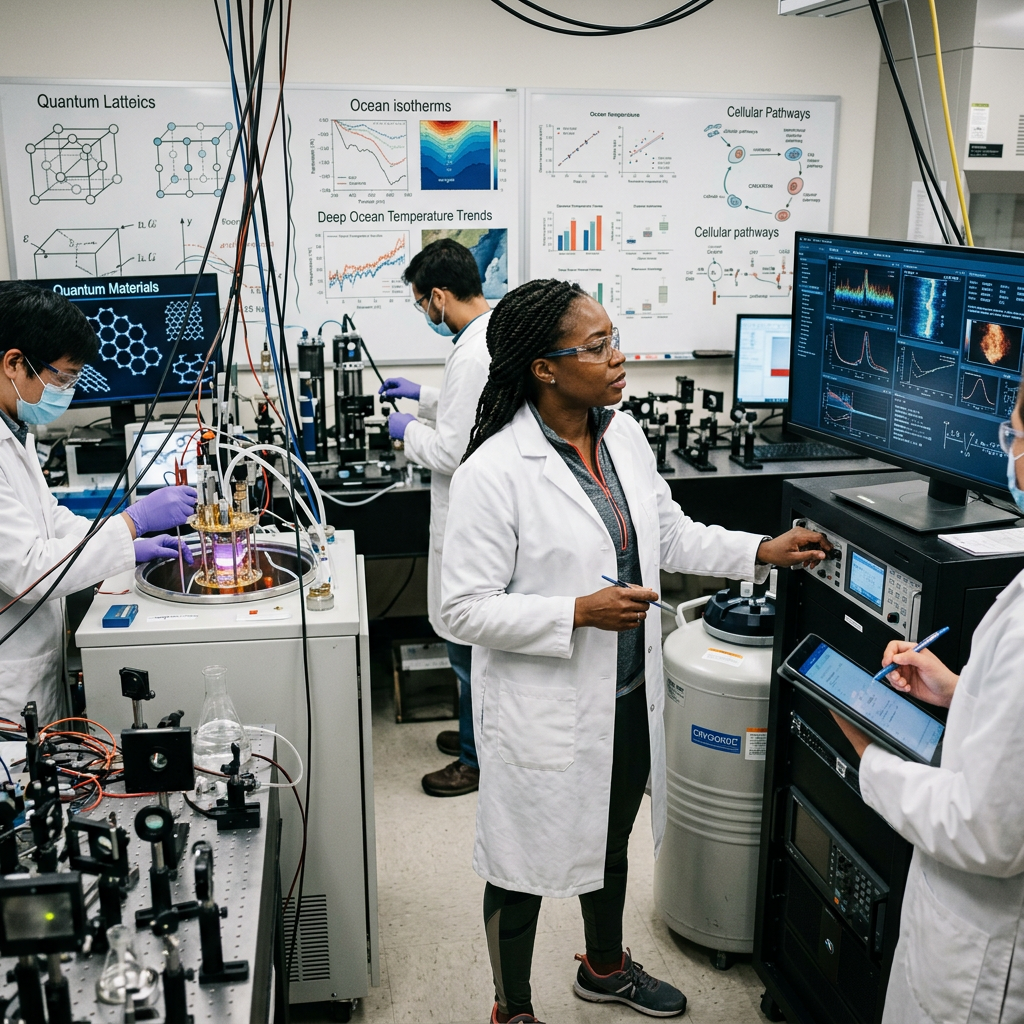
Frontiers of Discovery: Breakthroughs in Quantum Materials, Deep Ocean Heat, and Precision Oncology
Recent advances across physics, climate oceanography, and oncology highlight how atomic-scale manipulations, deep-sea tracking, and molecular genetic discoveries are reshaping modern science.
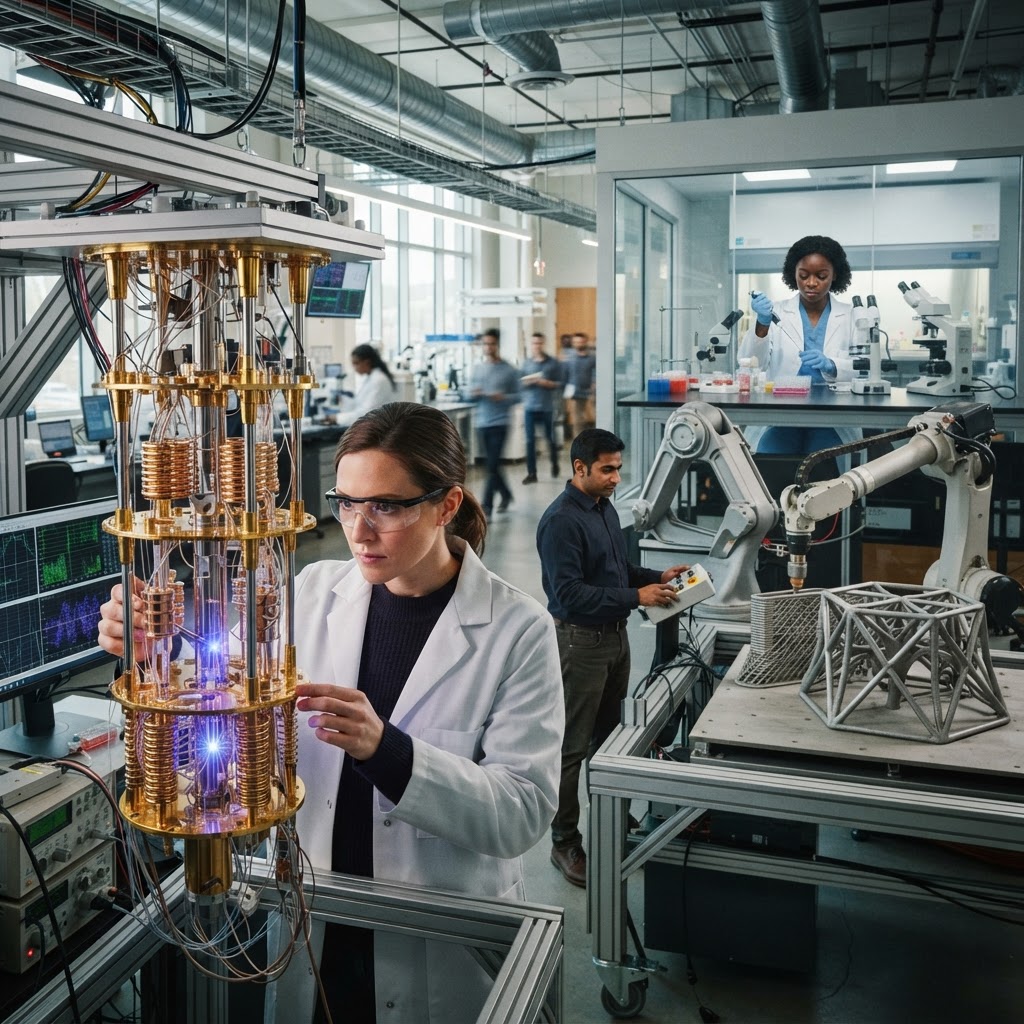
Frontiers of Matter and Mind: Landmark Advances Reshape Quantum Physics, Space Construction, and Biomedicine
Recent breakthroughs spanning room-temperature quantum states, autonomous orbital manufacturing, and targeted neuro-oncology therapies highlight a transformative week in global science.

Quantum Frontiers and Biohybrid Horizons: How Cross-Disciplinary Breakthroughs Are Reshaping Modern Science
Recent discoveries spanning quantum physics, biological computing, and deep-earth geophysics are challenging longstanding assumptions and accelerating technological integration across scientific fields.