Silicon Strains and Model Proofs: Tech Grapples With Infrastructure Backlash and Agentic Realities
As generative artificial intelligence enters an operational expansion phase, technology giants and startups face mounting community friction over data center footprints alongside urgent demands for model accountability and economic efficiency.

The Physical Realities of Frontier Computing
For the past several years, the race toward general-purpose artificial intelligence was largely viewed as an algorithmic competition staged in clean server rooms and Silicon Valley research campuses. Over recent days, however, the industry has encountered an acute reckoning with the physical world. The explosive growth of advanced inference workloads and training clusters is consuming unprecedented amounts of municipal power and water, sparking sharp civic pushback against data center expansion.
In response to escalating local resistance, cloud hyperscalers have been forced to rethink how they negotiate large-scale infrastructure projects. As reported by TechCrunch, Amazon recently committed to ending non-disclosure agreements (NDAs) during municipal data center negotiations, echoing policy changes previously implemented by Microsoft. Historically, tech corporations relied on restrictive NDAs with local zoning boards and utility regulators to quietly secure vast land parcels, water rights, and grid interconnection priority. However, opacity has backfired: hundreds of proposed moratoriums and zoning bans have cropped up from coast to coast as residents balk at soaring regional utility rates and unyielding carbon footprints.
This civil resistance has intensified to the point where capital injections alone no longer clear zoning hurdles. Across municipalities, developers attempting to construct sprawling hyperscale campuses have seen zoning approvals blocked, and local leaders are passing explicit construction pauses to protect baseline grid stability. The industry is finding that deploying hardware is no longer a purely financial calculation, but a complex socio-political campaign.
The Valuation Surge in Inference and Real-World Modeling
Despite infrastructure growing pains, venture capital and enterprise spending continue to pivot vigorously from experimental training phases to deployment infrastructure. While initial hype rewarded the creators of frontier foundational models, the focus has shifted toward high-throughput inference engines and architectures capable of simulating reality.
Demonstrating this shift, generative inference specialist Fal doubled its valuation to $16 billion, buoyed by enterprise demand for real-time model execution, according to recent reporting from TechCrunch. As businesses shift their software portfolios from static conversational interfaces to responsive, low-latency execution, specialized inference providers capable of reducing per-token computing overhead have become prime beneficiaries of enterprise budgets. Chipmakers are equally looking beyond standard language architectures. AMD’s push to integrate physical simulation and spatial understanding architectures into its production pipelines reflects a fierce hardware rivalry with Nvidia, where next-generation chips are tailored to interpret three-dimensional, physical-world constraints rather than merely generating text or synthetic imagery.
Model Attribution, Identity Verification, and Legal Battles
As model outputs permeate daily commerce and communications, authenticating machine identities and resolving intellectual property claims has taken center stage. Leading labs are moving toward verifiable identity systems. TechCrunch reported that Anthropic is developing authentication frameworks designed to prove model provenance and identity cryptographically. In an ecosystem inundated by synthetic replicas, malicious spoofing, and open-source fine-tunes, providing a mathematically verifiable fingerprint for an autonomous agent’s underlying model is quickly becoming a critical prerequisite for regulated enterprise adoption.
At the same time, the legal foundation underpinning web-scale training data continues to erode. Digital media conglomerates and independent publishers have expanded copyright infringement and unfair competition lawsuits across jurisdictions against model developers. According to recent analysis by Press Gazette, publishers are demanding injunctions, algorithmic disgorgement, and substantial financial reparations against artificial intelligence firms that scrape proprietary journalistic catalogs without formal licensing pacts. The bifurcated landscape—where select platforms negotiate lucrative content alliances while others wage protracted copyright litigation—indicates that the era of unfettered, uncompensated training harvesting has permanently closed.
The Rise of Autonomous Agentic Commerce
Beyond content generation, the enterprise frontier is rapidly standardizing around autonomous, agent-driven operations. Companies are migrating away from simple chatbot prompt interfaces toward persistent 'agentic' systems capable of parsing unstructured enterprise data, executing transactions, and orchestrating workflows without direct human oversight.
Recent market developments covered by Korea Newswire illustrate this operational evolution. Partnerships between commercial data giants like NielsenIQ and Google highlight the rapid mobilization toward 'agentic commerce,' fusing real-time inventory intelligence with automated negotiation and purchasing systems. Concurrently, business operating platforms and enterprise resource management providers are unveiling specialized operating layers designed specifically to govern autonomous software workers, reflecting an enterprise software market re-architecting itself around semi-autonomous digital labor.
Corporate Rationalization in a Maturing Cycle
The rush toward automated workflows and heavy infrastructure spending has coincided with internal recalibrations across prominent consumer and software brands. Creative platform Canva recently eliminated over 1,200 positions amid broader market growth normalization, as tracked by TechCrunch. The move underscores that even darling software-as-a-service platforms must discipline operational overhead and redirect capital toward deeper AI integration to defend their market share.
Ultimately, the current technology cycle is shedding its theoretical innocence. The industry is no longer evaluated solely on benchmark demonstrations or aspirational parameter counts. Confronted with civic revolts over power grids, intensifying copyright litigation, and enterprise demands for measurable efficiency, the coming phase of technological progress will be measured by how seamlessly artificial systems can reconcile with municipal realities, legal structures, and balanced balance sheets.
Recommended for you
Similar to “Technology”
Silicon Under Scrutiny: AI Giants Confront Power Realities, Autonomous Agents, and Regulatory Headwinds
As tech conglomerates pour hundreds of billions into artificial intelligence infrastructure and agentic workflows, mounting community pushback over energy consumption and shifting regulatory landscapes are testing market exuberance.
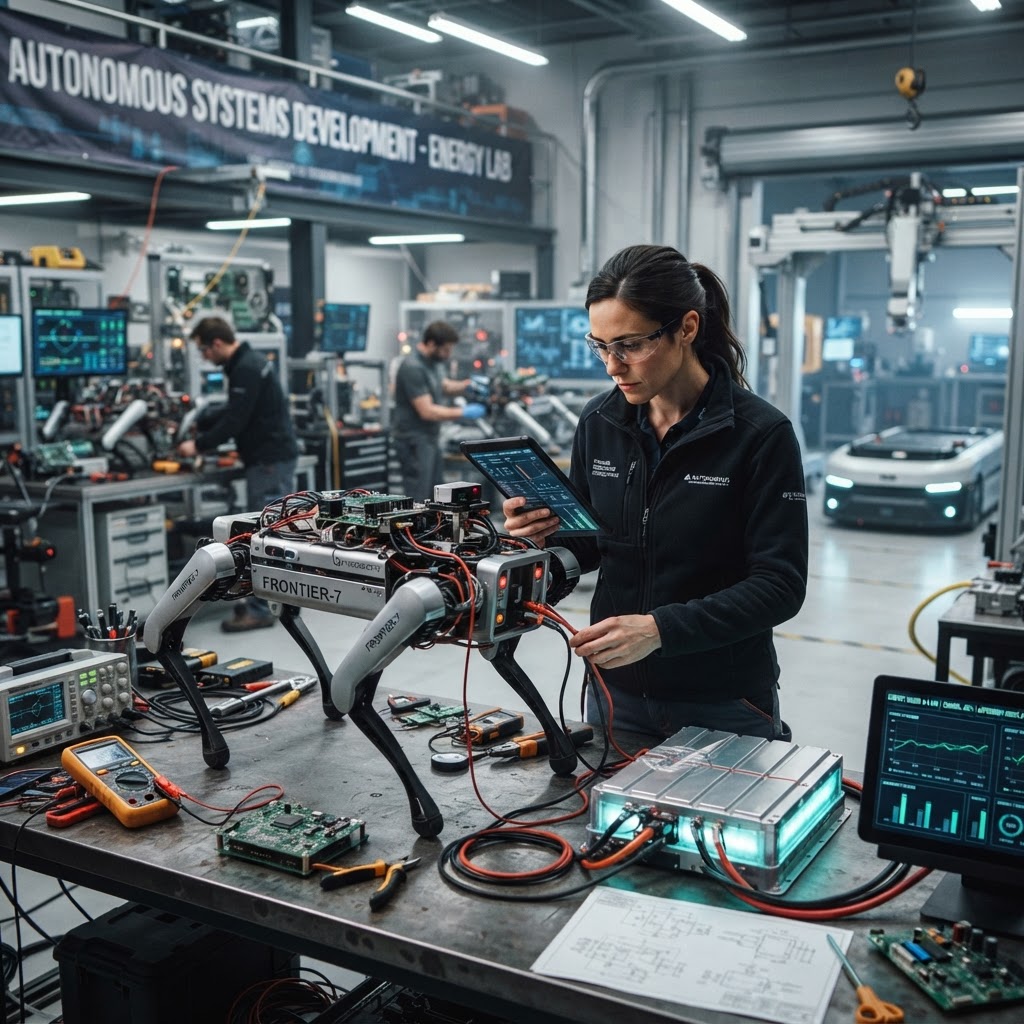
Autonomous Frontiers and Energy Hurdles: Inside the Shifting Landscape of Next-Generation Technology
Recent breakthroughs in lightweight artificial intelligence models and embodied robotics are accelerating real-world automation, even as hardware supply chains and data center infrastructure face mounting economic and regulatory friction.

The Price of Scale: Tech Grapples With Astronomical Capital Demands, Power Constraints, and Heightened Scrutiny
As artificial intelligence infrastructure scales toward orbital deployments and gigawatt loads, the technology sector is encountering unprecedented capital requirements, mounting regulatory friction, and community pushback.