Frontiers of Discovery: Breakthroughs in Neurodegenerative Therapy, High-Energy Astrophysics, and Planetary Adaptation
Recent advances across scientific disciplines have yielded promising new avenues for countering Alzheimer's disease and cellular aging, while deep-space detectors and solar alert technologies open fresh perspectives on cosmic phenomena.
A Paradigm Shift in Neurodegeneration and Cellular Rejuvenation
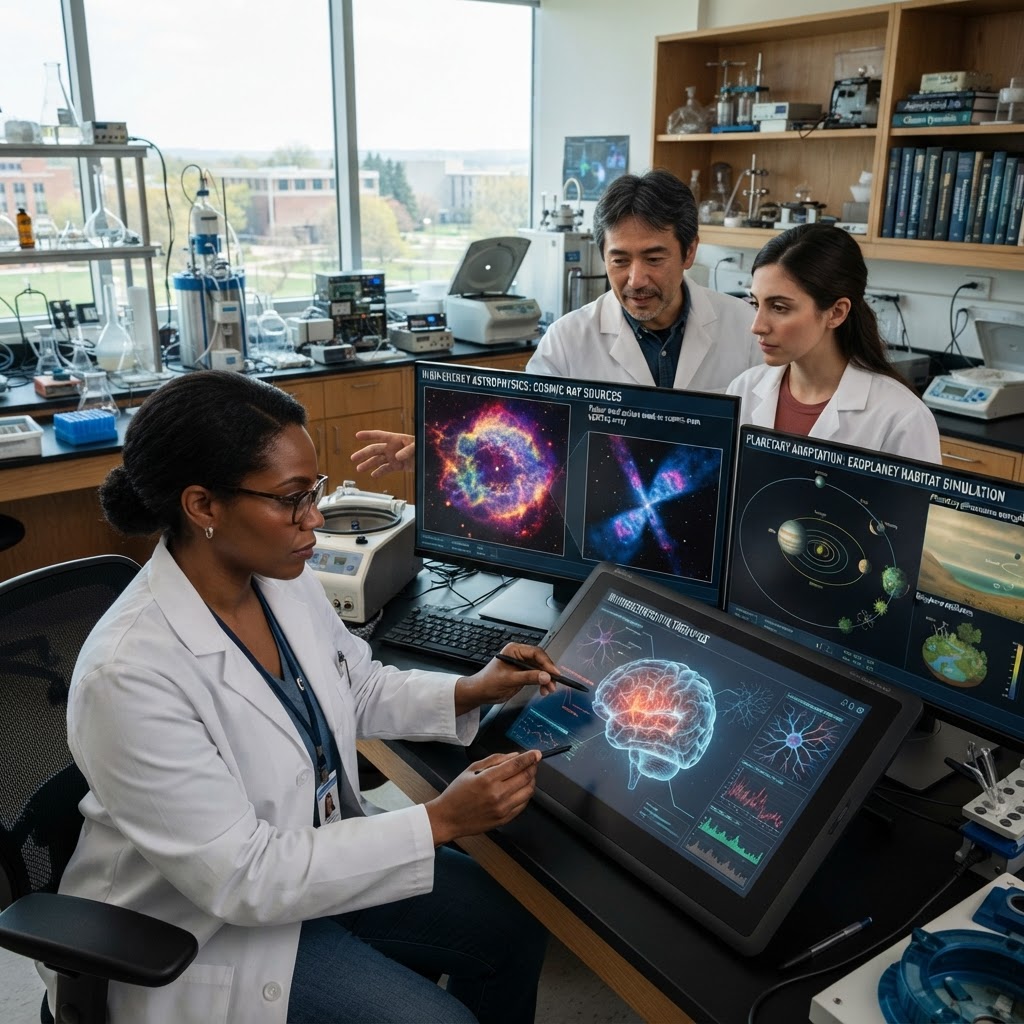
In recent days, the biomedical sphere has witnessed notable breakthroughs that challenge long-held models of age-related disease, specifically targeting Alzheimer's pathology and cellular deterioration. According to reports compiled by ScienceDaily, researchers have uncovered an unexpected therapeutic application for a compound originally engineered to treat spinal cord injuries. The repurposed compound demonstrates an ability to address multifaceted drivers of Alzheimer’s disease, notably repairing accrued DNA damage while significantly blunting chronic neuroinflammation in brain tissue.
Parallel research spearheaded by scientists at the University of Southern California has broadened this picture beyond the central nervous system. Investigators revealed that rejuvenating liver cells through targeted experimental treatments could cut circulating levels of an Alzheimer’s-linked pathological protein roughly in half. By showing that restoring metabolic vigor in hepatic tissue exerts a neuroprotective buffer, the findings emphasize systemic, multi-organ interactions in cognitive longevity and suggest that therapies acting outside the blood-brain barrier could serve as potent tools against dementia.
Tracing the High-Energy Cosmos from the Antarctic Ice
While cellular biologists work to prolong human healthspan, astrophysicists are capturing signatures from some of the most violent events in the deep cosmos. Data from the IceCube Neutrino Observatory, stationed deep within the Antarctic ice shelf, highlighted the detection of ultra-high-energy cosmic neutrinos—often referred to as 'ghost particles'—possessing energies roughly ten billion times greater than ordinary neutrinos originating from the Sun, as detailed in recent reporting by ScienceDaily.
Because neutrinos carry no electrical charge and interact exceptionally weakly with baryonic matter, they traverse billions of light-years across interstellar space undisturbed by magnetic fields or cosmic dust. Isolating these extraordinarily energetic detections offers physicists an uncorrupted window into cataclysmic astrophysical accelerators, such as supermassive black holes, active galactic nuclei, and ancient energetic events dating back toward the early universe.
Real-Time Heliophysics and Enduring Deep-Space Engineering
Closer to home, research into the Sun's dynamic behavior has taken a major technological step forward. In an operational update from NASA Science, mission scientists announced the successful maiden deployment of a rapid-response sounding rocket program guided by an automated solar flare alert system. The technology enabled researchers to detect the earliest indicators of an active flare and launch suborbital instrumentation directly into upper atmospheric pathways while the eruption unfolded. Capturing in-situ spectroscopic data during the flare's active acceleration phase provides crucial calibration data for solar weather models that protect orbital satellites and power grids on Earth.
Simultaneously, mission operators continue to sustain humanity's most distant outpost of robotic exploration. Nearly five decades following its departure from Earth, the Voyager 1 probe has overcome severe electrical power constraints and an unexpected communications blackout. Ingenious power-reallocation commands executed by mission teams have preserved instrument telemetry, ensuring the probe remains capable of sampling the boundary layer of interstellar space.
Cellular Plasticity and Environmental Adaptation
Emerging research in plant physiology is reshaping how scientists understand organismal resilience against extreme climate fluctuations. Analyses highlighted in The Johns Hopkins News-Letter describe an underlying transcriptional state in plant root structures that operates independently of traditional cell type categories. Termed the environment-regulated state, this genetic program activates dynamically under water-deficit stress, modulated by the signaling hormone abscisic acid.
By revealing that roots adapt not merely through hardwired cell specializations but through flexible, tissue-wide gene activation shifts, the work provides bioengineers with a tangible genetic framework. Such insights offer pragmatic pathways to strengthen drought tolerance in staple agriculture, pointing toward resilient food production systems amid shifting global precipitation patterns.
Recommended for you
Similar to “Science”
Frontiers of Precision: New Breakthroughs in Gene Editing, Materials, and Cellular Mapping Transform Science
Recent scientific advances highlight unprecedented precision across disciplines, from in vivo CRISPR therapies and massive brain cell atlases to energy-efficient magnetic nanomaterials.

Frontiers of Discovery: Subatomic Rarities, Martian Magma, and Systemic Medicine Reshape Modern Science
Recent breakthroughs across astrophysics, high-energy physics, and biomedicine are upending long-held scientific dogmas, revealing dynamic activity beneath the Martian crust and surprising systemic origins of chronic disease.
Frontiers of Discovery: How Recent Breakthroughs in Physics, Neuroscience, and Geophysics Are Reshaping Science
From high-energy cosmic ghost particles and non-destructive quantum computing to fluid earthquake faults and brain remapping, recent discoveries are upending decades-old paradigms across multiple disciplines.