Frontiers of Discovery: How Recent Breakthroughs in Physics, Neuroscience, and Geophysics Are Reshaping Science
From high-energy cosmic ghost particles and non-destructive quantum computing to fluid earthquake faults and brain remapping, recent discoveries are upending decades-old paradigms across multiple disciplines.
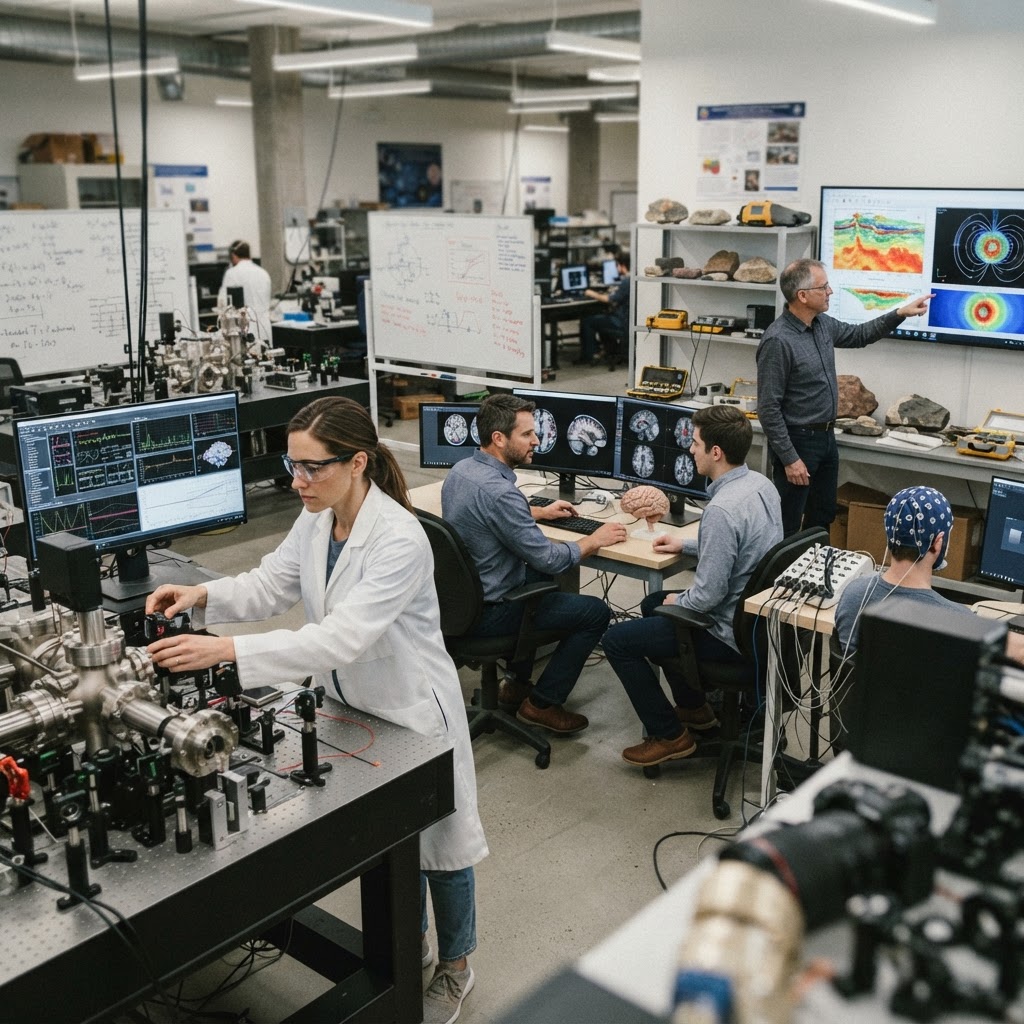
Unveiling Deep-Space Mysteries with High-Energy Neutrinos
In the frigid depths of Antarctica, the IceCube Neutrino Observatory has delivered another monumental discovery to the world of astrophysics. According to recent reports highlighted by ScienceDaily, researchers have registered incoming cosmic neutrinos with energies nearly ten billion times greater than typical solar neutrinos. Neutrinos, often dubbed 'ghost particles' because they carry no electric charge and virtually zero mass, traverse light-years of space without being deflected by magnetic fields or absorbed by matter. Detecting these extreme-energy messengers allows astrophysicists to peer directly into violent astrophysical engines, such as supermassive black hole jets and blazars, bypassing the optical veils that frequently hinder traditional telescopes.
Rewriting Quantum Rules and Molecular Engineering
Parallel advancements in physical science have emerged from condensed matter laboratories and quantum information centers. As reported by SciTechDaily, physicists have devised a novel mechanism to read quantum bits (qubits) without triggering their immediate decoherence. Traditionally, inspecting a qubit forces its fragile superposition state to collapse. By utilizing internal electric field dynamics, researchers can measure states non-destructively, taking a crucial stride toward fault-tolerant quantum computing.
Simultaneously, materials science is breaking centuries-old design thresholds. Nanotechnology teams have successfully fabricated an Archimedes screw scaled to the dimensions of a single molecule, driven bidirectionally by electrical pulses. Coupled with the discovery of altermagnetism—a newly verified third branch of magnetic classification alongside ferromagnetism and antiferromagnetism—condensed matter physics is unlocking an unprecedented toolkit for low-power memory storage and molecular-scale manufacturing.
Shedding New Light on Brain Plasticity and Neural Circuits
The biological sciences have witnessed their own flurry of paradigm shifts. Groundbreaking neurological investigations into psilocybin and synthetic therapeutics have demonstrated how neuroactive compounds physically rewire connectivity networks across the visual cortex and deeper brain structures. Rather than merely stimulating mood-associated pathways, these compounds prompt transient remodeling of synchronized signaling hubs, explaining their therapeutic efficacy in long-term trauma treatment.
Complementary work published in leading outlets such as Science highlights newly pinpointed neural circuits in the brainstem responsible for mediating pain perception and memory stabilization. In cellular biology, investigators have simultaneously identified hidden immune defenses that temper self-directed inflammation, alongside innovative liver rejuvenation approaches that dramatically reduce amyloid precursors tied to cognitive decline.
A Dynamic Earth: When Bedrock Becomes Fluid
Even fundamental assumptions in geophysics are being reexamined. Studies into tectonic mechanics published in SciTechDaily show that during seismic events, friction and pore pressure along fault lines can cause solid rock interfaces to momentarily act like a fluid. This sudden drop in frictional resistance enables faults to slip with far greater speed and displacement than standard predictive models anticipate. Understanding this fluid-like state promises to improve global seismic risk assessments and hazard forecasting for heavily populated earthquake corridors.
A Connected Scientific Horizon
Across cosmic particle physics, nanoscale engineering, brain circuitry, and planetary dynamics, the past few days demonstrate that modern scientific disciplines are rarely isolated. Technological leaps—ranging from sensitive cryo-detectors at Earth’s poles to atomic-resolution imaging in solid-state labs—continue to expose nature's hidden mechanics. As researchers translate these findings into quantum algorithms, medical therapeutics, and resilient infrastructure, the boundaries of human knowledge expand once again.
Recommended for you
Similar to “Scientific Discoveries”
Frontiers of Discovery: How Recent Breakthroughs in Physics, Medicine, and Computing Are Redefining Modern Science
From detecting extreme-energy cosmic ghost particles to unlocking backward bacterial defenses and brain-inspired electronics, a surge of recent discoveries is transforming our understanding of the universe and human biology.

Quantum Frontiers and Biohybrid Horizons: How Cross-Disciplinary Breakthroughs Are Reshaping Modern Science
Recent discoveries spanning quantum physics, biological computing, and deep-earth geophysics are challenging longstanding assumptions and accelerating technological integration across scientific fields.
Quantum Frontiers and Cosmic Riddles: Inside the Scientific Breakthroughs Reshaping Physics and Technology
Recent breakthroughs spanning altermagnetic materials for energy-efficient computing, ultracold quantum milestones, and fundamental particle observations are opening dramatic new pathways across modern physics.