Frontiers of Discovery: Subatomic Rarities, Martian Magma, and Systemic Medicine Reshape Modern Science
Recent breakthroughs across astrophysics, high-energy physics, and biomedicine are upending long-held scientific dogmas, revealing dynamic activity beneath the Martian crust and surprising systemic origins of chronic disease.
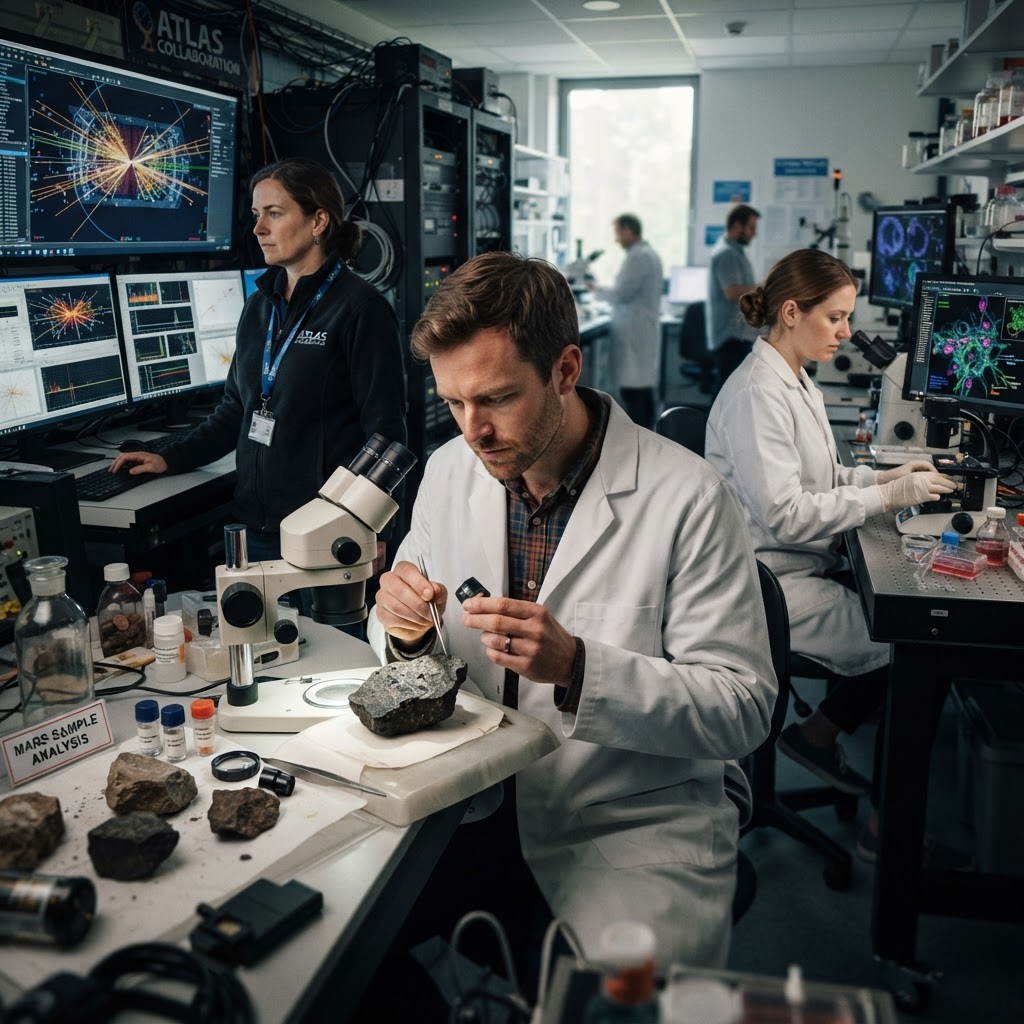
A Dynamic Red Planet and Unsolved Cosmic Mysteries
For decades, planetary science widely accepted that Mars had cooled into a quiescent, geologically dormant world following its volatile youth billions of years ago. Fresh data highlighted by ScienceDaily has fundamentally challenged this consensus. Researchers examining high-resolution satellite telemetry and geophysical readings have pinpointed localized gas plumes alongside newly fractured tectonic fissures. These geologic scars suggest that hot magma reservoirs may remain active deep beneath the Martian crust, releasing volatile gases through subterranean vents. The confirmation of active volcanism does not merely alter planetary evolution models; it creates a compelling new framework for astrobiologists searching for subsurface geothermal ecosystems capable of sheltering microbial life.
Farther out in the cosmos, astrophysicists are grappling with data that stretches conventional cosmological tenets to their limits. Novel theoretical modeling from the University of Ottawa suggests our universe could be significantly older than previously presumed, offering an alternative formulation that tests whether cosmic expansion and observational anomalies might be reconciled without invoking undetected dark matter or dark energy. Coupled with fresh detections of distant exoplanets identified in James Webb Space Telescope observations and deep-space imaging of sprawling dust reservoirs from the Hubble Space Telescope, astronomical institutions find themselves in a golden era of revision, where empirical observations regularly supersede theoretical comfort zones.
Breakthroughs in Fundamental Physics and Quantum Architecture
High-energy physics reached an elusive milestone after more than forty years of experimental observation at the European Organization for Nuclear Research (CERN). Particle physicists announced verified evidence of an ultra-rare decay pathway that occurs in roughly one out of every ten billion particle events. Detecting an anomaly of such infrequency requires unprecedented instrumental sensitivity, cutting through background quantum noise to observe fundamental subatomic interactions with high statistical certainty. These rare decays serve as precise stress tests for the Standard Model of particle physics, illuminating potential cracks where undiscovered forces or exotic particles might manifest.
Simultaneously, quantum engineering is breaking away from traditional silicon architectures. Researchers have demonstrated functional quantum memory storage that relies on microscopic physical vibrations akin to plucked acoustic strings. By translating fragile qubit states into localized mechanical oscillations, engineers can shield quantum data from environmental interference and decoherence. This hybrid vibrational paradigm promises to substantially shrink the spatial footprint required for quantum processors, providing a more robust path toward fault-tolerant quantum computing.
Reevaluating Human Disease: Beyond the Brain and Into the Body
Groundbreaking findings in the biomedical sector are redefining our understanding of severe neurological conditions. Investigations into inherited Alzheimer’s disease have revealed that early metabolic disruptions and cellular warning signs emerge outside the central nervous system. Utilizing micro-engineered organ-on-a-chip platforms cultivated from human stem cells, researchers tracked genetic mutations tied to familial Alzheimer's expressing pathological lipid signaling and systemic inflammation in peripheral tissues long before clinical neurological degeneration occurs. This perspective shifts Alzheimer’s from being conceptualized strictly as a localized brain disorder toward a multi-system metabolic pathology, opening doors for non-invasive peripheral biomarkers.
In a parallel effort to understand cognitive vulnerability, a comprehensive meta-analysis incorporating dozens of neuroimaging studies led by Florida International University demonstrated that diverse chronic sleep disorders generate convergent structural changes within the brain. Rather than solely inducing physical exhaustion, fragmented sleep alters cortical networks responsible for emotional regulation, executive planning, and sustained attention. Mapping these structural biomarkers across distinct clinical sleep syndromes provides medical practitioners with objective neurological benchmarks to design targeted interventions before cognitive decline becomes permanent.
Biotechnology and Everyday Preventative Interventions
Innovation at the intersection of public health and bioengineering is introducing surprising, accessible tools for disease prevention. In clinical oncology trials, researchers formulated an engineered therapeutic chewing gum capable of trapping and reducing oral human papillomavirus (HPV) viral loads by as much as 93 percent. Given the rising incidence of HPV-associated oropharyngeal and head and neck malignancies, such preventative consumer technologies represent a low-cost, scalable countermeasure against microbial oncogenesis.
Collectively, the scientific developments of recent days underscore a common theme across disciplines: natural systems—from subatomic particles and mammalian cells to planetary bodies—harbor layers of complexity far richer than historic models assumed. As sensor technologies grow sharper and cross-disciplinary approaches become standard practice, science continues to replace rigid assumptions with more integrated, dynamic paradigms.
Recommended for you
Similar to “Science”
Frontiers of Discovery: How Recent Breakthroughs in Physics, Neuroscience, and Geophysics Are Reshaping Science
From high-energy cosmic ghost particles and non-destructive quantum computing to fluid earthquake faults and brain remapping, recent discoveries are upending decades-old paradigms across multiple disciplines.
Frontiers of Discovery: Breakthroughs in Neurodegenerative Therapy, High-Energy Astrophysics, and Planetary Adaptation
Recent advances across scientific disciplines have yielded promising new avenues for countering Alzheimer's disease and cellular aging, while deep-space detectors and solar alert technologies open fresh perspectives on cosmic phenomena.
Frontiers of Discovery: How Recent Breakthroughs in Physics, Biomedicine, and Space Exploration Are Redefining Modern Science
From high-stakes neutrino observations to innovative therapeutics and potential biosignatures on Mars, contemporary scientific research is rapidly rewriting our understanding of both the human body and the cosmos.