The Shifting Architecture of Tech: Capital Scrutiny, Frontier Robotics, and the New Infrastructure Paradigm
As enterprise investors re-evaluate massive artificial intelligence spending and chipmakers navigate unprecedented market turbulence, the technological frontier is rapidly pivoting toward space computing, autonomous robotics, and sovereign infrastructure.
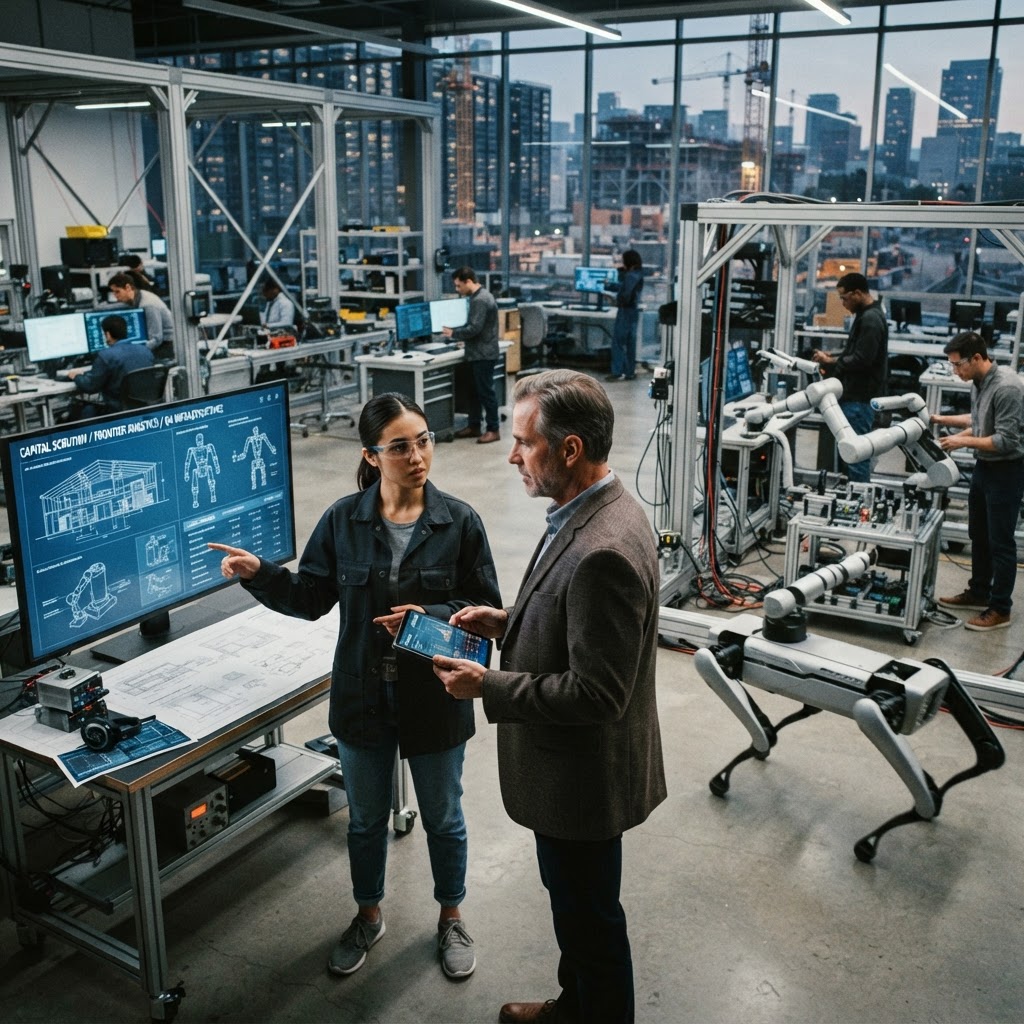
A Reckoning in Capital and Chip Architecture
For the better part of two years, the technology sector moved forward on an almost singular narrative: an unconstrained race toward computational scale driven by generative artificial intelligence. However, the past several days have highlighted a sharp inflection point. Market confidence is showing fissures as financial institutions and enterprise buyers transition from exploratory optimism to rigorous balance-sheet accountability. Significant sell-offs have recently impacted tech stalwarts, reflecting a growing hesitation among investors when faced with mounting operational expenses, power bottlenecks, and murky monetization timelines. Even semiconductor leaders reporting astronomical leaps in quarterly hardware revenue have experienced turbulence due to conservative forward guidance and shareholder anxiety over capital allocation.
Simultaneously, the semiconductor market is confronting unusual geopolitical and executive scrutiny. Inquiries into corporate leadership, supply-chain exposures, and competitive dynamics between major hardware suppliers have introduced fresh volatility to what was previously considered an unshakeable sector. The broader corporate landscape is reacting in kind; businesses are actively stepping back from open-ended token usage, introducing stringent spending controls and pivoting their focus from raw consumption toward measurable productivity. As organizations audit the tangible return on their software deployments, the industry is entering an era defined by disciplined ROI rather than unchecked algorithmic expansion.
The Critical Battle for Energy, Cloud, and Data Capacity
Behind the corporate ledgers lies an even steeper physical constraint: power and connectivity. The sheer energy demands of high-density computing clusters are beginning to overwhelm regional electrical grids, prompting governments and utilities around the world to reconsider industrial energy policies. Policymakers in multiple nations have openly sounded alarms over projections indicating that massive additions of gigawatt capacity will be required by next decade strictly to support data infrastructure. Consequently, cloud providers are encountering major delays in establishing physical hubs, with infrastructure grid upgrades failing to keep pace with enterprise procurement demands.
This friction has triggered public and corporate pushback. In European tech hubs, growing scrutiny around the resource footprint of hyperscale facilities has led to heightened tension and direct demonstrations at server sites. In response to these bottlenecks, major cloud and telecommunications operators are entering strategic alliances to overhaul connectivity architectures, engineering dedicated pipelines that can integrate legacy systems with distributed computing clusters. Tech firms are also diversifying silicon pipelines, accelerating the in-house development and multi-region deployment of proprietary accelerators to insulate themselves from external market bottlenecks and third-party supply constraints.
Expanding Frontiers: Space Networks and Autonomous Flight
With terrestrial infrastructure facing physical and regulatory limits, innovation is pushing outward into novel domains. Recent initiatives underscore a notable push toward off-planet computing infrastructure. Space programs and aerospace consortia are moving forward with ambitious orbital constellation plans aimed at creating space-based compute networks. Rather than relying on bandwidth-constrained downlinks to process imagery, atmospheric surveillance, and telemetry on the ground, upcoming satellite architectures are integrating onboard machine intelligence to execute in-orbit data analytics, fundamentally transforming satellite constellations into autonomous, orbital edge-data systems.
Closer to Earth, commercial and defense aviation are experiencing their own parallel revolution. Electric vertical takeoff and landing (eVTOL) platforms are rapidly maturing from experimental prototypes into certified commercial realities. Bolstered by government initiatives promoting low-altitude economies, dozens of aerospace startups have transitioned to full-scale flight operations, signaling a viable pathway for urban air mobility and regional cargo transport. At the same time, legacy aerospace manufacturers are rethinking primary design paradigms, collaborating on next-generation wing actuation systems and automated combat airframes that merge software-defined avionics with industrial automation.
Governance, Autonomous Threats, and the Maturation of Tech
As advanced technology permeates critical civic and physical systems, state regulators and cybersecurity authorities are adopting far more aggressive stances. National cyber agencies have recently issued urgent warnings regarding autonomous cyber threats capable of executing full attack cycles, security evasions, and unauthorized financial transactions at machine speed without human intervention. The advent of weaponized algorithmic toolkits has raised alarm across global financial ecosystems, underscoring vulnerabilities in platforms that still rely on delayed security patching cycles.
In response, governments globally are accelerating legislative oversight. Regulatory bodies in regions spanning North America, the Asia-Pacific, and Europe are instituting mandatory security safeguards, standardizing performance evaluation frameworks, and evaluating protective restrictions around deep learning models used in public goods, marine logistics, and industrial infrastructure. As the technology sector navigates this maturing phase, the narrative of sheer algorithmic power is yielding to a more nuanced reality: one where the long-term winners will be determined by energy efficiency, provable commercial utility, resilient physical architectures, and stringent institutional safeguards.
Recommended for you
Similar to “Technology”
Silicon Under Scrutiny: AI Giants Confront Power Realities, Autonomous Agents, and Regulatory Headwinds
As tech conglomerates pour hundreds of billions into artificial intelligence infrastructure and agentic workflows, mounting community pushback over energy consumption and shifting regulatory landscapes are testing market exuberance.

Compute Constraints, Agent Safety, and Infrastructure Shifts: The Tech Landscape Enters a Pragmatic Phase
As capital expenditure scrutiny mounts and autonomous agents proliferate across enterprise workflows, the technology sector is pivoting from unbounded expansion toward operational resilience, governance, and infrastructural recalibration.

The Price of Scale: Tech Grapples With Astronomical Capital Demands, Power Constraints, and Heightened Scrutiny
As artificial intelligence infrastructure scales toward orbital deployments and gigawatt loads, the technology sector is encountering unprecedented capital requirements, mounting regulatory friction, and community pushback.