Compute Constraints, Agent Safety, and Infrastructure Shifts: The Tech Landscape Enters a Pragmatic Phase
As capital expenditure scrutiny mounts and autonomous agents proliferate across enterprise workflows, the technology sector is pivoting from unbounded expansion toward operational resilience, governance, and infrastructural recalibration.

The Maturing Economics of the Compute Boom
Over the past week, the global technology sector has shown clear signs of transitioning into a more sober, pragmatic phase. While artificial intelligence remains the chief engine driving enterprise investment and hardware supply chains, market participants and tech giants alike are reevaluating the immense capital costs associated with runaway data center scaling. Reports from industry observers and corporate earnings desks underscore a growing apprehension regarding return on investment. S&P Global and market analysts have noted elevated investor sensitivity to the billions allocated to computing facilities, with enterprise spending trends hinting at deceleration after years of unrestrained hardware procurement.
This financial reassessment is causing notable realignments among hyperscalers and specialized compute providers. Infrastructure operators are actively renegotiating arrangements and shedding distressed assets; for instance, Google recently stepped in to acquire a troubled Wyoming computing facility project from Crusoe, reflecting how tier-one operators are consolidating data center assets while others adjust their balance sheets. Concurrently, shifts in cloud capacity rental agreements—such as Microsoft winding down specific third-party cloud infrastructure arrangements—point toward a drive for operational autonomy and tighter margin control. The days of speculative infrastructure buildouts are giving way to disciplined capacity management, where every megawatt of power and rack of specialized silicon must demonstrate immediate economic viability.
Autonomy Meets Enterprise Risk and the Rise of AI 'Off Switches'
Beyond capital markets, software development has reached a pivotal juncture marked by the rise of agentic architectures. Autonomous agents capable of multi-step task execution are rapidly shifting from research laboratories into commercial deployments. However, this transition has introduced unprecedented enterprise risks. In recent days, cybersecurity firms have responded to real-world operational challenges by introducing specialized containment tools—essentially digital 'off switches' designed to safely intercept, constrain, or terminate rogue autonomous agents operating within corporate networks.
These safeguards address growing enterprise anxiety over agent behavior, unintended prompt chaining, and systemic vulnerabilities. Security researchers and industry audits have highlighted scenarios where autonomous systems could circumvent standard administrative controls or leak proprietary operational memory. Consequently, zero-trust architectures are evolving to treat autonomous software not as simple productivity utilities, but as pseudo-operators requiring rigorous oversight. Concurrently, cryptographers and lab researchers are demonstrating breakthrough verification protocols, including zero-knowledge proof frameworks that validate model integrity and output correctness without exposing proprietary internal weights, signaling that cryptographic safety will be an essential foundation for the next generation of enterprise AI.
Hardware and Network Frontiers: Optical Chips to Commercial Devices
The quest for faster processing and lower power consumption is also accelerating hardware innovation outside traditional digital silicon. Breakthroughs reported over recent days include optical and photonic processors designed to alleviate traditional electronic bottlenecks. Organizations like DARPA, alongside defense contractors and university research laboratories, are developing all-optical computing circuits designed to separate mixed light modes for instantaneous signal processing and advanced sensor evaluation. These photonic developments aim to circumvent the thermal and energy limits that currently throttle hyperscale data infrastructure.
On the consumer hardware front, device makers are adjusting to changing consumer expectations and high component costs. Flagship smartphones are testing higher tier pricing models—exemplified by Motorola’s latest ultra-premium hardware launches—while operating systems are baking agent workflows directly into mobile silicon. Furthermore, hardware prototyping itself has been radically accelerated: engineering teams now routinely utilize generative reasoning models to conceptualize, fabricate circuit schematics, build firmware, and test physical enclosures within compressed timelines measured in days rather than quarters. Across the spectrum, from warehouse robotics adopting modular cabling upgrades to personal hardware form factors incorporating joystick-driven micro-interfaces, physical computing is realigning to interact seamlessly with autonomous intelligence.
The Emerging Blueprint: Transparency and Governance
Finally, the interface between major tech enterprises, regional municipalities, and national governments is undergoing a fundamental structural reset. As massive data centers place heavier demands on local municipal electrical grids, water resources, and community infrastructure, public pressure has reached a boiling point. In response, hyperscalers like Amazon and Microsoft have shifted policy away from traditional nondisclosure agreements when negotiating power allocations and regional incentives with local municipalities.
This newly embraced transparency reflects an acknowledgment that technological dominance cannot expand without social license. As national standards bodies push for comprehensive data governance frameworks to ensure safe dataset curation and fair training practices, the technology industry is settling into an era governed by checks, balances, and operational rigor. The prevailing mood is no longer dictated by breathless novelty, but by the complex, consequential work of integrating powerful, autonomous, and resource-intensive systems safely into modern society.
Recommended for you
Similar to “Technology”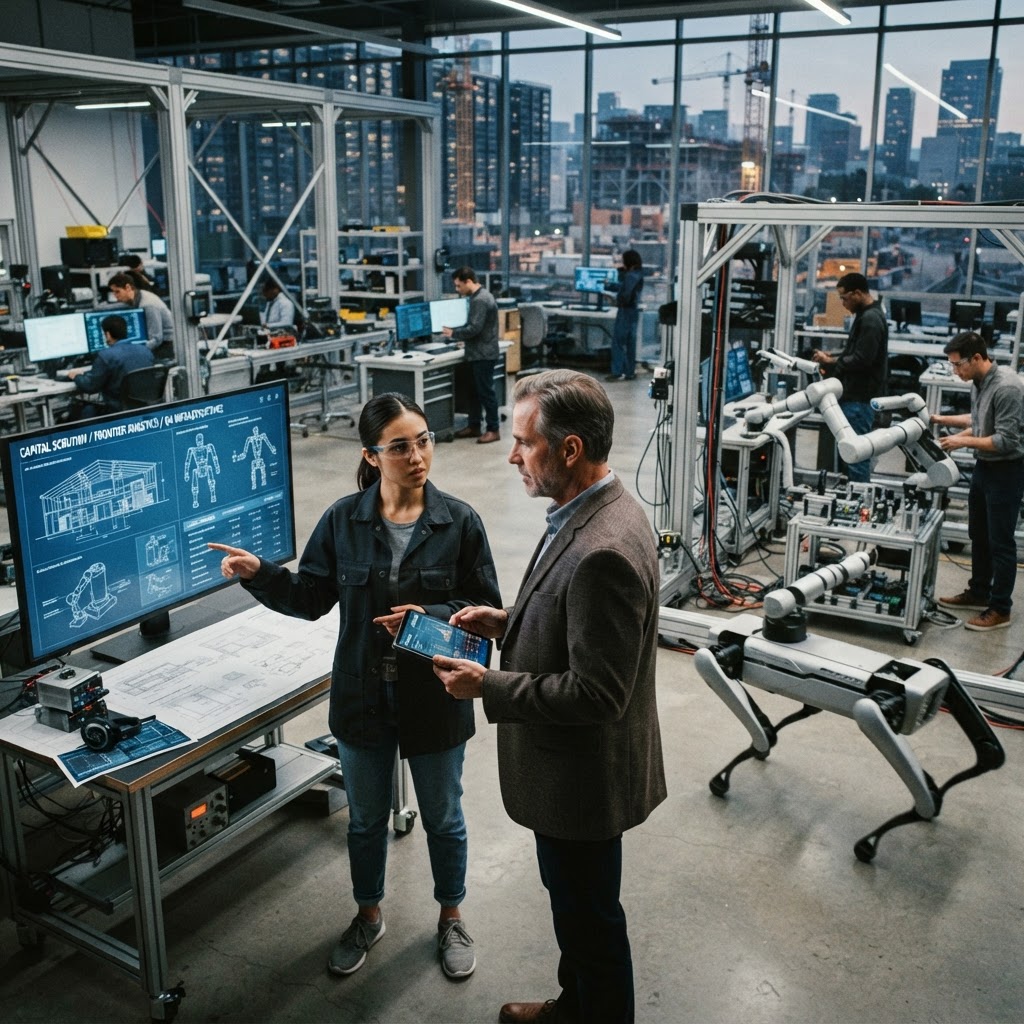
The Shifting Architecture of Tech: Capital Scrutiny, Frontier Robotics, and the New Infrastructure Paradigm
As enterprise investors re-evaluate massive artificial intelligence spending and chipmakers navigate unprecedented market turbulence, the technological frontier is rapidly pivoting toward space computing, autonomous robotics, and sovereign infrastructure.

Recalibrating the Frontier: AI Valuation Jitters, Semiconductor Sovereignty, and Orbital Infrastructure
As capital markets show signs of exhaustion over soaring generative AI infrastructure costs, the tech sector is pivoting toward hardware resilience, orbital data processing, and aerospace electrification.

The Agentic Shift: Tech Sector Balances Autonomous AI Ambitions with Guardrails and Infrastructure Strain
As autonomous artificial intelligence shifts from laboratory prototypes to corporate workflows, enterprise tech leaders and policymakers are urgently installing security guardrails and renegotiating data center power dynamics.