Frontiers of Matter and Motion: How Recent Breakthroughs Are Reshaping Physics, Computing, and Biology
From solving atomic-scale limits on energy-efficient AI chips to robotic orbital manufacturing and rare particle signatures at CERN, recent scientific milestones are bridging deep theory with practical engineering.
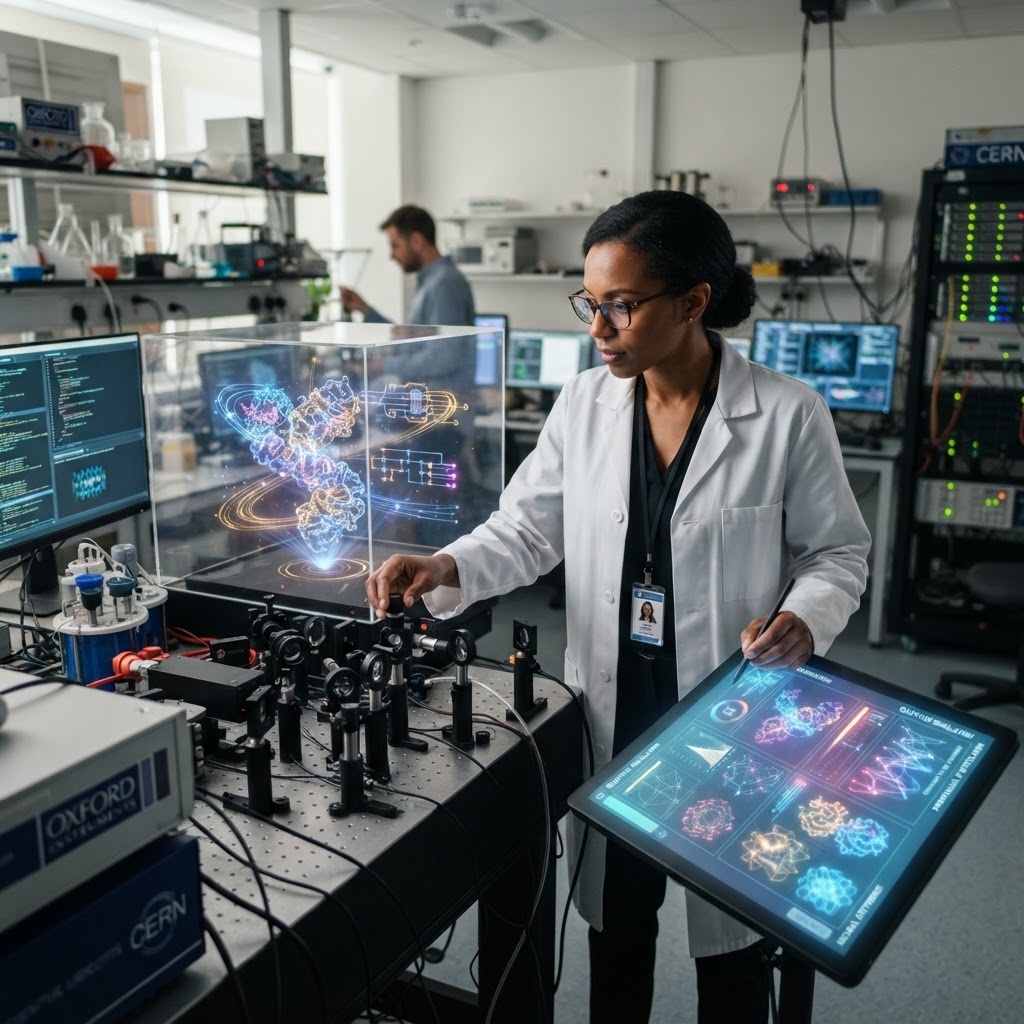
The Quest for Sustainable Computing at the Atomic Edge
As computational power requirements soar under the weight of modern artificial intelligence workloads, materials scientists have been hunting for hardware platforms that can operate on a fraction of current energy budgets. Multiferroic materials—substances that exhibit both ferromagnetism and ferroelectricity—have long been hailed as ideal candidates for ultra-low-power memory and logic architectures. However, practical implementation has historically stumbled over the 'dead layer' effect: when these compounds are reduced to the nanometer and atomic thicknesses necessary for contemporary microchips, their magnetic and electrical coupling typically collapses.
In a significant breakthrough reported by researchers at Brown University as detailed by ScienceDaily, scientists have devised a fabrication technique that eliminates this operational barrier in ultra-thin bismuth ferrite films. Not only does the process preserve crucial ferroic properties at near-atomic scales, but it also induces novel magnetic behaviors that could facilitate ultra-dense, low-voltage spintronic and neuromorphic computing systems. Concurrently, international consortia are looking beyond conventional phase boundaries to reimagine energy storage and mechanical actuation. A collaborative initiative led by Drexel University and France's University of Toulouse, backed by the European Research Council as reported by Drexel University, is deploying machine learning to synthesize programmable 'solid-liquid materials' (SLiMs). These hybrid states of matter aim to pioneer next-generation flexible structural batteries, electrochemical supercapacitors, and artificial muscles capable of responsive motion without traditional mechanical linkages.
Expanding Human Reach into Orbit and Fundamental Particles
Beyond terrestrial laboratories, the arena of space exploration has taken an important step toward true autonomy. Under the DARPA NOM4D program, engineers from Caltech demonstrated the in-orbit automated assembly of structural frameworks as noted in coverage by the Scientific Inquirer. Using the ASTRA robotic system, modular composite tubes and specialized joints were autonomously locked into place without human astronaut intervention. While technical hurdles prevented the complete deployment of an accompanying reflector antenna, the trial marks a critical proof-of-concept for assembling massive solar arrays, radio observatories, and interplanetary vessels directly in microgravity, bypassing the structural bottlenecks imposed by rocket payload fairings.
Simultaneously, subatomic physics reached a milestone four decades in the making at the Large Hadron Collider. Analyzing data from the LHCb detector, physicists at CERN announced statistical evidence (reaching 3.2 standard deviations) for an exceptionally rare decay mode: a neutral beauty meson, composed of a beauty quark and a down antiquark, transforming into a pair of muons. Occurring roughly once in every ten billion beauty-particle events, identifying this process required advanced detector sensitivity and machine-learning filtration to isolate the signal from immense background noise. While falling short of the definitive five-sigma discovery threshold, the measurement tightly aligns with the Standard Model while establishing rigorous boundaries on hypothetical, undiscovered fundamental forces.
Rethinking Cancer Dynamics and Earth's Carbon Reservoirs
In life and environmental sciences, researchers are uncovering hidden layers of complexity within biological resilience and oceanic cycles. A paradigm-shifting perspective from the University of East Anglia offers a compelling explanation for why aggressive childhood malignancies—such as neuroblastoma and Ewing sarcoma—proliferate rapidly despite presenting few genetic mutations. The researchers hypothesize that these tumors harness cellular plasticity, borrowing embryonic developmental programs to toggle phenotypic states rather than relying on sequential DNA errors. This framework suggests that next-generation oncology may succeed by targeting cellular transition mechanisms rather than chasing genomic mutations alone.
Beneath the surface of the world's oceans, researchers from UC San Diego's Scripps Institution of Oceanography and the University of Lincoln have revised our understanding of the planet's biological carbon pump. By applying high-resolution microscale imaging to 'marine snow'—the drifting aggregates of decaying plankton and organic detritus—scientists discovered that particle viscosity dictates deep-sea carbon sequestration. Bacteria were found to rapidly consume and degrade less viscous matter, whereas highly sticky, viscous aggregates resisted breakdown. Microscopic observations and climate simulations suggest that sticky marine snow can ferry up to six times more carbon into deep ocean sediments than previously modeled. Together, these interdisciplinary achievements underscore how probing the physical and biological micro-world continues to rewrite the rules governing global systems.
Recommended for you
Similar to “Science”
Quantum Frontiers and Cosmic Riddles: Inside the Scientific Breakthroughs Reshaping Physics and Technology
Recent breakthroughs spanning altermagnetic materials for energy-efficient computing, ultracold quantum milestones, and fundamental particle observations are opening dramatic new pathways across modern physics.
Frontiers of Discovery: Recent Breakthroughs Reshaping Physics, Genetics, and Earth Science
From unexpected magnetic control at the atomic scale to massive genetic catalogs and deep ocean thermal shifts, recent findings are actively challenging long-held scientific paradigms.
Frontiers of Discovery: Breakthroughs in Quantum Materials, Deep Ocean Heat, and Precision Oncology
Recent advances across physics, climate oceanography, and oncology highlight how atomic-scale manipulations, deep-sea tracking, and molecular genetic discoveries are reshaping modern science.