Quantum Frontiers and Cosmic Riddles: Inside the Scientific Breakthroughs Reshaping Physics and Technology
Recent breakthroughs spanning altermagnetic materials for energy-efficient computing, ultracold quantum milestones, and fundamental particle observations are opening dramatic new pathways across modern physics.
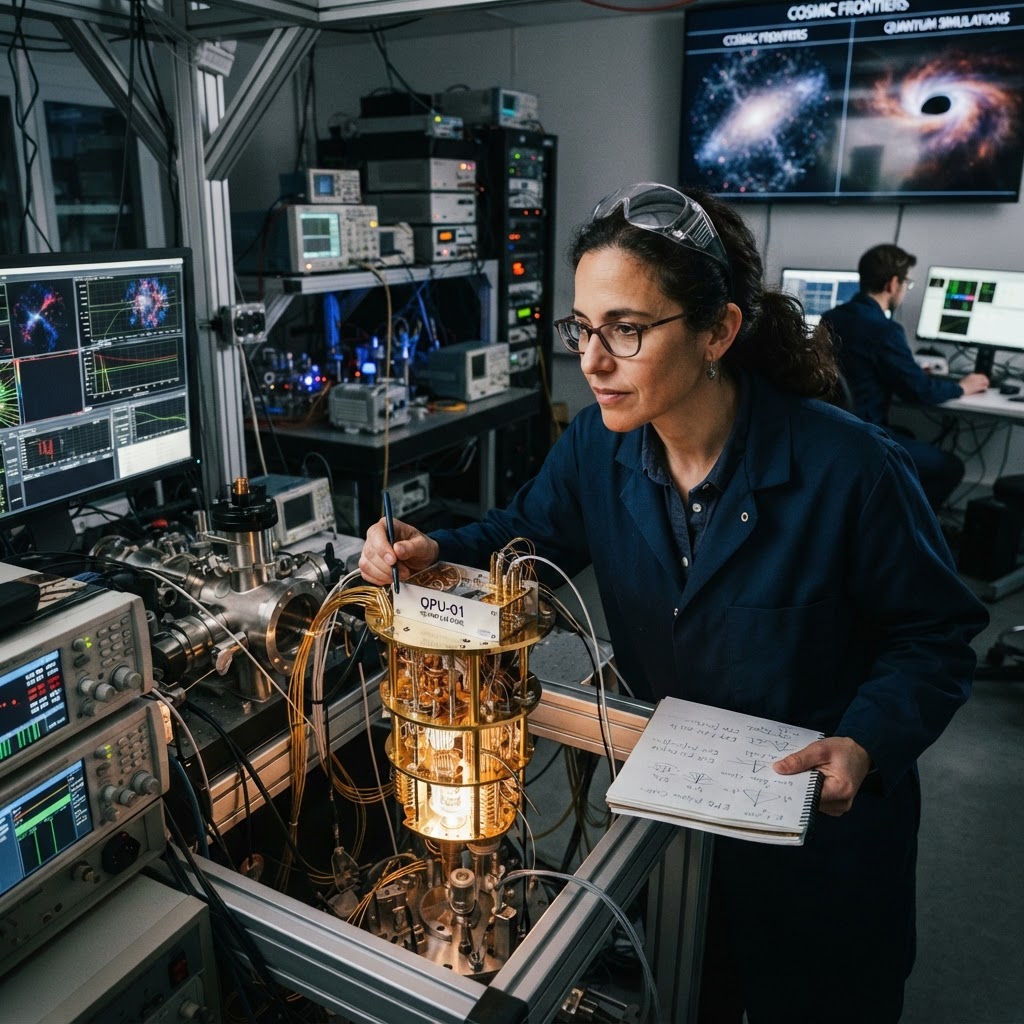
Bridging the Efficiency Gap in Computing
In recent days, the scientific landscape has seen a confluence of discoveries linking the strange behavior of fundamental particles with practical engineering challenges. At the forefront is an urgent dilemma facing modern computation: the spiraling energy consumption of artificial intelligence infrastructure. According to reporting on recent materials advances by ScienceDaily, researchers at Brown University have achieved a critical step forward in multiferroic technology by overcoming the persistent 'dead layer' problem—a phenomenon that traditionally degrades magnetic properties when functional materials are engineered down to nanometer-thin dimensions.
By overcoming this obstacle, the scientists managed to induce altermagnetism in ultrathin bismuth ferrite films. Altermagnetism represents an intriguing intermediate state between traditional ferromagnets—which are easily read but prone to magnetic crosstalk—and antiferromagnets, which offer rapid switching speeds and high density but remain notoriously difficult to probe. This synthesis of readable magnetic signals with rapid, interference-free behavior offers hardware engineers an avenue toward building ultra-low-power memory and logic architectures capable of handling heavy AI workloads with a fraction of current energy demands.
Extending Quantum Control Across Earth and Orbit
The mastery of physical matter at the microscopic scale is accelerating on other experimental fronts as well. As reported by Interesting Engineering, advances in photonics have demonstrated that chip-based laser cooling can bring trapped calcium ions near their motional quantum ground state in as little as 150 microseconds across three vibrational modes. Such chip-scale miniaturization represents a vital shift away from cumbersome laboratory optics toward modular, integrated quantum processors.
Simultaneously, quantum research is reaching into orbit. Synthesizing recent laboratory milestones documented by the Scientific Inquirer, researchers operating aboard the Chinese space station have achieved record-breaking low temperatures for orbital quantum gases, leveraging microgravity to sustain fragile quantum states longer than is typically feasible within terrestrial gravitational wells. In tandem with these cryogenic triumphs, European researchers have observed novel collective quantum phases of matter at room temperature by coupling organic semiconductors with liquid crystals, illustrating that the boundary between macroscopic environmental stability and quantum coherence continues to blur.
Precision at the Limits: Probing Rare Decays and Particle Physics
While materials scientists manipulate atoms on chips, high-energy particle physicists have achieved a long-sought observational milestone. A search spanning roughly four decades reached fruition at CERN, where physicists uncovered evidence of an extraordinarily rare particle decay that occurs roughly once in ten billion events. Relying on advanced machine-learning filters to extract an elusive signal from vast oceans of background collider noise, researchers achieved an empirical significance of 3.2 standard deviations.
While falling short of the definitive five-sigma threshold required for a confirmed scientific discovery, the observation provides tightly constrained parameters for beauty-particle decays. For now, the empirical measurements maintain alignment with the Standard Model of particle physics, yet the extreme precision of the observation establishes vital guardrails that restrict hypothetical models proposing undiscovered forces or hidden particles.
Reevaluating Planetary Geodynamics and Oceanic Systems
Beyond the laboratory bench and subatomic detectors, contemporary research has also uncovered surprising activity in macroscopic systems. Planetary scientists examining recent geodynamic signatures on Mars have identified unexpected gas venting and fresh geological fissures, suggesting that the Red Planet may still harbor residual volcanic activity and underground magma reservoirs rather than being the geologically inert body long assumed. Closer to home, oceanographic studies focusing on marine ecosystems have revealed that the mechanical consistency and flocculation of 'marine snow'—the steady descent of organic matter toward the ocean floor—exerts a far greater influence on carbon sequestration than previously accounted for, giving climate scientists critical new variables for predictive modeling.
From the nanoscale engineering of altermagnetic films to subatomic collisions and deep planetary dynamics, these collective milestones reflect a broader trend across contemporary science: the convergence of higher-precision instruments, computational data filtering, and tailored materials design is systematically transforming long-held theoretical assumptions into tangible physical discoveries.
Recommended for you
Similar to “Physics & Technology”
Frontiers of Matter and Motion: How Recent Breakthroughs Are Reshaping Physics, Computing, and Biology
From solving atomic-scale limits on energy-efficient AI chips to robotic orbital manufacturing and rare particle signatures at CERN, recent scientific milestones are bridging deep theory with practical engineering.
Frontiers of Discovery: How Recent Breakthroughs in Physics, Neuroscience, and Geophysics Are Reshaping Science
From high-energy cosmic ghost particles and non-destructive quantum computing to fluid earthquake faults and brain remapping, recent discoveries are upending decades-old paradigms across multiple disciplines.
Quantum Frontiers and Biohybrid Horizons: How Cross-Disciplinary Breakthroughs Are Reshaping Modern Science
Recent discoveries spanning quantum physics, biological computing, and deep-earth geophysics are challenging longstanding assumptions and accelerating technological integration across scientific fields.