Frontiers of Discovery: Breakthrough Therapies, Cellular Mapping, and the Shifting Landscape of Global Science
Recent major advances in medical therapeutics and in vivo cellular tracking highlight a transformative era for biological sciences, even as international research faces complex geopolitical and environmental headwinds.
A Watershed Moment in Antiviral Prevention
The landscape of biomedical science has witnessed a dramatic shift following landmark trial successes and structural biology insights centered on long-acting viral prevention. Leading scientific journals, including Science's 2024 Breakthrough of the Year, have underscored the exceptional promise of lenacapavir, a novel capsid inhibitor designed for HIV pre-exposure prophylaxis (PrEP). Unlike conventional daily oral regimens that frequently suffer from adherence hurdles, this twice-yearly injectable offers an unprecedented level of protection by disrupting the structural dynamics of the virus's protective capsid shell.
The drug represents far more than an incremental advance in patient adherence. Because capsid proteins form the vital protective architecture housing viral genetic material across a broad spectrum of pathogens, researchers believe this victory validates an entirely new therapeutic paradigm. By targeting the capsid rather than standard enzymatic mechanisms, scientists anticipate that the development of similar inhibitors could yield new lines of defense against a host of emerging and persistent viral diseases worldwide, as noted in assessments from Discover Magazine.
Mapping the Fleeting Conversations of Living Cells
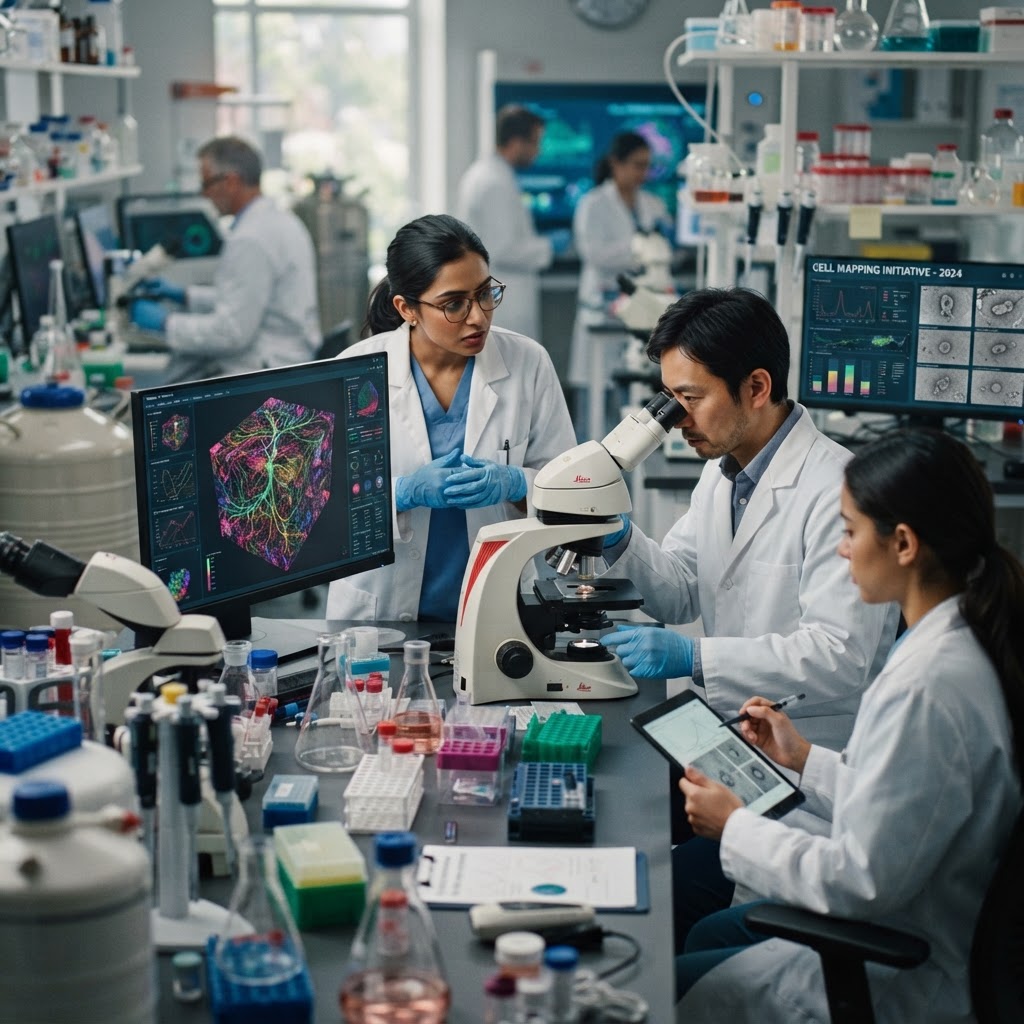
In tandem with antiviral developments, fundamental cell biology has taken a significant leap forward in understanding direct intercellular communication. According to reports from The Rockefeller University, investigators have engineered an advanced universal labeling system dubbed uLIPSTIC. The platform expands upon earlier biochemical tagging mechanisms to record fleeting cell-to-cell contacts directly in vivo, permitting scientists to dynamically observe and quantify how disparate cell types interact in living tissues.
By enabling virtually any cell to tag adjacent cells during transient contacts—a process colloquially described as a biochemical 'kiss-and-run'—the methodology gives researchers unprecedented visibility into cellular networks. Immunologists and oncology researchers are already applying the tool to decipher how malignant cells evade immune detection, such as investigating how tumors construct lipid shields to hide from cytotoxic lymphocytes. Such insights are proving pivotal in uncovering how intercellular signaling drives senescence, immune exhaustion, and tissue regeneration.
Innovative Delivery and Translational Therapies
Translational engineering is simultaneously redefining therapeutic delivery systems. As documented by Columbia University, bioengineers are pioneering inhalable nanotechnologies, leveraging specialized extracellular vesicles known as exosomes to transport anti-cancer compounds directly into pulmonary tissue. In preclinical models, administering targeted biological payloads through aerosolized exosomal bubbles provides a localized, minimally invasive route that bypasses systemic toxicity.
This momentum extends into neuroscience and cognitive biology. New studies into the architecture of human perception reveal that the human brain discretely demarcates daily experience into distinct narrative 'chapters' whenever an individual shifts environments or contextual goals. In parallel, neuroscientists exploring neurodegenerative pathologies have begun investigating the profound interplay between localized neuroinflammation and sleep degradation, seeking non-invasive interventions capable of restoring vital restorative cycles independently of canonical biomarker clearance.
Global Headwinds and Geopolitical Crosscurrents
While experimental laboratories celebrate significant leaps, the broader scientific enterprise faces considerable systemic headwinds. Scientific infrastructure has felt the acute weight of modern geopolitical conflict, with major regional conflicts causing the physical destruction of academic campuses, severe strain on research budgets, and the forced cancellation or delay of critical facilities such as advanced synchrotron light sources. Concurrently, environmental diplomacy encountered profound limits at recent international negotiations, where efforts to broker a legally binding treaty to cap virgin plastics production stalled amid disagreements between petrochemical producers and conservation coalitions.
Nevertheless, the international scientific community continues to navigate these roadblocks through collaborative frameworks and novel global benefit-sharing initiatives. As cross-disciplinary research converges—uniting structural biology, nanoscale bioengineering, and high-resolution tracking tools—the boundaries of medical and physical sciences are rapidly redrawing what is possible, offering tangible solutions to some of humanity's most persistent challenges.
Recommended for you
Similar to “Science”
Frontiers of Discovery: Breakthroughs in Quantum Physics, Biomedicine, and the Ongoing Pressures on Global Research
Recent advances spanning topological quantum computing and life-saving antiviral therapies mark extraordinary scientific progress, even as international research communities navigate severe geopolitical and economic headwinds.
Frontiers of Discovery: Breakthrough Therapies, Ecological Resilience, and the Fight for Research Integrity
Recent advances across global scientific disciplines highlight promising medical breakthroughs, urgent ecological strategies for warming oceans, and renewed efforts to safeguard scientific integrity.
Frontiers of Precision: New Breakthroughs in Gene Editing, Materials, and Cellular Mapping Transform Science
Recent scientific advances highlight unprecedented precision across disciplines, from in vivo CRISPR therapies and massive brain cell atlases to energy-efficient magnetic nanomaterials.