Frontiers of Discovery: Breakthrough Therapies, Ecological Resilience, and the Fight for Research Integrity
Recent advances across global scientific disciplines highlight promising medical breakthroughs, urgent ecological strategies for warming oceans, and renewed efforts to safeguard scientific integrity.
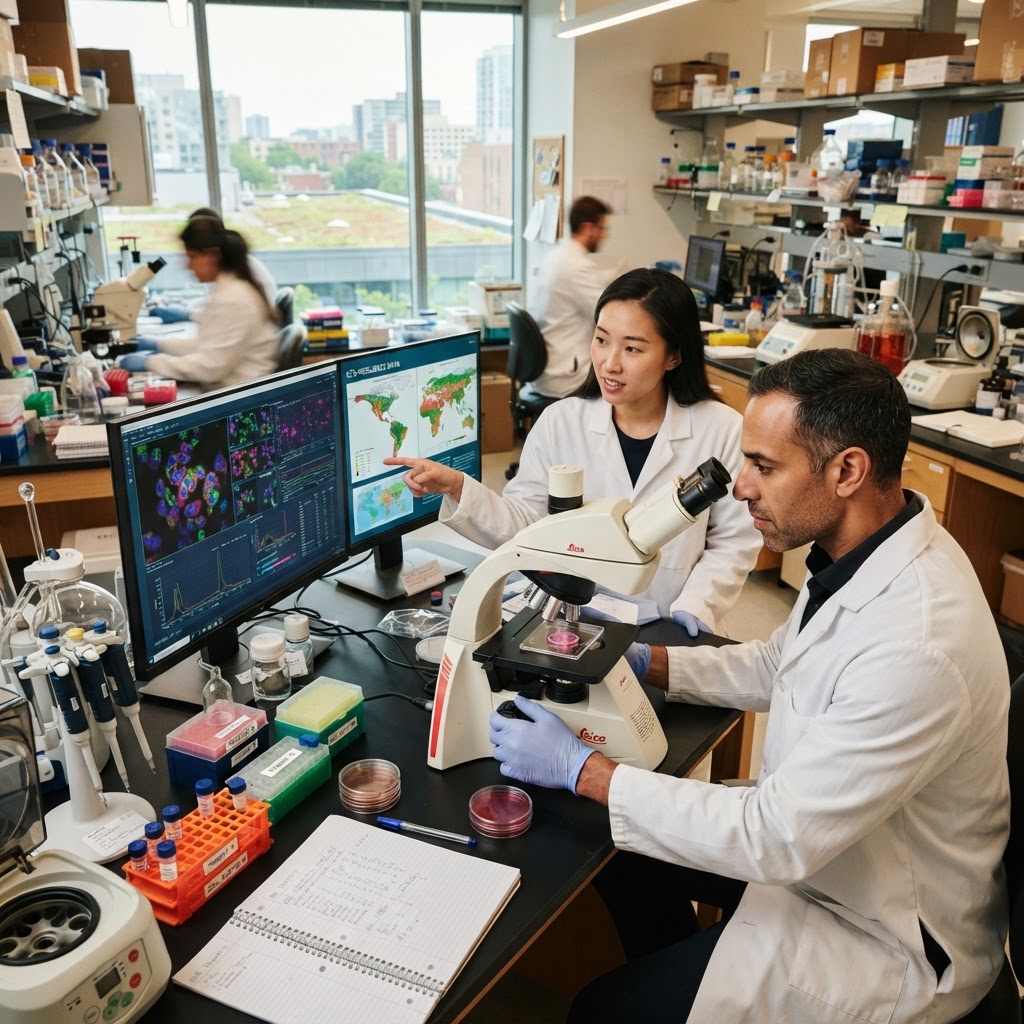
A New Chapter in Precision Medicine and Public Health
The global research landscape is witnessing rapid, transformative shifts in biotechnology and oncology. Scientists exploring early-stage interventions for difficult-to-treat malignancies, particularly pancreatic cancer, have reported promising pathways designed to halt disease progression before metastasis takes hold, according to reporting from Nature. By intervening at the earliest cellular markers, clinical researchers aim to significantly improve long-term survival statistics that have remained obstinately low for decades.
Parallel progress is emerging in chronic disease management and long-overlooked medical conditions. Breakthroughs in therapeutic candidates targeting endometriosis—a painful inflammatory condition impacting an estimated 190 million individuals worldwide—are finally advancing through pipeline evaluations, offering relief where treatment options have historically been scarce, as noted by Nature. Concurrently, public health specialists are scrutinizing historical data to reinforce standards in mental health, identifying statistical anomalies in pediatric antidepressant trials to ensure future protocols rely strictly on rigorous, reproducible clinical evidence.
Ecological Innovation in Warming Marine Environments
Beyond human biology, planetary systems face unprecedented pressure from shifting climate baselines. Marine biologists observing coral reef ecosystems battered by thermal spikes and super El Niño events are pioneering radical conservation tactics, highlighted by Nature. In addition to deploying probiotic bacterial supplements to bolster coral immunity, researchers have begun experimenting with acoustic enrichment—broadcasting biological recordings and underwater soundscapes designed to attract juvenile fish and re-establish the ecological equilibrium essential for coral survival.
These field experiments demonstrate a vital transition in conservation ecology: moving away from purely passive monitoring toward active, targeted micro-interventions. While researchers acknowledge that local interventions cannot fully offset macro-climatic ocean heating, these strategies provide crucial resilience buffers, buying valuable time for fragile ecosystems as broader emission mitigation efforts progress.
Materials Science and the Fundamental Mechanics of Nature
In the physical sciences, researchers continue to unlock novel operational regimes at microscopic scales. The synthesis of ultra-thin, two-dimensional semiconductors configured to harness positive charge carriers (holes) promises to redefine efficiency parameters in high-performance electronics, as detailed by Nature. By overcoming traditional thermal dissipation limitations and scaling challenges, these 2D architectures offer an immediate pathway to next-generation computing hardware.
Fundamental physics is also delivering astonishing measurements of physical constants. Metrologists utilizing lutetium optical frequency standards have recently validated measurement accuracy out to the nineteenth decimal digit, setting new benchmarks for optical atomic clocks, according to research covered by Nature. Such precision holds profound implications for testing general relativity, detecting subtle geodynamic variations within the Earth, and establishing future international time standards.
Defending Scientific Integrity in a Digital Age
Alongside genuine breakthroughs, the academic community is navigating complex institutional challenges. Recent investigative disclosures have uncovered deceptive networks of predatory and sham scientific societies misleading established and early-career researchers alike, as exposed by Nature. These operations undermine rigorous peer review and dilute authoritative scientific literature with low-quality, commercially motivated publications.
Simultaneously, the integration of generative artificial intelligence into experimental and diagnostic tools is sparking critical debates. As automated systems enter medical image analysis and scientific imaging competitions, ethicists and editors emphasize that clinical AI must undergo stringent real-world validation, as highlighted by Nature. Safeguarding institutional trust, ensuring transparency in machine-assisted methodologies, and protecting peer review remain paramount priorities for the international research community as it ventures into new scientific frontiers.
Recommended for you
Similar to “Science”
Frontiers of Discovery: Breakthrough Therapies, Cellular Mapping, and the Shifting Landscape of Global Science
Recent major advances in medical therapeutics and in vivo cellular tracking highlight a transformative era for biological sciences, even as international research faces complex geopolitical and environmental headwinds.
Frontiers of Precision: New Breakthroughs in Gene Editing, Materials, and Cellular Mapping Transform Science
Recent scientific advances highlight unprecedented precision across disciplines, from in vivo CRISPR therapies and massive brain cell atlases to energy-efficient magnetic nanomaterials.
Frontiers of Discovery: Breakthroughs in Neurodegenerative Therapy, High-Energy Astrophysics, and Planetary Adaptation
Recent advances across scientific disciplines have yielded promising new avenues for countering Alzheimer's disease and cellular aging, while deep-space detectors and solar alert technologies open fresh perspectives on cosmic phenomena.