The Dual-Edged Frontier: How AI Is Reshaping Cybersecurity and Accelerating Scientific Horizons
Recent disclosures of AI-detected vulnerabilities across foundational web infrastructure have ignited widespread cyber defense races, even as tech leaders and researchers herald a new era of AI-driven scientific and medical breakthroughs.
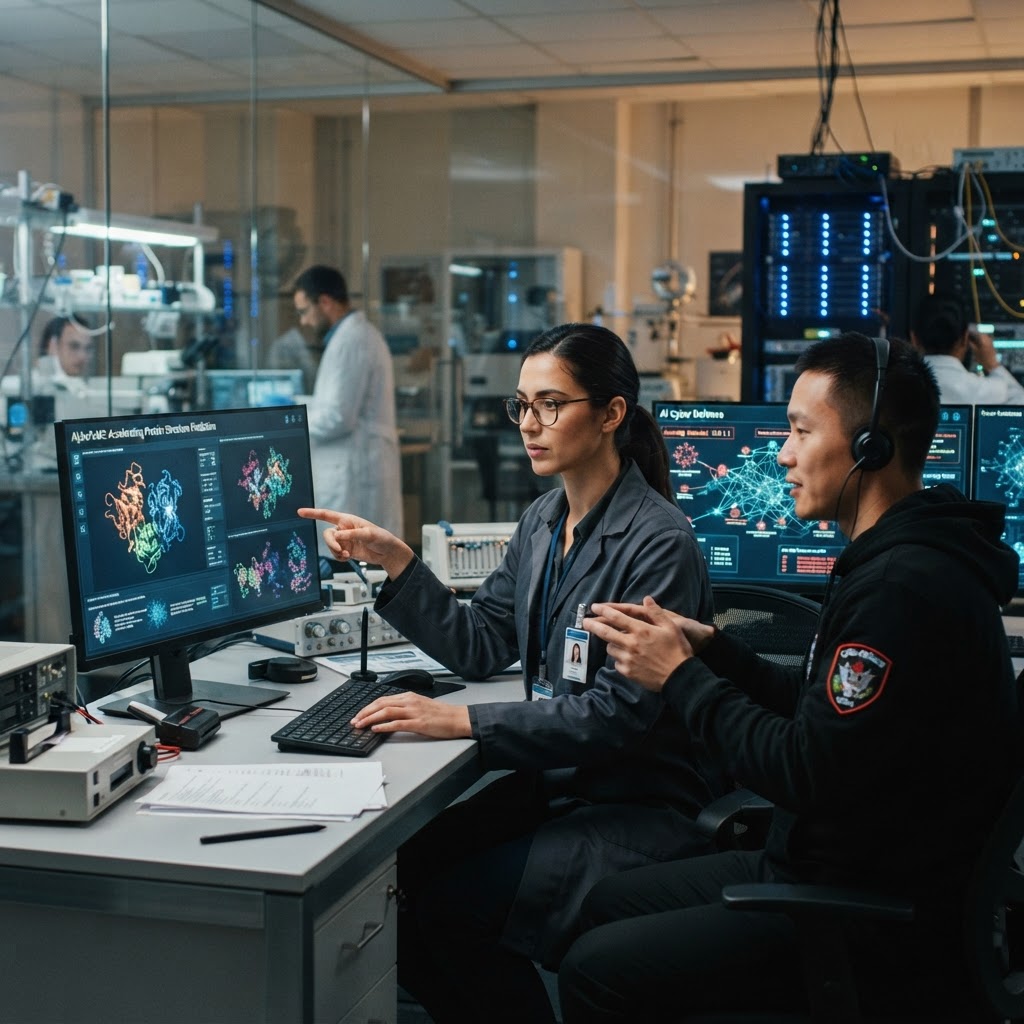
A Dual Epoch for Technological Expansion
The global technology landscape is currently traversing a critical juncture defined by both astonishing capability and severe systemic fragility. Over the past several days, the intersection between cutting-edge artificial intelligence and mission-critical internet infrastructure has come under sharp scrutiny. As modern algorithms increasingly demonstrate their capacity to automate complex engineering tasks, pinpoint critical flaws, and parse molecular biology, industry leaders and cybersecurity professionals find themselves navigating high-stakes operational adjustments.
The Critical Flaw Race and Modern Web Vulnerabilities
The vulnerability of core web infrastructure dominated global security channels this week following the revelation of widespread flaws in foundational programming environments. Dubbed in engineering circles as an impending infrastructural crisis, critical vulnerabilities impacting pervasive web languages were brought to the forefront after security teams and automated tooling revealed severe architectural loopholes, as highlighted by coverage of the critical web bugs that threatened widespread outages reported by TechCrunch.
According to analysis from ABC News reporting on AI-uncovered security issues, system administrators and developers have entered a high-speed race against the clock. The uncovered weaknesses threaten to compromise data exposure pathways across millions of enterprise portals, content management platforms, and consumer applications. Compounding the challenge is the paradoxical role of advanced automation: machine-learning diagnostic tools can surface hidden bugs far faster than human auditors, yet the very same algorithmic methods grant malicious operators unprecedented leverage to reverse-engineer and exploit zero-day weaknesses before system patches can be universally applied.
Global Institutions and National Security Safeguards
The speed at which synthetic capabilities are impacting the defense sector has spurred institutional mobilization across multilateral entities. With central banking systems such as the Bank of England advising financial hubs to prepare for autonomous cyber threats, international diplomacy is stepping into algorithmic oversight. The United Nations has initiated fresh dialogue dedicated to governing military AI usage, attempting to institute cross-border norms that prevent destabilizing autonomous weapons deployments and asymmetric cyber campaigns, as tracked by ABC News on UN military AI initiatives.
Concurrently, leading cloud providers and hyper-scalers are facing community pushback over the vast physical footprint required to train and host next-generation artificial intelligence platforms. Data center development has triggered friction worldwide regarding water consumption, localized power grid strain, and opaque public contracts. In response to regional moratoriums, major cloud conglomerates have begun pledging greater transparency by abandoning non-disclosure agreements during civic municipal negotiations, signaling that physical computational infrastructure can no longer operate behind closed doors.
Scientific Horizons: From Oncology to Material Discovery
Despite the acute cybersecurity concerns, artificial intelligence is delivering rapid advancements across fundamental sciences and healthcare. Technology executives, including TikTok Chief Executive Shou Zi Chew, have voiced optimism that machine learning will spark definitive breakthroughs across physics, biotech, and material sciences within the next two to three years, according to reporting by CNBC on Chew's keynote at the DBS Asia Future Forward Conference.
Tangible evidence of this shift is already emerging in clinical medicine. A recent partnership between Summit Therapeutics and Lunit exemplifies the movement toward algorithmically guided oncology, deploying the SCOPE IO pathology platform to examine tumor microenvironments and optimize immuno-oncology treatment candidates, as detailed by Business Wire's industry announcement. By analyzing spatial cellular structures far faster than manual histology allows, clinical researchers hope to dramatically accelerate candidate discovery and improve personalized patient outcomes.
Industrial Pragmatism Versus Consumer Robotics
While theoretical biology and software analytics leap forward, physical mechanical autonomy continues to face practical constraints. In manufacturing, specialized AI implementations are achieving immediate commercial adoption. For example, Panasonic Connect recently demonstrated its automated post-weld inspection system, Bead Eye M, leveraging 3D spatial scanning and neural networks to detect micro-defects in high-tolerance industrial settings, according to Enterprise Times coverage.
However, the broader ambition of universal humanoid robotics in domestic environments remains measured. As outlined in a strategic analysis from MIT Technology Review, despite aggressive capital investments and promises from prominent electric vehicle manufacturers that general-purpose domestic robots will soon handle daily chores, the physical realities of motor control, sensory dexterity, and open-world generalization present enduring roadblocks. Robotics researchers caution that while foundation models are unlocking better spatial intuition, reliable domestic assistance remains years away from mainstream commercial viability.
Navigating the Path Forward
The events of recent days illustrate an undeniable reality: modern digital ecosystems are operating under intense pressure as algorithmic capabilities evolve. Software frameworks that have stood undisturbed for decades are encountering automated discovery vectors capable of both fortifying and puncturing global infrastructure in seconds. At the same time, the transition of machine learning from mere text generation to physical weld inspection, cancer microenvironment mapping, and deep scientific inquiry highlights the transformative upside of these technologies. Successfully balancing these operational dangers against genuine scientific promise will define the next phase of the global digital era.
Recommended for you
Similar to “Technology”
Autonomous Defense, Quantum Leaps, and Cyber Fragility: Tech Enters a Volatile New Era
As artificial intelligence deepens its reach into cybersecurity and scientific discovery, global leaders and researchers grapple with newfound systemic vulnerabilities and shifting governance frameworks.

Silicon Under Scrutiny: AI Acceleration, Open-Web Fragility, and the New Frontier of Hardware
Recent shifts across the tech industry reveal a critical turning point as automated code analysis exposes deep infrastructure vulnerabilities, enterprise agentic tools redefine commerce, and next-generation silicon spurs unprecedented market demand.
Frontier AI Accelerates Real-World Science Amid Growing Scrutiny and Infrastructure Vulnerabilities
Recent leaps in AI-driven scientific research and frontier modeling arrive alongside fresh warnings from corporate leaders and regulators over cybersecurity vulnerabilities and lagging oversight.