Frontiers of Discovery: Accelerating Climate Shifts, Cellular Mechanosensation, and the Rise of Machine-Derived Proofs
Recent discoveries spanning global climate dynamics, molecular immunology, metabolic medicine, and algorithmic reasoning are reshaping our fundamental understanding of both natural and computational systems.
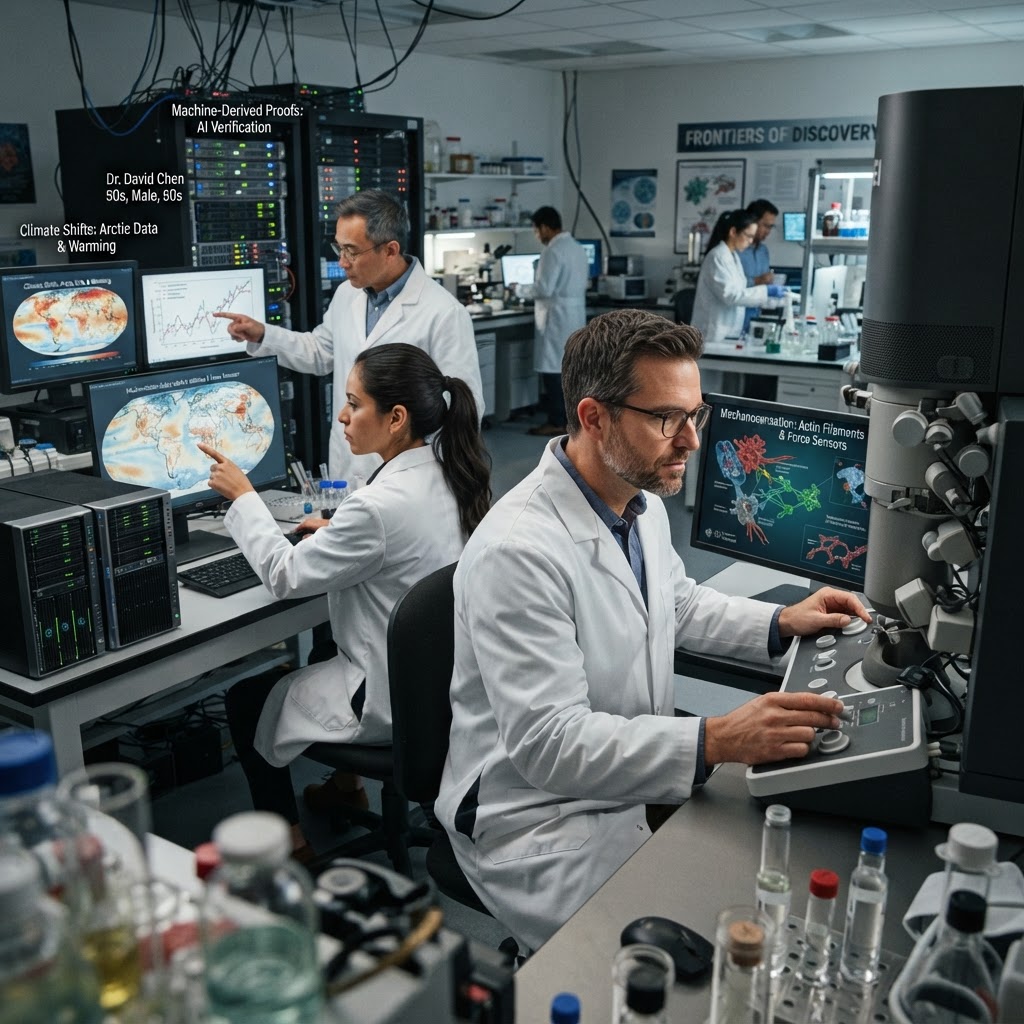
A Dynamic Week Across the Scientific Disciplines
Scientific inquiry moves simultaneously along multiple fronts, often bridging the vast scale of planetary systems with the microscopic mechanics of the cell and the abstract realms of computational theory. In recent days, researchers worldwide have unveiled findings that challenge entrenched assumptions across climate science, molecular immunology, chronic disease therapy, and theoretical computation.
Planetary Signals: Climate Acceleration and Ocean History
Geoscientists and climate monitors have documented evidence that modern warming trends are progressing at rates faster than previously recorded, according to recent updates highlighted by ScienceDaily. The detection of accelerated atmospheric heating underlines significant shifts in global climate dynamics, drawing renewed urgency toward climate modeling frameworks. Simultaneously, planetary geologists probing deep time uncovered an ancient, 100-million-year-old volcanic complex in Iran, unlocking long-obscured chapters in continental plate shifts and historical ocean disappearance reported in ScienceDaily's Top Science News. These geological chronicles illustrate the sensitive equilibrium of Earth’s climate mechanisms over geological epochs, providing essential context for today's atmospheric shifts.
The Molecular Landscape: Cellular Touch and Metabolic Remission
In the life sciences, fundamental paradigms are evolving inside human tissue. At McGill University, investigators identified that immune cells possess an unanticipated mechanosensory ability. Rather than relying exclusively on biochemical cues, T cells can physically discern the stiffness of surrounding cellular matrix structures. This 'sense of touch' alters existing models of adaptive immunity and may unlock novel pathways for immunotherapy design and autoimmune disease interventions. Concurrently, medical researchers have unveiled clinical results demonstrating that over 50 percent of younger adults with type 2 diabetes managed to achieve remission within a six-month period through targeted lifestyle and therapeutic interventions, while parallel research explores novel biological implants designed to regulate glucose levels, as reported by Live Science.
The Neurobiology of Pain and Perception
Neuroscientists have also made strides in unraveling the neural foundations of chronic conditions. New research indicates that chronic lower back pain becomes deeply integrated into broader cognitive and emotional neural networks, clarifying why long-term physical discomfort frequently feels so deeply personal and resistant to standard localized treatments. Complementary investigations into sensory processing revealed that neural pathways dedicated to facial recognition develop distinct activation timelines in autistic children earlier than historical data suggested, challenging legacy theories about developmental perception.
Shifting Boundaries in Mathematics and Theoretical Computation
Beyond biological systems, the boundary between automated intelligence and foundational science is reaching an inflection point. According to reports from India Today and Qazinform, artificial intelligence models have generated proposed formal proofs addressing deep theoretical problems in computer science, mathematics, and quantum physics. Most notable among these claims is an algorithmic challenge to the Exponential Time Hypothesis (ETH), a pillar used by computational theorists for decades to determine computational complexity limits. The machine-generated solutions, formalized using proof-checking software like Lean, also extend toward wave behavior conjectures and the mathematics underlying quantum chromodynamics. Independent panels of mathematicians and theoretical physicists are rigorously evaluating the formulations to determine their validity.
Cross-Disciplinary Synthesis
Whether examining the physical forces that guide immune response, the planetary thresholds governing the atmosphere, or the algorithms rewriting theoretical mathematics, recent developments emphasize that the frontiers of discovery are increasingly interconnected. As verification and peer scrutiny proceed across each of these domains, the boundaries of modern science continue to expand at a remarkable cadence.
Recommended for you
Similar to “Science”
Frontiers of Discovery: How AI Biolabs, Metabolic Research, and Endosymbiosis Are Redefining Modern Science
Recent advances across biotechnology, cellular evolution, and targeted therapeutics are transforming our understanding of living systems and opening new horizons for global medicine.
Frontiers of Discovery: Recent Breakthroughs Reshaping Medicine, Molecular Biology, and Quantum Physics
Recent major developments across global laboratories highlight extraordinary momentum in modern research, ranging from optical control of cellular mechanisms and gut microbiome discoveries to unprecedented leaps in quantum hardware and preventative medicine.
Frontiers of Discovery: How AI, Evolutionary Timelines, and Sustainable Engineering Are Reshaping Modern Science
Recent breakthroughs spanning biological communication, ancient evolutionary paleontology, and resource extraction demonstrate how cross-disciplinary research is accelerating global scientific understanding.