Frontiers of Discovery: Subatomic Matter, Cellular Longevity, and the Automation of Science
Recent breakthroughs spanning particle physics, cellular gerontology, and automated laboratory intelligence are reshaping contemporary scientific paradigms and accelerating discovery pipelines.
Unveiling Primordial Matter at the Subatomic Scale
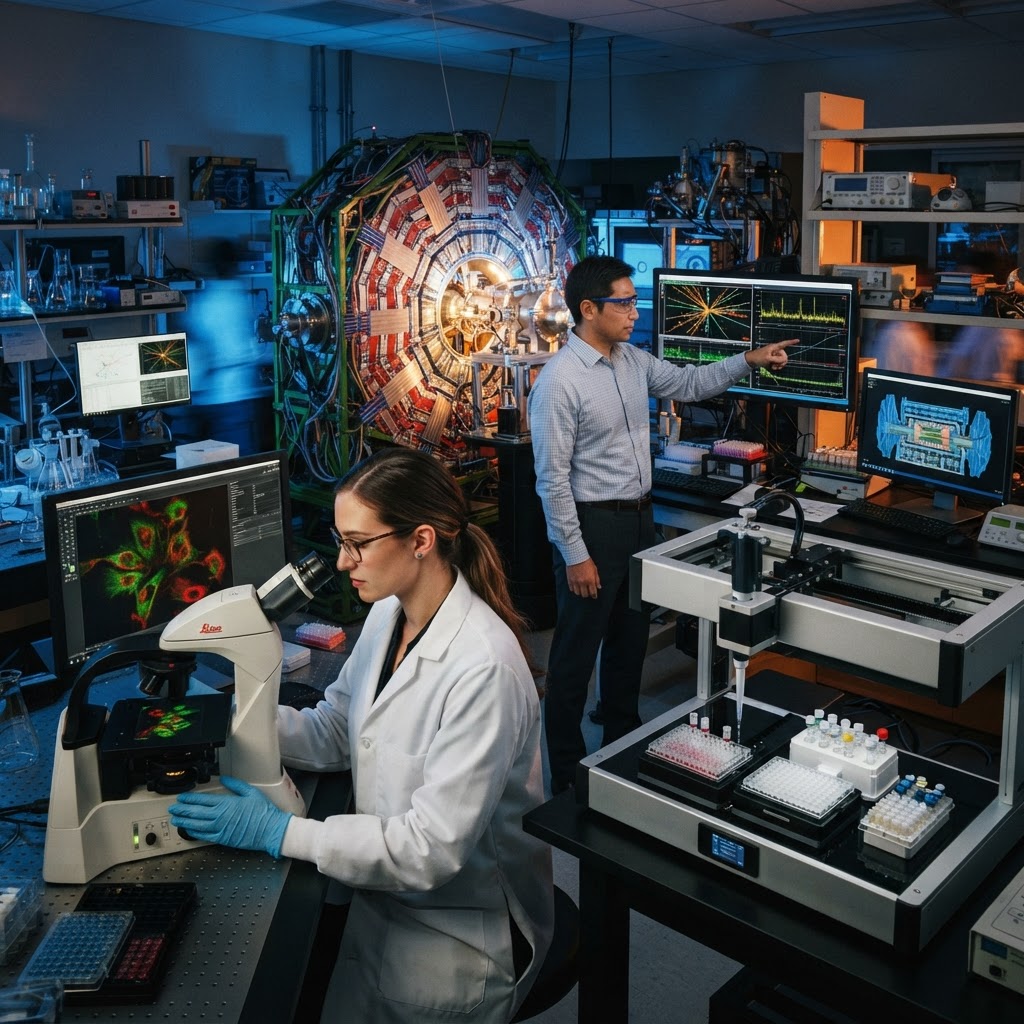
In recent experimental updates from high-energy physics, researchers at CERN's Large Hadron Collider have reported surprising evidence concerning the formation of primordial states of matter, as noted in recent physics releases from ScienceDaily. Traditionally, the creation of quark-gluon plasma—the ultra-dense, super-hot fluid that populated the cosmos microseconds after the Big Bang—was considered the exclusive domain of colossal collisions between heavy nuclei, such as lead or gold ions. However, recent particle evaluations reveal signatures of collective hydrodynamic flow and thermodynamic behavior reminiscent of this primordial soup within significantly smaller collision systems.
These observations challenge foundational models regarding the threshold of particle density and energy required to disintegrate nucleons into their fundamental components. By demonstrating that small-scale proton-proton or proton-nucleus impacts can mirror the conditions of the nascent universe, particle physicists are forced to rethink how energy thermalizes across microscopic domains. Parallel developments in quantum manipulation, such as the isolation and control of single antimatter particles reported by Northwestern University and highlighted in The Johns Hopkins News-Letter, further highlight a broader trend: precision control over individual quantum systems is transforming speculative subatomic theory into tangible, bench-scale experiments.
Re-evaluating Longevity: From Bone Signals to Microbial Clocks
Simultaneously, the biological sciences are witnessing a profound paradigm shift in how researchers conceptualize and measure the aging process. A pivotal study reported in Science Magazine reveals that bones act as endocrine regulators capable of influencing systemic lifespan. Physical exercise prompts osteocytes—the predominant cellular units within mature bone architecture—to secrete specialized protective proteins. When circulating throughout the body, these chemical signals exert systemic anti-aging effects in mammalian models, slowing tissue deterioration and highlighting an unexpected inter-organ axis of longevity.
This systemic view of aging is complemented by discoveries in microbial ecology and gerontology. Studies on the gut microbiome indicate that distinct microbial signatures account for measurable variations in biological aging rates across populations. Simultaneously, researchers publishing in Frontiers in Science have proposed standardized aging rate indicators (ARIs). Traditionally, evaluating the efficacy of dietary, genetic, or pharmacological interventions required following cohorts through their full natural lifespans—a process taking years in mice and decades in humans. By establishing measurable biological proxies assessed at single intervals, scientists estimate that preclinical trials can now be conducted up to four times faster, slashing experimental costs and expediting the transition of longevity therapeutics to clinical testing.
Plant Resilience and the Mechanics of Cellular Plasticity
Beyond mammalian biology, foundational discoveries in cellular mechanics are offering critical tools to address ecological vulnerability. Investigations into plant physiology, particularly within model species like Arabidopsis thaliana, have unveiled an unappreciated layer of cellular identity. While root cells have historically been cataloged strictly by tissue lineage and developmental milestone, single-cell transcriptomic mapping detailed in The Johns Hopkins News-Letter reveals an environmental-regulated state (ERS) that operates as an adaptive transcriptional switch across various root tissues.
Under acute water scarcity, a higher fraction of root cells transition into this environmentally responsive state, modulated primarily by the stress hormone abscisic acid. This modular plasticity demonstrates that plants do not merely rely on rigid structural adaptations to survive drought; rather, they adjust the proportion of cellular machinery operating in defensive postures. As global climate disruptions accelerate environmental strain on arable land, deciphering how to programmatically trigger or tune this molecular switch provides agronomic engineers with an essential blueprint for developing climate-resilient crop strains.
The Ascent of Autonomous Discovery and Shifting Methodologies
Underpinning these empirical discoveries across disciplines is an accelerating transformation in scientific methodology itself. The rapid development of closed-loop, automated laboratories—pioneered by institutions such as Chalmers University of Technology and highlighted by Phys.org—is delegating significant portions of the scientific method to artificial intelligence systems. These platforms do not merely analyze vast datasets; they autonomously formulate novel hypotheses, design physical experiments using automated robotics, evaluate real-world microbiological outcomes, and iteratively refine their theoretical frameworks.
This shift from passive computation to active scientific agency is prompting institutional recalibration. Major academic bodies and journals, as reflected in Science Magazine, are actively revising standards regarding authorship, attribution, and methodological disclosure. As intelligent models resolve complex computational benchmarks and independently design experimental protocols, the scientific community faces novel governance challenges: delineating human accountability from automated deduction, and ensuring transparency when discovery loops bypass human intuition entirely.
A Cohesive Trajectory in Modern Inquiry
Whether probing the thermal boundaries of quark interactions, parsing the endocrine communication of the skeleton, or outsourcing biological hypothesis testing to autonomous instruments, contemporary research is characterized by a drive toward interconnected systems and rapid validation. The barriers separating physical theory, molecular physiology, and automated logic are steadily thinning. As these multifaceted initiatives converge, they reflect a scientific landscape defined not merely by incremental observations, but by structural changes in how knowledge is conceived, tested, and cataloged across the global archive.
Recommended for you
Similar to “Science”
Frontiers of Discovery: Recent Breakthroughs Reshaping Physics, Genetics, and Earth Science
From unexpected magnetic control at the atomic scale to massive genetic catalogs and deep ocean thermal shifts, recent findings are actively challenging long-held scientific paradigms.

Frontiers of Matter and Motion: How Recent Breakthroughs Are Reshaping Physics, Computing, and Biology
From solving atomic-scale limits on energy-efficient AI chips to robotic orbital manufacturing and rare particle signatures at CERN, recent scientific milestones are bridging deep theory with practical engineering.
Quantum Frontiers and Cosmic Riddles: Inside the Scientific Breakthroughs Reshaping Physics and Technology
Recent breakthroughs spanning altermagnetic materials for energy-efficient computing, ultracold quantum milestones, and fundamental particle observations are opening dramatic new pathways across modern physics.