A New Magnetic Reality and Deep-Space Messengers: Inside This Week's Groundbreaking Scientific Shifts
Recent discoveries in physics, astrophysics, and molecular engineering are reshaping fundamental science, headlined by experimental validation of a third magnetic phase and ultra-high-energy cosmic detections.
Challenging Decades of Magnetic Orthodoxy
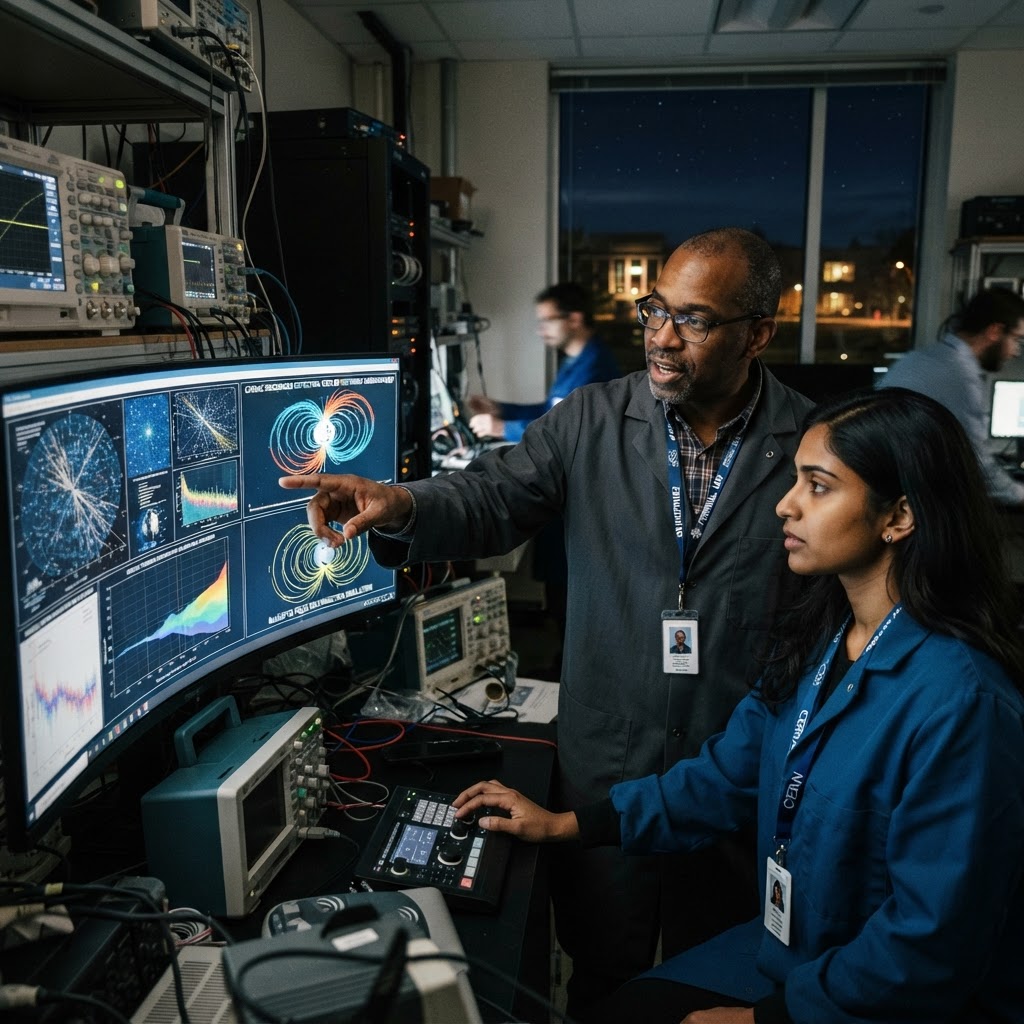
For nearly nine decades, solid-state physics divided magnetism into two traditional regimes: ferromagnetism, where magnetic moments align parallel to create a macroscopic magnetic field, and antiferromagnetism, where alternating internal moments cancel each other out. This foundational binary was formally upended this week following landmark experimental findings reported by a research team led by the U.S. Department of Energy’s SLAC National Accelerator Laboratory. Publishing their findings in Science, physicists have presented definitive experimental verification of a third category of magnetic phase known as altermagnetism.
Using specialized, high-resolution X-ray spectroscopy, investigators identified a distinct chiral signature embedded within candidate materials, resolving long-standing theoretical ambiguity. Altermagnets exhibit an unusual structural symmetry: while their net magnetization remains zero like that of antiferromagnets, their electronic band structures display spin-polarized splitting characteristic of ferromagnets. This dual nature allows altermagnetic materials to remain immune to stray magnetic fields while simultaneously driving spin-polarized currents. Physicists anticipate this breakthrough will rapidly transform spintronics and modern microelectronics, unlocking energy-efficient computing architectures and significantly faster data processing across dense storage platforms.
Signals from the Extreme Universe
Simultaneously, the astrophysical community is grappling with profound data emerging from the extremes of the cosmos. At the South Pole, the IceCube Neutrino Observatory recorded extraordinary detection signatures of ultra-high-energy ghost particles exhibiting energy levels up to ten billion times greater than typical solar neutrinos. Neutrinos, which travel vast cosmic distances unimpeded by matter or magnetic deflections, carry pristine records of high-energy cosmic engines such as supermassive black hole jets, gamma-ray bursts, and catastrophic stellar collisions. Detecting particles at this unprecedented magnitude equips astrophysicists with an essential roadmap to probe previously inaccessible environments within the distant universe.
These deep-space measurements complement new orbital observations challenging previous assumptions about early cosmic evolution. Revised analyses utilizing data from space observatories—including the Hubble Space Telescope—have forced researchers to reconsider standard timelines regarding the reionization era, when the universe’s dense neutral hydrogen fog dissipated into transparent, ionized gas some 13 billion years ago. Alongside ongoing monitoring of historical deep-space hardware such as NASA’s Voyager 1, which continues to transmit diagnostic readings as it nears a distance of one light-day from Earth, these astronomical achievements highlight an accelerating phase in observational cosmology.
Molecular Innovations and Earth-Bound Breakthroughs
Far beyond astrophysics, laboratory science is experiencing equivalent strides in molecular engineering and chemical separation. In physical chemistry, researchers have achieved room-temperature crude oil separation through the synthesis of an innovative molecular filtration membrane. Rather than relying on traditional, energy-intensive distillation columns that consume vast quantities of thermal power, the new platform leverages components within the oil mixture itself to form microscopic filtration channels, effectively purifying fractions at ambient temperatures. If scaled successfully, the technique could dramatically curb the industrial energy footprint associated with petrochemical refining.
Concurrently, nanotechnology has marked another mechanical milestone with the creation of molecular-scale rotary devices. Scientists reported shrinking mechanical architectures—mirroring the ancient principle of the Archimedes' screw—down to individual molecules capable of controlled bidirectional rotation. Such nanoscale engines provide concrete mechanisms for driving fluids and directed molecular cargo in targeted chemical synthesis and microscopic diagnostic systems.
A Paradigm Shift Across Modern Science
What binds these seemingly divergent discoveries is their shared disruption of entrenched scientific conventions. Whether it is overturning a ninety-year-old classification of fundamental matter, measuring the most intense cosmic emissions known to physics, or replacing centuries-old mechanical and thermal processing paradigms with molecular-scale manipulation, the current scientific landscape is experiencing rapid conceptual evolution. As experimental precision accelerates across laboratories and observatories worldwide, researchers are systematically transitioning from observing physical phenomena to re-engineering the foundational rules of matter and the cosmos.
Recommended for you
Similar to “Science”
Mapping the Unknown: From Deep-Space Cosmological Surveys to Inside-the-Body Gene Therapies
Recent scientific breakthroughs are rewriting textbooks across disciplines, highlighted by Euclid's massive cosmic survey, pioneering in vivo CRISPR treatments, and landmark discoveries in fundamental physics.
Quantum Frontiers and Cosmic Riddles: Inside the Scientific Breakthroughs Reshaping Physics and Technology
Recent breakthroughs spanning altermagnetic materials for energy-efficient computing, ultracold quantum milestones, and fundamental particle observations are opening dramatic new pathways across modern physics.
Rewriting the Physical World: Groundbreaking Discoveries Shake Quantum Mechanics, Magnetism, and Astrophysics
Recent experimental breakthroughs across the globe are upending decades-old paradigms in fundamental science, from the physical verification of a third class of magnetism to record-breaking cosmic particle detections.