Rewriting the Physical World: Groundbreaking Discoveries Shake Quantum Mechanics, Magnetism, and Astrophysics
Recent experimental breakthroughs across the globe are upending decades-old paradigms in fundamental science, from the physical verification of a third class of magnetism to record-breaking cosmic particle detections.
A Paradigm Shift in Fundamental Physics
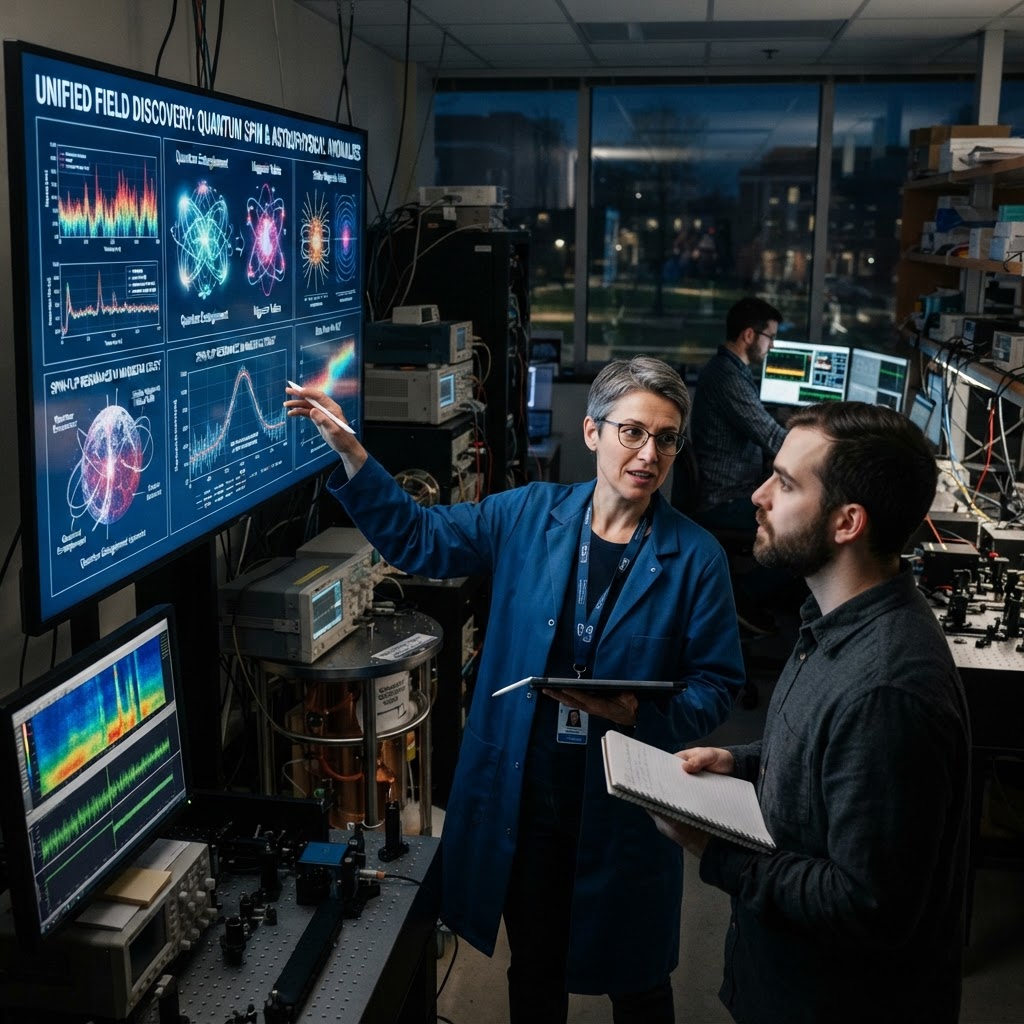
For nearly nine decades, standard physics curricula taught that magnetic phenomena fundamentally fell into two distinct categories: ferromagnetism, where atomic magnetic moments align parallel to create everyday permanent magnets, and antiferromagnetism, where alternating antiparallel spins cancel each other out internally. In recent days, that bedrock assumption has been dismantled. Using advanced synchrotron X-ray probes, researchers at the SLAC National Accelerator Laboratory confirmed conclusive experimental evidence of altermagnetism—a third magnetic state that exhibits zero net magnetization like an antiferromagnet, while boasting the strong spin-polarized electronic band structures typical of ferromagnets.
This discovery bridges a long-standing theoretical divide in condensed matter physics. By circumventing the stray magnetic fields that routinely disrupt conventional magnetic memory, altermagnetic materials promise ultra-dense, ultra-fast spintronic computing architectures capable of processing information at terahertz speeds without cross-talk interference.
Taming the Quantum Domain
Simultaneously, the quantum realm has yielded a succession of startling developments. Physicists experimenting with ultracold lithium atoms have directly observed an elusive quantum contest between conflicting magnetic forces. When cooled to microkelvin temperatures, these atoms mimic complex electron behavior that standard supercomputers have struggled to simulate for decades, providing a tangible window into quantum phase transitions.
In related breakthroughs, European research teams announced the discovery of a novel quantum state of matter functioning stably at room temperature—an achievement historically thwarted by thermal noise. By carefully engineering organic semiconductors suspended within liquid crystal matrices, the scientists preserved fragile quantum interactions before parasitic molecular reactions could dissolve the state. Complemented by the arrival of specialized detectors capable of resolving single and multiphoton arrivals without distortion, these findings suggest that practical, ambient-temperature quantum information systems and photonic networks are shifting rapidly from theoretical constructs into laboratory reality.
Cosmic Neutrinos and the Extreme Universe
Far beyond the microscopic scale, astrophysics has registered an equally historic achievement. Deep beneath the South Pole ice sheet, the IceCube Neutrino Observatory logged deep-space 'ghost particles' possessing energy levels ten billion times greater than ordinary solar neutrinos. Because neutrinos interact extraordinarily weakly with conventional matter, they traverse vast intergalactic distances without deflecting or slowing down, acting as pristine messengers from violent astrophysical accelerators such as supermassive black holes, active galactic nuclei, and catastrophic stellar mergers.
These ultra-high-energy detections arrive alongside fresh observations from the Hubble Space Telescope and orbit-based platforms, which recently uncovered the wreckage of colliding dwarf planet systems dozens of light-years away and tracked inexplicable atmospheric chemical releases hinting at modern volcanic activity on Mars. Together, these astronomical discoveries are forcing planetary scientists and cosmologists to rethink the dynamics of planetary evolution and the mechanisms driving cosmic radiation.
Molecular Engineering and the Horizon Ahead
The boundary between material physics and mechanical nanotechnology is advancing at a parallel pace. In molecular engineering, researchers have successfully fabricated an electrically driven molecular motor modeled after Archimedes’ screw, miniaturized down to the atomic scale. Capable of bi-directional rotation, the tiny mechanism surprisingly amplifies surrounding electrical conductivity by up to one hundredfold, opening dramatic pathways for intelligent drug delivery, micro-actuators, and self-regulating molecular electronics.
From the confirmation of altermagnetism and room-temperature quantum states to the identification of extreme cosmic messengers, recent breakthroughs illustrate that foundational science is not merely refining existing formulas. Instead, researchers are unlocking entirely new mechanical, magnetic, and cosmic regimes—laying the scientific groundwork for the next generation of computing, energy, and planetary exploration.
Recommended for you
Similar to “Science”
Frontiers of Discovery: How Recent Breakthroughs in Physics, Neuroscience, and Geophysics Are Reshaping Science
From high-energy cosmic ghost particles and non-destructive quantum computing to fluid earthquake faults and brain remapping, recent discoveries are upending decades-old paradigms across multiple disciplines.
A New Magnetic Reality and Deep-Space Messengers: Inside This Week's Groundbreaking Scientific Shifts
Recent discoveries in physics, astrophysics, and molecular engineering are reshaping fundamental science, headlined by experimental validation of a third magnetic phase and ultra-high-energy cosmic detections.
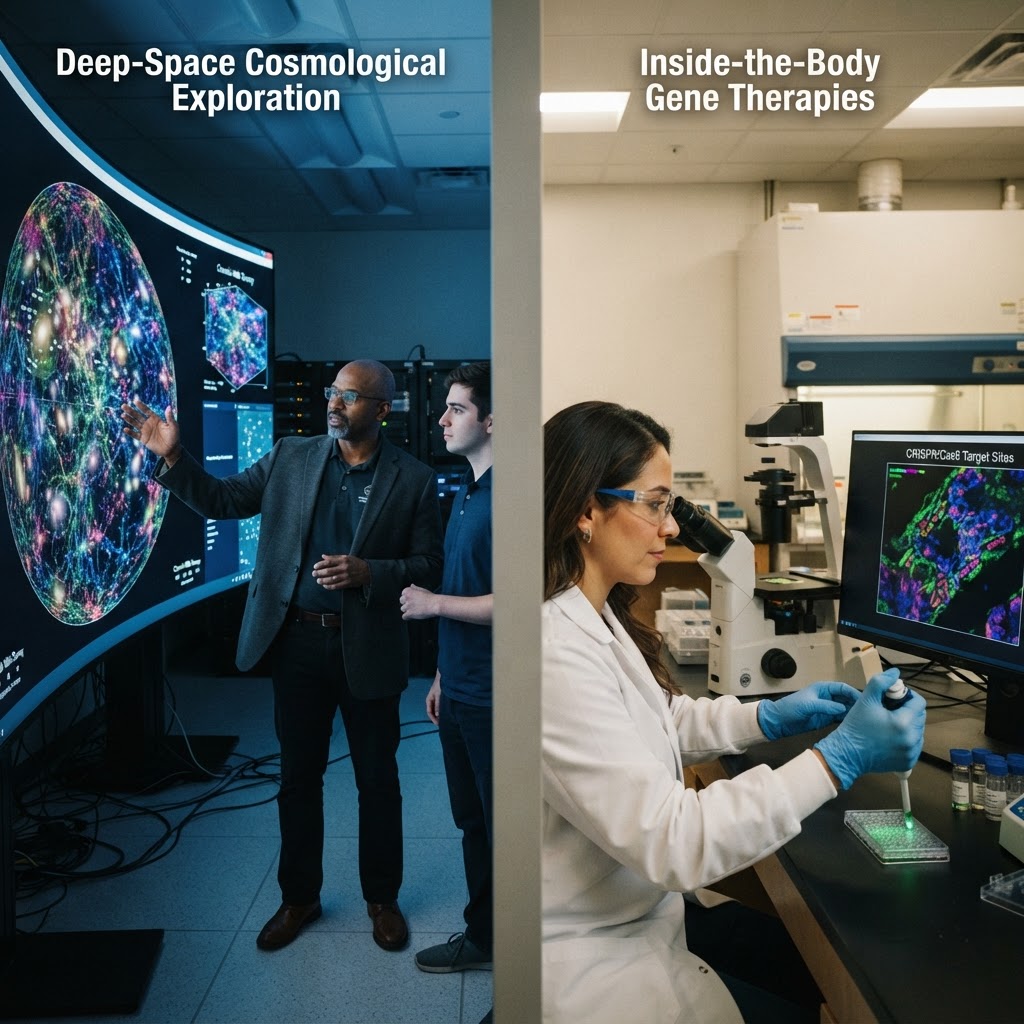
Mapping the Unknown: From Deep-Space Cosmological Surveys to Inside-the-Body Gene Therapies
Recent scientific breakthroughs are rewriting textbooks across disciplines, highlighted by Euclid's massive cosmic survey, pioneering in vivo CRISPR treatments, and landmark discoveries in fundamental physics.