Frontiers of Discovery: From Cellular Computers to Ultra-High-Energy Ghost Particles
Recent breakthroughs spanning biological computing, astroparticle physics, and medical therapeutics demonstrate how researchers are decoding fundamental biological and physical mechanisms to solve modern challenges.
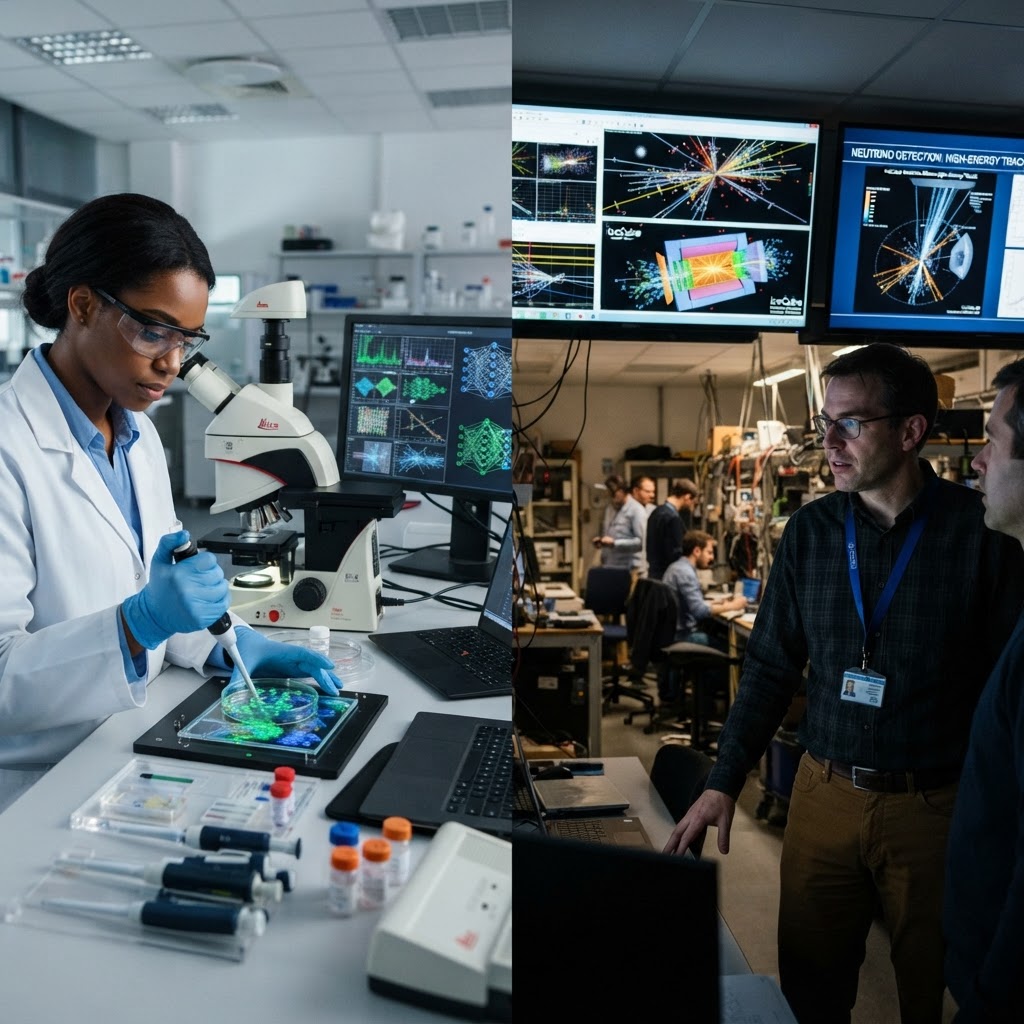
Unconventional Computing: Living Neurons on Silicon Platforms
In a compelling fusion of neuroscience and computer architecture, researchers have made substantial strides in deploying cultured biological cells as functional processors. Groundbreaking work highlighted in Science demonstrates that cortical and hippocampal neurons maintained in cell culture dishes can perform computational tasks previously reserved for semiconductor circuits. By interfacing living neural networks with microelectrode arrays, scientists have begun harnessing the intrinsic adaptability and energy efficiency of biological plasticity. These biological computing architectures demonstrate remarkable learning capabilities, showing that cellular systems can process complex signaling patterns while consuming only a fraction of the electrical power required by traditional silicon processors.
This paradigm shift arrives as computer scientists simultaneously observe artificial intelligence tools advancing into scientific research itself. Recent evaluations indicate that AI platforms are surpassing human reviewers in identifying methodological and statistical errors in clinical trials, underscoring an era where machine learning and biological matter increasingly intertwine to accelerate discovery.
Astroparticle Physics and Deep Space Cosmic Messengers
Far beyond Earth's biosphere, physicists investigating the outer cosmos have captured some of the most energetic signals ever recorded. Reporting from the South Pole, researchers operating the IceCube Neutrino Observatory revealed the detection of extremely high-energy cosmic neutrinos—popularly described as 'ghost particles'—possessing energies roughly 10 billion times greater than standard solar neutrinos, as covered by ScienceDaily's Space & Time News. Because neutrinos possess almost no mass and carry neutral charge, they travel vast cosmic distances unimpeded by interstellar dust or magnetic fields, providing researchers with uncorrupted snapshots of cataclysmic astrophysical events such as blazar jets or black hole mergers.
These observations are complemented by ongoing operational triumphs and orbital rescue strategies elsewhere in space science. Engineers are currently mobilizing to maintain the Hubble Space Telescope's orbit to prevent an early atmospheric reentry, while interplanetary explorations like NASA's Perseverance rover continue to push boundaries on Mars, setting lifetime distance milestones across ancient lakebeds.
Therapeutic Revolutions: Reprogramming Cellular Defense Mechanisms
Biomedical research has simultaneously delivered critical advances in molecular and cellular medicine. Investigators are pioneering targeted methods to eliminate antibiotic-resistant bacteria, often termed superbugs, by engineering specialized bacteriophages capable of penetrating stubborn bacterial defenses. Rather than relying on traditional broad-spectrum antibiotics, these precision-guided biological agents dismantle resistant infections from within without disrupting beneficial systemic microbiomes.
Concurrently, genetic engineering is delivering potent tools to regulate neural signaling in neurological disorders. As reported by Science, novel gene therapies are being refined to enable pharmaceutical compounds to temporarily dampen hyperactive brain circuitry, offering a targeted mechanism to suppress severe epileptic seizures without inducing systemic sedative effects. Parallel work targeting internal biochemistry has also demonstrated that rejuvenating liver cellular pathways can significantly lower circulating neurotoxic proteins linked to Alzheimer's disease, strengthening our understanding of the direct biochemical axis between peripheral metabolic organs and cognitive health.
Molecular Mechanics and Condensed Matter Discoveries
At the nanoscale, physics and materials science are overturning longstanding dogmas. Scientists have engineered an Archimedes screw reduced down to the scale of a single molecule. This molecular machine can rotate in both directions upon application of an electric current, vastly boosting local electrical conductivity and offering unprecedented possibilities for targeted drug transport and molecular nanotechnology. In parallel, condensed-matter physicists at institutions like SLAC have documented physical confirmation of altermagnetism—a distinct, third class of magnetism bridging conventional ferromagnetism and antiferromagnetism—paving the way for next-generation, high-density spintronic computing architectures.
Ancient Ecosystems and Paleontological Insights
Earth's distant biological history continues to offer crucial context for living systems. Paleontologists in Southeast Asia, as documented by BrightSurf, have uncovered the remains of Yakamys sirindhornae, a giant prehistoric rodent species that lived 34 million years ago in what is now Thailand. The findings confirm that evolutionary pressures repeatedly drove rodents toward gigantic body sizes across disparate geographic regions during the Eocene and Oligocene epochs. In tandem with recent imaging studies examining fossilized soft tissues and dinosaur cellular remains, evolutionary biologists are continuously refining their maps of how animal physiology, immune adaptations, and bodily mechanics withstand millennia of selective pressure.
Together, these diverse breakthroughs reveal a common narrative: across microscopic scales, biological systems, and cosmic horizons, modern science is increasingly transcending traditional interdisciplinary boundaries to address humanity's most complex challenges.
Recommended for you
Similar to “Science”
Frontiers of Discovery: How Recent Breakthroughs in Physics, Neuroscience, and Geophysics Are Reshaping Science
From high-energy cosmic ghost particles and non-destructive quantum computing to fluid earthquake faults and brain remapping, recent discoveries are upending decades-old paradigms across multiple disciplines.
Frontiers of Discovery: How Recent Breakthroughs in Physics, Medicine, and Computing Are Redefining Modern Science
From detecting extreme-energy cosmic ghost particles to unlocking backward bacterial defenses and brain-inspired electronics, a surge of recent discoveries is transforming our understanding of the universe and human biology.
Quantum Frontiers and Cosmic Riddles: Inside the Scientific Breakthroughs Reshaping Physics and Technology
Recent breakthroughs spanning altermagnetic materials for energy-efficient computing, ultracold quantum milestones, and fundamental particle observations are opening dramatic new pathways across modern physics.